Most of the 5 Candidates Take a Hardline Stance
New Medical School Project in Jeonnam Region Also Faces Obstacles
The Korea Medical Association (KMA), currently operating under an emergency response committee system, has begun the election to choose a new president. With the five candidates running generally taking hardline stances, it is expected that the medical crisis will become even more difficult to resolve due to the government's push for medical reform and the establishment of a new medical school in the Jeonnam region.
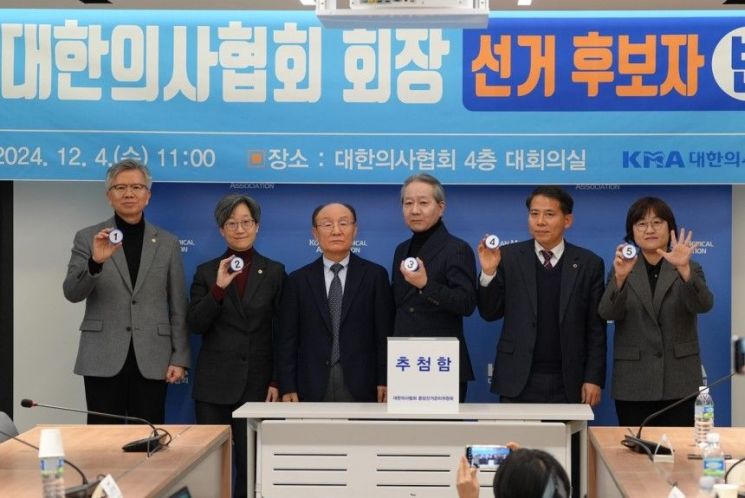 On the 4th of last month, the candidates for the next president of the Korean Medical Association were showing their drawn numbers after a lottery at the KMA Hall in Yongsan-gu, Seoul. From the left: candidate Kim Taek-woo, candidate Kang Hee-kyung, Ko Kwang-song, chairman of the KMA Central Election Commission, candidate Joo Soo-ho, candidate Lee Dong-wook, and candidate Choi Anna. Korean Medical Association
According to the medical community on the 3rd, a total of 58,634 KMA members with voting rights will elect the 43rd president through electronic voting over three days from the previous day until the 4th. If a candidate receives a majority of votes by 6 p.m. on the 4th, they will be declared the winner; if no candidate achieves a majority, a runoff election will be held between the top two candidates with the most votes.
This election is a by-election held after the impeachment of former president Im Hyun-taek, who took office in May last year but was impeached after six months amid controversies over offensive remarks and poor communication. Five candidates have entered the race: Kim Taek-woo, president of the National Metropolitan City and Provincial Medical Association; Kang Hee-kyung, professor at Seoul National University College of Medicine; Joo Soo-ho, former KMA president; Lee Dong-wook, president of the Gyeonggi-do Medical Association; and Choi Anna, KMA spokesperson (in order of candidate number).
The medical community has maintained a position to reconsider the medical school quota from scratch, citing disruptions in medical education. They argue that if about 3,000 medical students who took a leave of absence return next year, more than 7,500 students, including new entrants, will have to attend classes together, making normal medical education impossible.
However, since the new KMA president will take office after the regular admission application deadline for the 2025 academic year (January 3), there is a possibility that new alternatives will be demanded. The current KMA emergency committee also stepped back from the previous stance of "completely canceling the 2025 medical school quota increase" on the 22nd of last month, stating, "If the increase in medical school quotas cannot be prevented next year, recruitment for medical schools in 2026 should be suspended, and sequential educational measures for 7,500 students should be prioritized."
However, the likelihood of finding a solution to the medical crisis and normalizing the situation does not seem high. On the contrary, except for candidate Kang Hee-kyung, the other four candidates maintain a hardline stance against the government, suggesting that the struggle against the government will intensify. For now, candidates Joo Soo-ho and Kim Taek-woo hold the position that recruitment for the 2025 medical school year should be suspended. Candidates Kang Hee-kyung, Lee Dong-wook, and Choi Anna argue that if the 2025 admissions proceed as planned by the government, the quota should be drastically reduced from the 2026 academic year onward.
At a candidate debate hosted by the Seoul Medical Association on the 21st of last month, when asked, "If the government offers to reduce the 2026 medical school quota by the amount increased in 2025, would you accept it?" candidates Lee Dong-wook and Choi Anna responded positively. In contrast, candidates Kim Taek-woo, Kang Hee-kyung, and Joo Soo-ho said they could not accept the proposal, citing the impossibility of medical education next year. Candidate Kang Hee-kyung even argued that the 2026 medical school quota should be limited to 0?500 students.
The government's firm determination to push forward with medical reform also raises concerns that conflicts with the new KMA president will intensify. On the 31st of last month, Minister of Health and Welfare Cho Kyu-hong emphasized in his New Year's address, "We will steadily promote medical reform to resolve medical gaps and save lives and regions."
There is even potential for further escalation of conflicts. Earlier on the 31st of last month, Suncheon National University and Mokpo National University in Jeonnam submitted a university integration application to the Ministry of Education, officially beginning efforts to establish a new medical school in the Jeonnam region. The medical community strongly opposes the additional establishment of medical schools following the policy to increase medical school quotas.
© The Asia Business Daily(www.asiae.co.kr). All rights reserved.

















