Yeosu Airport, Gwangju Airport, and Pohang Gyeongju Airport Also Have Concrete Structure Issues
It Is Important to Prioritize Removal to Ensure Safety as Problems Have Been Proven
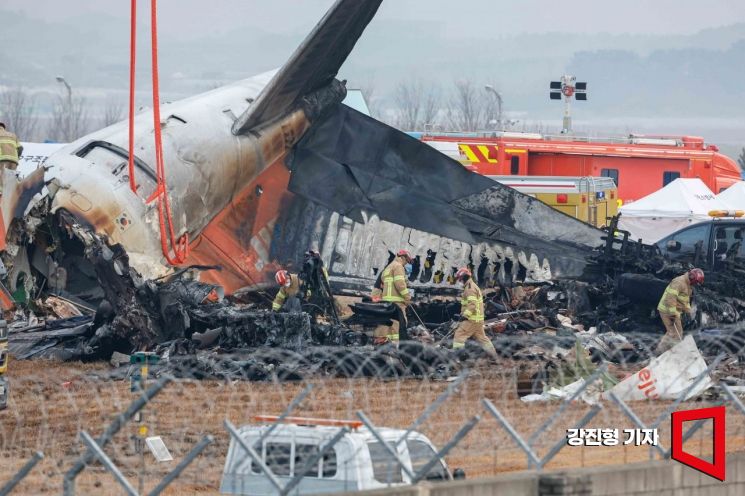 Firefighters are searching for fuel items at the site of the Jeju Air passenger plane collision and explosion accident that occurred 30 days ago at Muan International Airport in Jeonnam. Photo by Kang Jin-hyung
Aviation experts have emphasized that existing structures at regional airports like Muan International Airport, where concrete structures are installed beyond the runway, should all be replaced with flexible materials or placed underground. The concrete structure installed to support the localizer (landing guidance antenna) is considered a key cause of the recent Jeju Air passenger plane disaster.
At 9:03 a.m. on the 29th of last month, the aircraft that belly-landed on the Muan Airport runway failed to reduce speed and went off the runway, traveling about 251 meters further. It then collided head-on with a concrete structure measuring 2 meters in height, 4 meters in thickness, and 40 meters in width, shattering and exploding.
Now is not the time to debate whether it complies with regulations
As of the 2nd, five days after the accident, the Ministry of Land, Infrastructure and Transport is investigating whether this concrete structure was installed according to the law. However, experts unanimously agree that "since the danger of the concrete structure has been proven, it is urgent to remove this facility from all airports regardless of legality."
According to the Ministry of Land, Infrastructure and Transport and the aviation industry, among the 14 domestic airports, the localizer is installed on concrete structures at airports including Yeosu Airport, Gwangju Airport, and Pohang Gyeongju Airport, in addition to Muan. These airports have concrete structures 1.5 to 4 meters high installed just beyond the runway end, similar to Muan.
Regarding concerns that these airports may also be unsafe, the Ministry of Land, Infrastructure and Transport avoided giving a clear answer. At a briefing held at the Government Sejong Complex on the 1st, Joo Jong-wan, Director of Aviation Policy at the Ministry, said, "Domestic airport facilities are operated according to standards," adding only, "However, if issues arise during special safety inspections, necessary measures will be taken."
The concrete structures must be removed as soon as possible
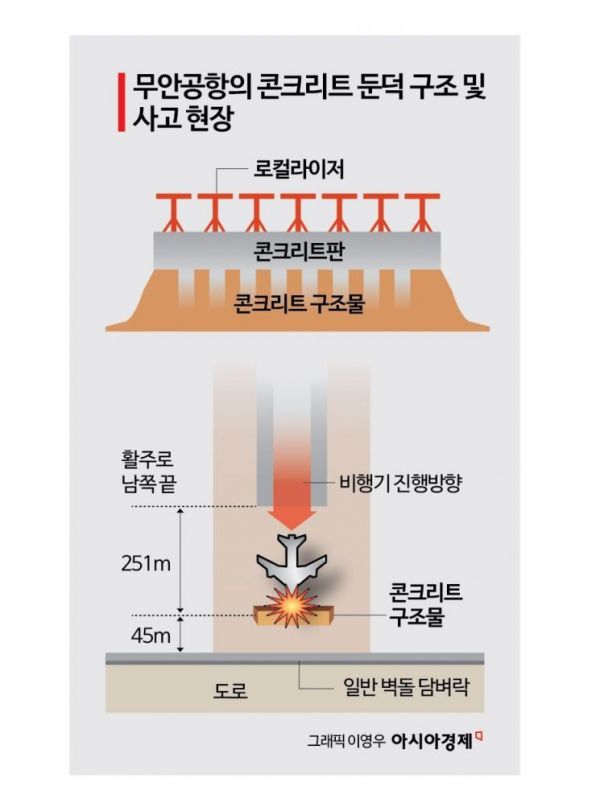
Experts view other airports with concrete structures as dangerous as well. Professor Jung Yoon-sik of the Department of Aviation Operations at Catholic Kwandong University said, "The localizer support is actually not a concrete structure but a red pipe-shaped part designed to break easily," adding, "The concrete structure should be changed to an underground facility beneath the runway surface."
Professor Jung explained, "Muan Airport has a slope on the runway, which caused the concrete structure to protrude, increasing the scale of the accident," emphasizing, "Following this incident, airports like Muan, Yeosu, Gwangju, and Pohang should level their runway foundations, like Incheon and Gimpo Airports, and remove concrete structures protruding above ground."
Professor Lee Hwi-young of the Department of Aviation Management at Inha Technical College said, "The concrete structure under the localizer should be replaced with materials that can break or absorb impact when colliding with an aircraft," adding, "This safety measure is very important not only for existing airports but also for the newly constructed Gadeokdo New Airport."
An aviation operations professor who requested anonymity said, "According to International Civil Aviation Organization (ICAO) regulations, obstacles within the longitudinal safety area should be designed to break easily," and stressed, "This accident should serve as a catalyst to replace concrete structures at other regional airports." He also mentioned, "It is necessary to introduce EMAS (Engineered Materials Arrestor System) to ensure safety when belly-landing on the runway, as in this accident."
EMAS is a safety device that rapidly reduces an aircraft's speed when it must perform an 'overrun,' i.e., exit the runway due to an unavoidable accident. When an aircraft enters this zone, the pavement, made of breakable blocks, crumbles under the aircraft's weight, slowing it down by dragging the fuselage or wheels.
.
© The Asia Business Daily(www.asiae.co.kr). All rights reserved.


















