Semiconductor Special Act and Other Bills Fail to Pass Standing Committee
Democratic Party "Considering Measures Including Fast Track"
On the 31st, the National Assembly held its last plenary session of the year and concluded the processing of bills, but major livelihood bills, including the 'Semiconductor Special Act,' will be carried over to the next year.
The Semiconductor Special Act, which includes provisions to provide subsidies to semiconductor companies and to flexibilize working hours in the semiconductor industry, was a bill on which both ruling and opposition parties had reached a consensus amid intensifying semiconductor hegemony competition. However, the People Power Party insisted on an 'exception to the 52-hour workweek' for researchers and developers (R&D) involved in national advanced strategic projects, causing disagreements between the parties, and ultimately the bill did not even pass the subcommittee stage of the relevant standing committee.
The 'Special Act on Expansion of National Power Grid,' which contains various support measures to back the power demand of advanced industries, and the 'Special Act on Management of High-Level Radioactive Waste,' which involves constructing disposal facilities for spent nuclear fuel generated by nuclear power plant operations, were also proposed by both parties but remained pending in the standing committees, resulting in no processing within the year.
Other livelihood bills that were not processed despite no significant disagreements between the parties include the Offshore Wind Power Special Act, which designates offshore wind power development zones led by the state; the Renewable Energy Act amendment, which aims to alleviate excessive site regulations and recommends prioritizing the use of domestically produced equipment; and the Foreign Employment Act amendment, which extends the stay period for skilled foreign workers.
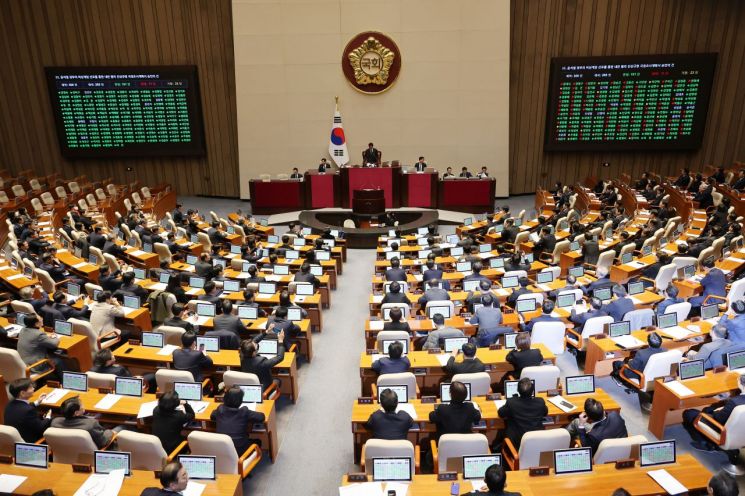
The Democratic Party is also considering the 'fast-track' card for processing some bills. If designated as fast-track, it can take up to 330 days until the bill is submitted to the plenary session (180 days in the standing committee, 90 days in the Legislation and Judiciary Committee, and 60 days for submission to the plenary session).
At the party strategy meeting held at the National Assembly that day, Lee Jung-moon, the senior deputy floor leader of the Democratic Party, said, "If the People Power Party continues to avoid legislative discussions, we will consider extraordinary measures according to the National Assembly Act procedures, including fast-track designation."
The Democratic Party views that discussions on bills pending in standing committees chaired by the ruling party, such as the Industry, Trade, Small and Medium Enterprises, and Political Affairs Committees, are particularly delayed, and is considering fast-track designation for bills under the jurisdiction of those committees.
In response, the People Power Party stated that discussions at the standing committee level were postponed only due to the emergency martial law situation and schedules of the National Assembly and the party, and that they can accelerate the processing of livelihood bills at any time.
© The Asia Business Daily(www.asiae.co.kr). All rights reserved.

















