Plan to Reduce Flight Volume by 10-15%
"Maintenance Staff per Aircraft is 12.7, Not Insignificant"
"The Crash Should Be Called the 'Jeju Air Disaster'"
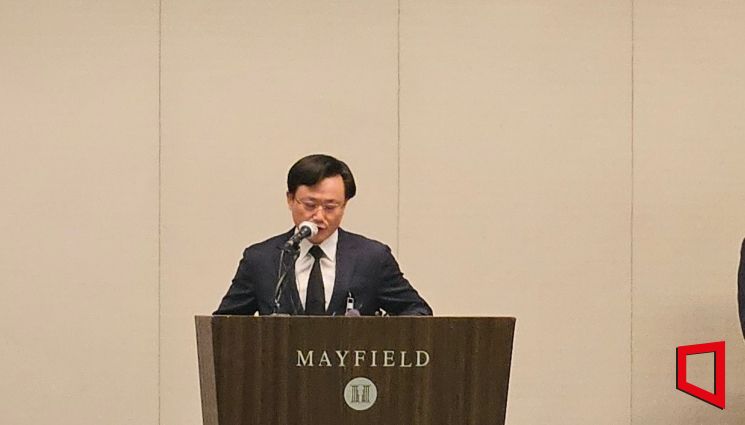 Kim I-bae, CEO of Jeju Air, is speaking at a briefing held on the 31st at the Mayfield Hotel in Oebalsan-dong, Gangseo-gu, Seoul. Photo by Park Seung-wook
Kim Eebae, CEO of Jeju Air, stated on the 29th that they are "preparing emergency support funds to assist the families of the victims" in relation to the passenger plane crash accident at Muan International Airport in Jeonnam.
At a briefing held on the 31st at the Mayfield Hotel in Oebalsan-dong, Gangseo-gu, Seoul, CEO Kim said, "Currently, the families of the victims are unable to work, so urgent assistance is necessary."
The emergency support funds mentioned by CEO Kim are "financial support for the livelihood of the families, which is different from compensation through insurance." He explained, "The compensation process is under discussion with domestic and international insurance companies."
Additionally, Jeju Air will reduce its flight operations by 10-15% during the winter period until March next year. CEO Kim said, "Although we need to consult with the government, internally we plan to reduce flight operations until March next year to secure additional capacity for aircraft maintenance," adding, "We will selectively manage routes booked until March next year to minimize inconvenience to passengers." He also explained, "Along with adjusting the number of flights according to aircraft routes, we will prioritize routes that other airlines have the capacity to serve."
Regarding criticism that Jeju Air has a small number of maintenance technicians, he responded, "The number of maintenance technicians is related to the number of aircraft. The primary standard is how many technicians per aircraft, which has increased from 12.0 per aircraft in 2019 to 12.6 now."
Concerning the claim that the accident aircraft had no accident history but had previously been fined, he said, "The fine in 2021 was due to failure to detect scratches on the rear of the aircraft." CEO Kim explained, "Accident history is classified as accidents, serious incidents, or aviation safety hazards according to regulations. At that time, there were scratches on the rear of the aircraft, which would be classified as an aviation safety hazard if problematic, but that was not the case." He added, "If the scratches were severe, it would be considered an aviation safety hazard, but it was not to that extent at the time."
Regarding the possibility of major executives of Jeju Air stepping down from management after the accident response, CEO Kim said it was "premature." He elaborated, "The accident response process is currently very complicated. It is a priority for the management to take responsibility for the response and resolve the issues first."
Finally, he emphasized again that the proper name for this plane crash accident is the "Jeju Air Disaster," stating, "Some refer to it as the Muan Airport Disaster, but it is appropriate to include Jeju Air in the name."
© The Asia Business Daily(www.asiae.co.kr). All rights reserved.

















