Ministry of Land, Infrastructure and Transport says "Concrete embankment is outside the longitudinal safety zone, so no problem"
But guidelines require concrete embankment to be within the longitudinal safety zone
Controversy likely to grow
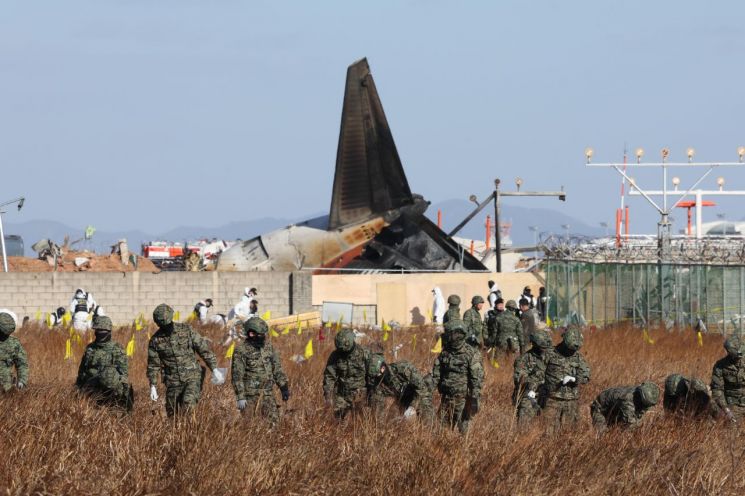
One of the causes of the Muan International Airport Jeju Air passenger plane accident has been identified as a concrete embankment, raising suspicions of guideline violations. In particular, there is a growing controversy over the 'longitudinal safety zone' mentioned by the Ministry of Land, Infrastructure and Transport (MOLIT) when it stated that there was no legal issue with this embankment facility, as the MOLIT’s explanation differs completely from the guidelines, and the debate is expected to intensify.
Accident worsened by collision with 2m-high concrete embankment
At 9:03 a.m. on the 29th, the aircraft that made a belly landing failed to reduce speed and veered off the runway, traveling about 250 meters further before colliding with a concrete embankment measuring 2 meters in height, 4 meters in thickness, and 40 meters in width, splitting in two and exploding. This structure was a localizer, known as ‘bangwihak’ in Korean. A localizer is an antenna-like facility installed at the end of an airport runway. It emits radio waves to help aircraft land precisely in the center of the runway. Localizers are installed at both ends of the runway so that planes can land from either direction depending on weather conditions. The accident aircraft collided with the concrete embankment where the localizer was installed on the south side of Muan Airport’s runway. The localizer on the north side of the runway was absent due to ongoing runway construction.
In response to criticism that the localizer increased the human damage, MOLIT explained, "The localizer at Muan Airport was installed in accordance with relevant regulations." MOLIT stated, "According to Article 23 of the Detailed Guidelines for the Management of Aviation Obstacles under the Airport Facilities Act, ‘all equipment or installations considered obstacles on airport grounds must be mounted on breakable supports,’ but this applies only when located on the runway safety area or the longitudinal safety zone." They added, "The regulation does not apply to equipment or obstacles installed outside the longitudinal safety zone, such as the localizer at Muan Airport."
The 'longitudinal safety zone' refers to a flat, obstacle-free area starting at both ends of the runway to prevent damage to aircraft from collisions with obstacles when landing short of the runway or overrunning the end. MOLIT said, "(The longitudinal safety zone) is a minimum mandatory standard of 90 meters according to international standards, with a recommended standard of 240 meters," and "Muan Airport’s longitudinal safety zone is 199 meters."
Guidelines differ from MOLIT’s ‘no problem’ stance
Contrary to MOLIT’s rebuttal, some domestic regulations include provisions that the longitudinal safety zone distance should be extended to the localizer, which is expected to fuel further controversy.
Article 18 of MOLIT’s ‘Detailed Design Guidelines for Airport and Airfield Facilities’ states that when determining the length of the longitudinal safety zone, it must be sufficient to cover cases where aircraft land short or overrun the runway, and that for precision approach runways, the localizer is usually the first obstacle, so the longitudinal safety zone must be extended to this facility.
Article 21 of the ‘Standards for Installation of Airport, Airfield Facilities, and Landing Sites’ also specifies that for precision approach runways, the longitudinal safety zone must be extended to the point where the localizer is installed.
A precision approach runway refers to a runway equipped with instrument landing systems such as a localizer. A MOLIT official said, "All runways at airports operating international and domestic flights in Korea have localizers installed, so they can be considered precision runways," adding, "Non-precision runways are those used by light aircraft where pilots can judge visually."
Experts agree that a thorough investigation is necessary since the localizer was one of the factors that increased the scale of the accident. Professor Choi Ki-young of Inha University’s Department of Aerospace Engineering said, "If the concrete embankment had not been there, the damage could have been reduced. Looking at MOLIT’s regulations, I question whether it is appropriate to build the localizer’s foundation so high. We need to examine the fact that the support was built on soft ground and that the foundation was not set at ground level."
Meanwhile, MOLIT announced on the 31st that eight U.S. experts participating in the investigation of the Jeju Air accident arrived in Korea the previous day and have begun a joint accident investigation. Joo Jong-wan, Director of the Aviation Policy Office, said, "The eight members of the U.S. joint investigation team include one from the Federal Aviation Administration (FAA), three from the National Transportation Safety Board (NTSB), and four from the aircraft manufacturer Boeing." From that day, 11 accident investigators from MOLIT’s Aviation and Railway Accident Investigation Board and the eight U.S. joint investigators will start on-site meetings at Muan Airport to conduct field inspections and discuss the direction of the investigation.
© The Asia Business Daily(www.asiae.co.kr). All rights reserved.
![Clutching a Stolen Dior Bag, Saying "I Hate Being Poor but Real"... The Grotesque Con of a "Human Knockoff" [Slate]](https://cwcontent.asiae.co.kr/asiaresize/183/2026021902243444107_1771435474.jpg)
















