"Successfully Landed on the Runway"
"Could Have Stopped Safely If There Were No Structures"
Regarding the Jeju Air passenger plane disaster that occurred at Jeonnam Muan International Airport, American experts supported the claim that the concrete structure (berm) installed at the end of the airport runway may have exacerbated the damage.
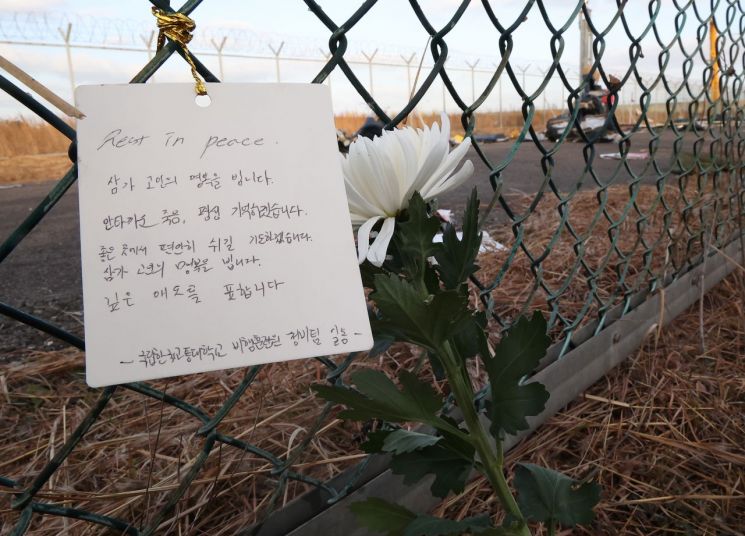 On the morning of the 31st, memorial messages were placed at the site of the Jeju Air passenger plane accident at Muan International Airport in Muan-gun, Jeollanam-do. Photo by Yonhap News
On the 30th, Yonhap News cited an article from The Washington Post (WP) and introduced interviews with Hassan Shahidi, chairman of the U.S. nonprofit organization 'Aviation Safety Foundation,' among others. Shahidi said, "This is a very complex accident," adding, "There are many factors that investigators need to identify." He explained, "The placement of structures within the airport is determined according to international standards," and "For example, objects near the runway should be fragile in the event of a collision with an aircraft."
According to the report, former aircraft pilot Doug Moss pointed out that the airport layout appears to be a major cause of the disaster. He said that making the runway completely flat is costly, so it is not uncommon for runways to have slight slopes, and personally, he has seen many unusual airport designs. However, he stated, "This one takes the cake." He emphasized, "It is necessary to anticipate that an aircraft might veer off the runway." Moss also speculated that "the plane landed too quickly" and "they did not have enough time to review the checklist."
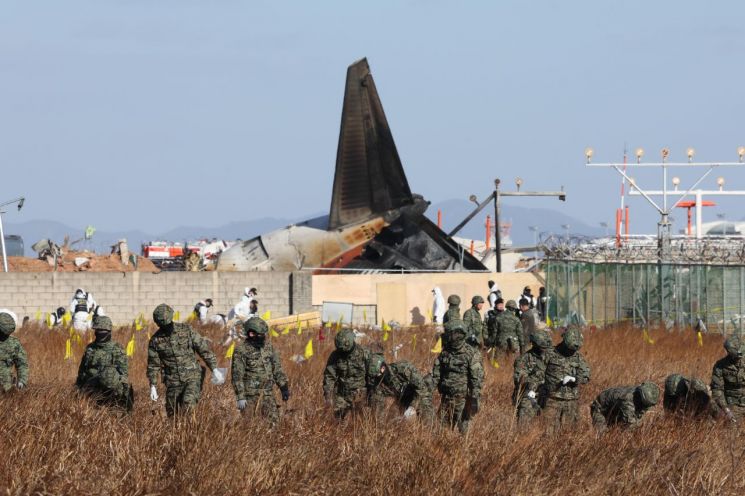 On the morning of the 31st, special forces soldiers are conducting search operations at the site of the collision and explosion accident involving a Jeju Air passenger plane at Muan International Airport in Muan County, Jeollanam-do. Photo by Yonhap News
Aviation safety consultant John Cox said, "The video showing the aircraft running on the runway suggests that the pilots maintained some degree of control," and added, "They landed excellently on the runway." He further pointed out, "If there had been no structures there, they might have had enough space to stop safely."
There was also an opinion that the cockpit voice recorder (CVR) would provide clues to solving the problem. Robert Sumwalt, former chairman of the U.S. National Transportation Safety Board (NTSB), said in an interview with CBS, "As a captain, I flew Boeing 737 series aircraft (the same series as the accident plane) for 10 years, and I can say that the landing gear can be manually lowered by the pilot." He added, "So the real question is how the events unfolded here," and "Since the landing gear can be manually operated through normal means, I have doubts about whether the landing gear functioned properly in any form." Sumwalt also said, "If the cockpit voice recorder can be read, it will be the key to solving the mystery."
Earlier, at 9:03 a.m. on the 29th, Jeju Air flight 7C2216, which departed from Bangkok, Thailand, and was heading to Muan International Airport, attempted a belly landing without the landing gear (equipment necessary for takeoff and landing such as airplane wheels) being deployed, collided with the outer wall, and caught fire. There were 181 people on board the passenger plane (175 passengers and 6 crew members), and except for 2 crew members, all 179 others died.
© The Asia Business Daily(www.asiae.co.kr). All rights reserved.
![Clutching a Stolen Dior Bag, Saying "I Hate Being Poor but Real"... The Grotesque Con of a "Human Knockoff" [Slate]](https://cwcontent.asiae.co.kr/asiaresize/183/2026021902243444107_1771435474.jpg)

















