The Incident Originated from a Disaster
Concrete Localizer Identified as Cause of Accident Growth
Ministry of Land, Infrastructure and Transport: "Localizer Installed According to Regulations"
Black Box Analysis with U.S. Investigation Team to Begin Soon
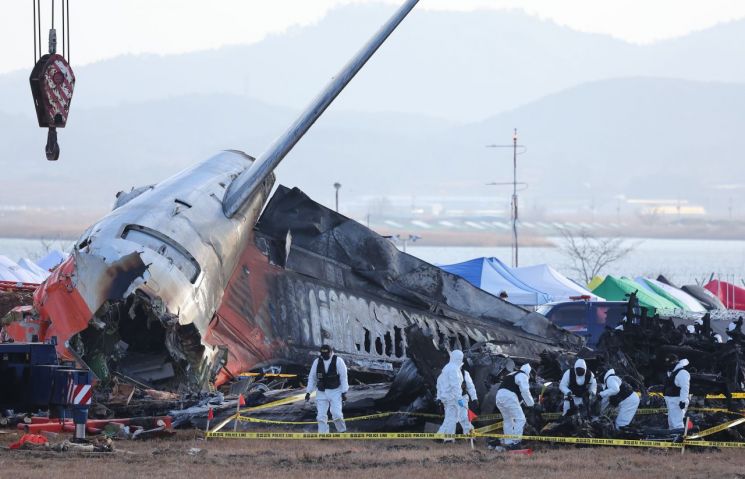
According to the Ministry of Land, Infrastructure and Transport's announcements and aviation experts' opinions so far, the cause of the Jeju Air passenger plane crash at Muan International Airport was a combination of natural and human factors. If the collision between the aircraft and the flock of birds is considered a natural disaster, the inoperable fuselage and the concrete localizer at the end of the runway are classified as man-made causes.
The black box, which is the key to uncovering the cause of the accident, was transferred to the Aviation and Railway Accident Investigation Board's analysis room at Gimpo Airport, where decoding work began jointly with a U.S. investigation team. However, there are observations that the black box was damaged, and the work could take several months.
4 Minutes Before the Accident, Pilot: "Mayday! Bird Strike!"
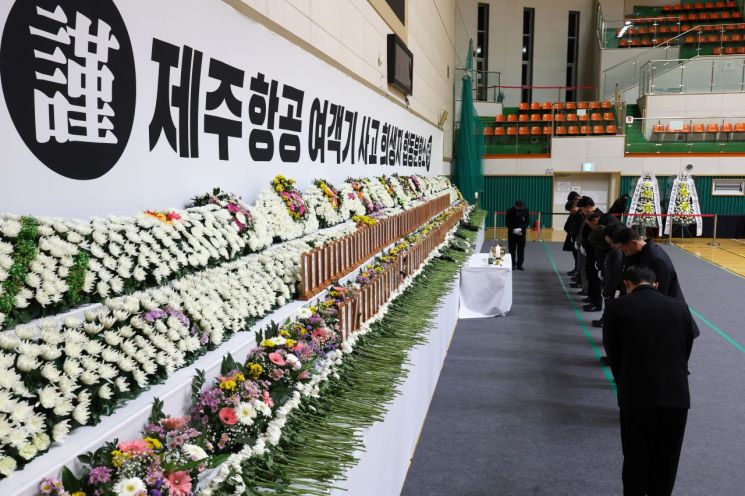
The Ministry of Land, Infrastructure and Transport officially confirmed the day before that a bird strike was the trigger for this accident. At 8:59 a.m., four minutes before the accident on the 28th, the pilot sent a distress signal by shouting "Mayday, Mayday, Mayday," followed by "Bird strike, bird strike, going around." Joo Jong-wan, head of the Ministry's Aviation Policy Office, stated, "The pilot declared 'Mayday' for the first and only time at 8:59 due to a 'bird strike' and during the go-around process, communication with air traffic control became disrupted at some point, and while attempting to land again, the accident occurred."
The area around Muan Airport is a migratory bird habitat, home to 88 species of birds. Among them, six species including mallards are classified as 'level 3 risk' birds based on bird strike risk analysis. According to a recent survey conducted by the National Institute of Ecology this month, 1,792 migratory birds were observed at Muan Reservoir, 4,315 along the Muan and Mokpo coasts, and 12,779 in Hyeonggyeong-myeon and Unnam-myeon. According to the government's Central Accident Response Headquarters, the bird prevention workforce at Muan Airport was two people on weekdays and one person on weekends. Due to the poor conditions typical of regional airports, manpower management was insufficient.
If there is a shortage of personnel, detection can be done by machines, but even that was not in place. Park Yong-gap, a member of the National Assembly's Land, Infrastructure and Transport Committee from the Democratic Party, said, "After checking with Korea Airports Corporation and Incheon International Airport Corporation, none of the 15 domestic airports have bird detection radar installed." Only three airports?Gimpo, Gimhae, and Jeju?have thermal cameras installed for bird detection. Park said, "I plan to propose an amendment to the Airport Facilities Act to mandate the installation of bird strike prevention facilities such as bird detection radar and thermal cameras at airports."
Witnesses Say the Wheels Were Functioning Normally During the First Landing Attempt
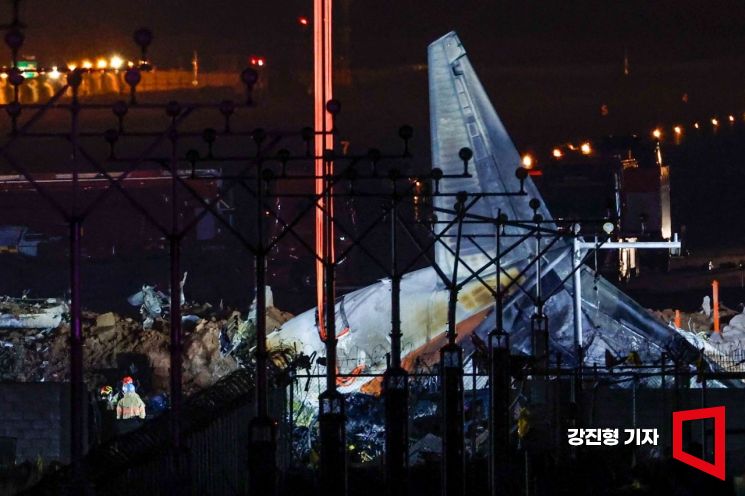 On the 29th, a Jeju Air passenger plane carrying 181 passengers collided with the outer wall of the runway while landing at Muan International Airport, causing a fire that resulted in a major disaster with most passengers dead. Firefighters are searching for missing persons among the wreckage of the accident aircraft on the runway at Muan International Airport, Jeonnam. Photo by Kang Jin-hyung
Although the initial cause was a natural disaster, it is presumed that human factors also contributed to the accident escalating to the extent that 179 out of 181 passengers died. Even if one engine was damaged by the bird strike, it remains an unresolved question why the other engine, braking system, and landing gear (wheels) did not function properly.
Witnesses have reported that the wheels were functioning normally during the first landing attempt. However, during the second landing attempt that led to the collision, the wheels were not deployed, and the fuselage made a belly landing on the runway, sliding with significant friction for about 10 seconds.
The Ministry of Land, Infrastructure and Transport expects answers to these questions to come only after black box analysis. Joo Jong-wan said, "We will first review how much of the black box investigation (including data download) is possible," adding, "The exact cause of the aircraft malfunction can only be determined through black box investigation."
The Concrete Embankment That Worsened the Accident: No Legal Issues, But...
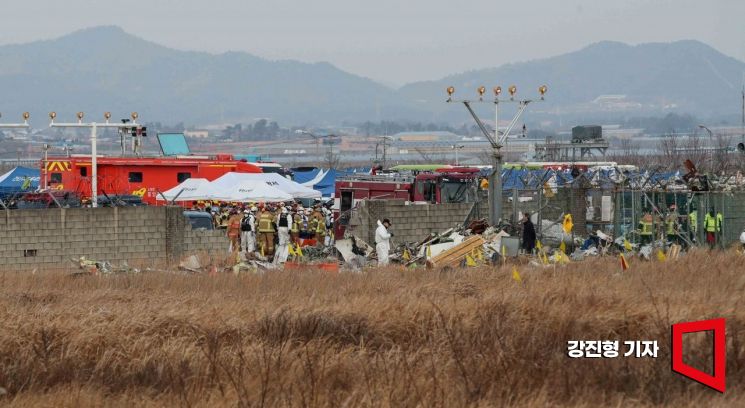 At Muan International Airport, a Jeju Air passenger plane carrying 181 passengers collided with the outer wall of the runway during landing, causing a fire that resulted in a major disaster with most passengers dying. On the 29th, firefighters and forensic investigators were recovering the victims at the accident site on the runway of Muan International Airport, Jeollanam-do. Photo by Kang Jin-hyung
Besides the aircraft malfunction, another man-made factor identified was the concrete structure at the end of the runway. The aircraft, which made a belly landing, failed to reduce speed and went about 250 meters beyond the runway, colliding with a structure measuring 2 meters in height, 4 meters in thickness, and 40 meters in width, breaking in two and exploding. This structure is a localizer called the 'azimuth.'
The localizer is an antenna-like facility installed at the end of airport runways. It emits radio waves to help aircraft land precisely in the center of the runway. Localizers are installed at both ends of the runway to allow aircraft to land from any direction depending on weather conditions. The accident aircraft collided with the localizer located at the southern end of Muan Airport's runway. The localizer at the northern end was absent due to ongoing runway construction.
The Ministry of Land, Infrastructure and Transport drew a line on the controversy that the aircraft's collision with the concrete-mounted localizer worsened the accident, stating, "The localizer at Muan Airport was installed in accordance with relevant regulations." According to the Airport Facilities Act, "All equipment or installations considered obstacles on airport grounds must be mounted on breakaway supports." However, the Ministry explained, "This applies only if the equipment is located on the landing strip or runway end safety area. The localizer at Muan Airport is installed outside the runway end safety area, so this regulation does not apply."
However, experts believe the localizer was one of the factors that increased the scale of the accident. Professor Choi Ki-young of Inha University's Department of Aerospace Engineering said, "If the concrete embankment had not been there, the damage might have been reduced. Looking at the Ministry's regulations, I question whether it is appropriate to build the localizer foundation this high. We need to examine the fact that the support was built on soft ground and that the foundation was not set at ground level."
© The Asia Business Daily(www.asiae.co.kr). All rights reserved.
![Clutching a Stolen Dior Bag, Saying "I Hate Being Poor but Real"... The Grotesque Con of a "Human Knockoff" [Slate]](https://cwcontent.asiae.co.kr/asiaresize/183/2026021902243444107_1771435474.jpg)


















