Even if detention is secured for new recruits,
it must be completed within 20 days at the latest.
Challenges expected if the Security Office refuses execution.
Yoon's side says "Difficult to accept."
An arrest warrant has been issued for President Yoon Seok-yeol, who is accused of being the ringleader of a rebellion. This is the first time in constitutional history that an arrest warrant has been issued for a sitting president. However, challenges are still expected in the actual execution and subsequent investigation.
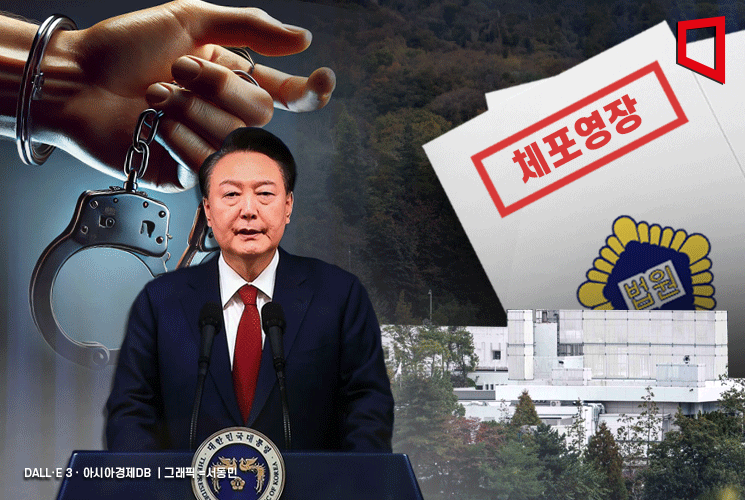
Concerns about clashes with the Presidential Security Service during the execution of the arrest warrant are rising, and even if custody is secured and detention follows, all investigations must be completed within a maximum of 20 days, making a 'speed operation' inevitable.
The Joint Investigation Headquarters (Joint HQ), investigating the December 3 emergency martial law incident, announced on the morning of the 31st, "Arrest and search warrants requested for President Yoon have been issued," adding, "No schedule has been set for the future."
The Joint HQ, composed of the High-ranking Officials' Crime Investigation Unit (HOCIU) and the police, requested an arrest warrant for President Yoon at midnight the previous day at the Seoul Western District Court. President Yoon did not respond to any of the three summonses from HOCIU.
Following the court's decision, the issue of HOCIU's investigative authority over the crime of rebellion seems to be settled. Previously, President Yoon's side submitted a statement to the court arguing that HOCIU does not have investigative authority over rebellion, claiming, "The arrest warrant request was made by an unauthorized agency and does not meet the requirements under the Criminal Procedure Act." The issuance of the arrest warrant is interpreted as a rejection of these claims.
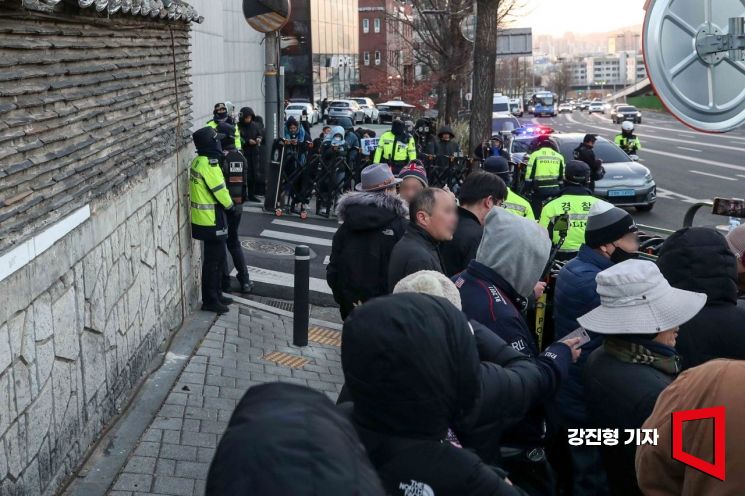 On the 31st, near the Presidential Residence in Yongsan-gu, Seoul, groups calling for the arrest of President Yoon and groups opposing the arrest are confronting each other with the police in between. Photo by Kang Jin-hyung
However, whether the arrest warrant can be practically executed remains another variable. President Yoon is staying at the official residence under the protection of the Presidential Security Service. If the Security Service refuses to cooperate and blocks the execution of the warrant, a physical confrontation with HOCIU could occur.
In fact, the police attempted to seize CCTV footage from the Presidential Safety House located in Samcheong-dong, Jongno-gu, Seoul, and the secret phone server held by the Presidential Security Service, but returned empty-handed due to obstruction by the Security Service. At that time, the Security Service cited Article 110 of the Criminal Procedure Act, which stipulates that "places requiring military secrets cannot be searched or seized without the consent of the person in charge."
Obstructing the execution of an arrest warrant without justifiable reason can constitute obstruction of official duties, but there is a possibility that the Presidential Security Service may again refuse execution citing the need to protect military secrets. The Joint HQ is reportedly reviewing various scenarios in preparation. Typically, the validity period of an arrest warrant is seven days from the date of issuance.
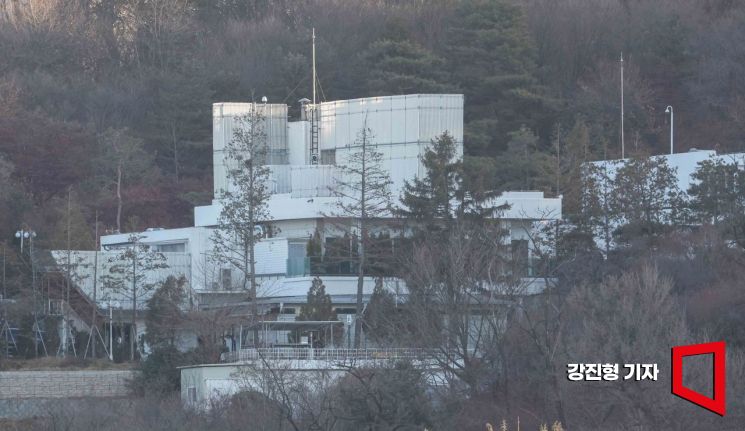 On the 31st, a sense of silence enveloped the Presidential Residence in Yongsan-gu, Seoul. Photo by Kang Jin-hyung
If the warrant is successfully executed despite these obstacles, a race against time begins. For a detained suspect, a detention warrant must be requested and issued within 48 hours to maintain custody. The likelihood of issuance increases if the gravity of the charges is clearly established without dispute. A high-intensity investigation is required in a short time based on existing evidence and testimonies.
If detention is achieved, the Joint HQ will have some breathing room. Under the Criminal Procedure Act, prosecutors can detain a suspect for up to 20 days before filing charges. However, HOCIU can only investigate the president and lacks prosecution authority, so after completing the investigation, the case must be transferred to the prosecution. Since the prosecution may require additional or supplementary investigation, the Joint HQ cannot fully utilize the 20-day detention period.
In the case of the previously detained Director of the Defense Intelligence Command, Moon Sang-ho, HOCIU and the prosecution agreed to use 10 days each. If the same procedure is followed, HOCIU will have only 12 days from arrest to detention and transfer to the prosecution. The timing of the arrest warrant issuance and actual custody will determine the schedule for future investigation and prosecution.
President Yoon's side strongly opposed the issuance of the arrest warrant, stating it is "unacceptable." On the day, President Yoon's legal team said, "It is surprising that an arrest warrant requested by HOCIU, which lacks investigative authority, was issued."
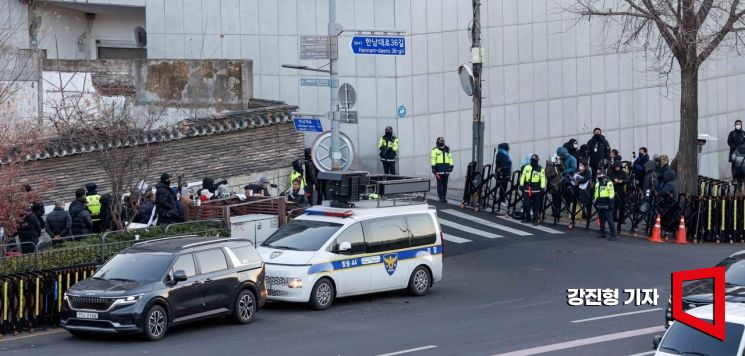 On the 31st, near the Presidential Residence in Yongsan-gu, Seoul, groups calling for the arrest of President Yoon and groups opposing the arrest are confronting each other with the police in between. Photo by Kang Jin-hyung
The legal team further stated, "It is very regrettable that the arrest warrant was requested at the Seoul Western District Court, not the Seoul Central District Court where the main trial is expected, which goes against principles and precedents," adding, "It is hard to accept that an arrest warrant was issued despite legitimate reasons for non-appearance, such as issues with investigative authority, as a sitting president."
Meanwhile, Constitutional Court Justice Kim Hyung-doo expressed the view that the Constitutional Court will prioritize the impeachment trial of President Yoon while simultaneously handling multiple cases. On the morning commute, Justice Kim told reporters, "There is no change in the commitment to prioritize the president's case."
Justice Kim explained, "Measures are in place to ensure that dates for each impeachment case do not overlap, allowing justices to proceed simultaneously," adding, "There is no hindrance to handling multiple cases concurrently."
The Constitutional Court currently has 10 impeachment trials pending, including President Yoon's case. The impeachment case against Prime Minister Han Duck-soo was also filed on the 27th. Regarding the operation of the six-member Constitutional Court, Justice Kim emphasized, "There are many difficulties. We hope that the three justices elected by the National Assembly will be appointed promptly."
© The Asia Business Daily(www.asiae.co.kr). All rights reserved.
![Clutching a Stolen Dior Bag, Saying "I Hate Being Poor but Real"... The Grotesque Con of a "Human Knockoff" [Slate]](https://cwcontent.asiae.co.kr/asiaresize/183/2026021902243444107_1771435474.jpg)

















