It is forecasted that the domestic commercial real estate market in 2025 will undergo a paradigm shift in investment structure and cycles. As the cycle changes in traditional sectors such as office and logistics become visible, it is predicted that investment restructuring centered on new growth sectors like rental housing, data centers, and life sciences will accelerate.
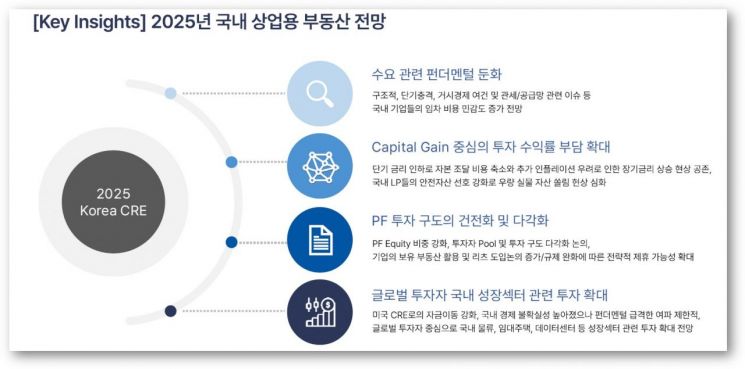
Aegis Asset Management announced on the 31st that it published a ‘2025 Market Outlook’ report containing these insights. The report anticipated that in next year’s commercial real estate market, the efficiency and differentiation of individual assets will become key factors for investment competitiveness.
The report viewed 2025 as a structural turning point for the commercial real estate market. In the global market, it analyzed that changes in tariffs, trade, and immigration policies due to the U.S. administration change will act as new inflationary pressures. Particularly, with inflation risks highlighted on the demand side such as labor supply, it is expected that U.S. interest rates and weak dollar policies will increase volatility in the global market.
For the domestic market, political uncertainties both at home and abroad are expected to increase volatility in exchange rates and capital markets until the first half of next year. Amid the likelihood of export slowdown due to increased tariff burdens and decreased corporate profits, foreign capital is expected to demand higher returns, intensifying liquidity concentration and demand contraction.
By sector, the cycle change in the traditional real estate market is expected to become full-fledged. The office market transaction volume next year is forecasted to remain at the 2023?2024 level. This is due to price adjustments centered on small and non-prime assets and a slowdown in rent growth, weakening the office investment environment and deepening polarization. With institutional investors maintaining a conservative stance, a shift from capital gain to stable income gain is anticipated. Capital inflows into prime assets such as ‘trophy assets’ are also expected.
The logistics market is likely to see intensified transaction polarization as efficiency and profitability become key issues amid household consumption contraction and rising cost pressures. Additionally, along with the trend of asset efficiency, concerns about oversupply are expected to gradually ease due to adjustments in the supply volume scheduled after 2026.
The hotel sector may experience some contraction due to political issues, but there is also potential for additional growth due to the base effect of exchange rates. However, the balance between the rise in average daily rate (ADR) and the pace of cost increases will be a key variable in investment decisions.
The report evaluated 2025 as a turning point to prepare for new growth engines. As asset polarization intensifies, the efficiency and differentiation of individual properties are expected to become more important. Especially, as new standards for asset value are established, the investment cycle is expected to be restructured around growth industry-linked sectors such as rental housing, data centers, and life sciences.
The research office proposed a dual approach as the investment strategy for 2025. It advised investing in stable core assets in traditional real estate sectors such as office and retail, achieving economies of scale through scale-up in ‘essential goods’ assets like rental housing, and emphasizing the strengthening of manager expertise in high-growth sectors such as data centers and life sciences.
Choi Jaryeong, head of the research office at Aegis Asset Management, said, “To secure competitiveness in a market with high volatility and capital hurdles, selection and concentration on assets are necessary,” adding, “This transition in investment structure and cycle is a new opportunity factor for the domestic real estate market, and it is important to capture investment opportunities linked to growth industries in line with demand-driven market changes.”
© The Asia Business Daily(www.asiae.co.kr). All rights reserved.
![Clutching a Stolen Dior Bag, Saying "I Hate Being Poor but Real"... The Grotesque Con of a "Human Knockoff" [Slate]](https://cwcontent.asiae.co.kr/asiaresize/183/2026021902243444107_1771435474.jpg)















