Meta, Google, MS and Other Big Tech Gathered in Atlanta
Data Centers Expected to Revitalize Economy but 'Not So Sure'
Residents' Complaints Rise Over Excessive Power and Land Use
Meta Platforms, Google, Microsoft (MS), and X (formerly Twitter). Atlanta, Georgia, has been struggling with the continuous expansion of data centers by big tech companies that it attracted in large numbers years ago. Although the government provided tax incentives and lowered electricity rates to revitalize the local economy, residents are complaining about difficulties due to power consumption and land occupation exceeding expectations.
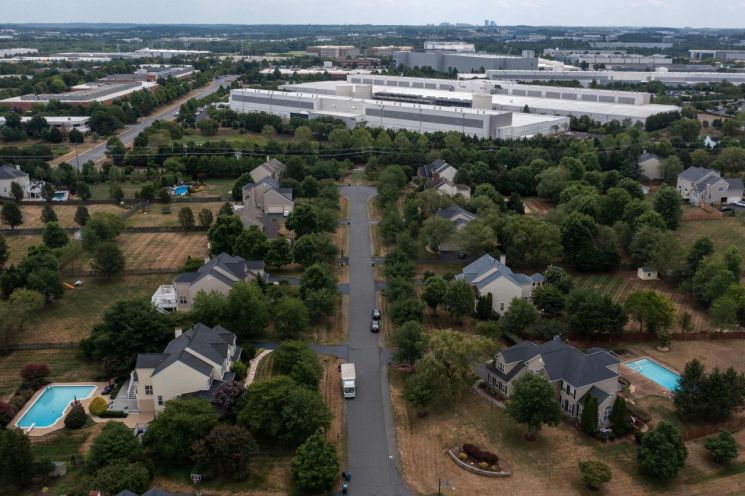 This photo shows a data center next to residential houses in Virginia, USA. Photo by Getty Images Yonhap News
The Wall Street Journal (WSJ) recently reported that "in the AI era, big tech companies are accelerating efforts to secure large-scale facilities capable of supplying sufficient power." According to global real estate services firm CBRE, the scale of data center construction in Atlanta, measured by power consumption, increased by 76% in the first half of last year compared to the same period the previous year.
Initially, the Atlanta government provided various incentives with the expectation that data centers would boost the local economy. Based on low electricity rates and tax incentives, major big tech companies built data centers. Just last year, Elon Musk’s Tesla CEO’s social networking service (SNS) company, X, announced an expansion of its data center after securing $10 million (approximately 14.72 billion KRW) in local tax incentives.
Especially after the generative AI ChatGPT boom in November 2022 intensified competition among big tech companies in AI technology development, the need to expand data centers grew. These companies sought to expand existing data centers or build new ones, focusing on securing more space in Atlanta. In this process, office spaces in downtown that had been vacant due to the impact of remote work after COVID-19 were transformed into spaces for operating data centers.
However, WSJ explains that data centers have become a headache as they have not spurred economic revival as expected, consume more power, and disrupt the local real estate market due to land acquisition needed for operation. Data centers create relatively few jobs but consume more electricity than other industries, leading to criticism that they do not significantly contribute to local economic revitalization.
One area in southwest downtown Atlanta was emerging as a new residential and commercial district with various shops, but conflicts arose when a data center tried to move into this area. Local residents are voicing concerns that urgent facilities are being pushed aside in favor of data centers.
Ultimately, in September last year, the Atlanta City Council passed a bill banning the establishment of new data centers in certain downtown areas. Atlanta Mayor Andre Dickens emphasized, "Data center development should not take precedence over people-centered urban development such as adequate housing, quality jobs, and nearby retail." Outside Atlanta, Fairfax County in Virginia, which also hosts many big tech data centers, recently banned new data center construction within one mile of railway stations.
© The Asia Business Daily(www.asiae.co.kr). All rights reserved.
![Clutching a Stolen Dior Bag, Saying "I Hate Being Poor but Real"... The Grotesque Con of a "Human Knockoff" [Slate]](https://cwcontent.asiae.co.kr/asiaresize/183/2026021902243444107_1771435474.jpg)















