'2nd Tier Hospital Development' Medical Reform Proposal Forum Held
Government: "Uniform Classification Bonuses to Be Reorganized into Performance Rewards by Type"
Medical Community: "Without Careful Compensation Design, Another Competition May Arise"
The government is set to initiate structural transformation for secondary hospitals and clinic-level medical institutions following its efforts with tertiary general hospitals. The goal is to establish a cooperative system among primary to tertiary medical institutions by fostering 'hub general hospitals' capable of responding to severe and emergency patients in local areas through performance- and value-based compensation systems, and by focusing investments on specialized hospitals responsible for essential medical fields such as burns, finger replantation, and childbirth. However, concerns have been raised about unnecessary competition arising from overlapping medical practices between secondary hospitals and tertiary general hospitals, as well as the long-term financial support needed from health insurance funds to expand compensation.
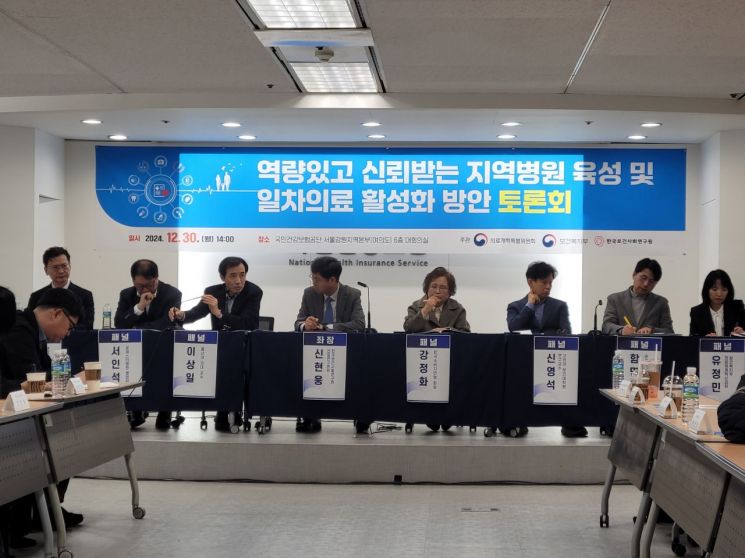
On the 30th, the Ministry of Health and Welfare and the Presidential Commission on Medical Reform held a forum titled "Discussion on Fostering Competent and Trusted Regional Hospitals and Revitalizing Primary Care," where they announced the structural transformation plan for secondary hospitals and clinic-level institutions.
The government plans to strengthen general hospitals and hospitals, which serve as the 'waist' of the medical delivery system, in line with the structural transformation of tertiary general hospitals focusing on severe, emergency, and rare diseases. To this end, the functions of secondary hospitals will be redefined, and a corresponding compensation system will be established. The plan is to develop 'hub general hospitals' that can comprehensively respond to medical demands within the region, increase appropriate disease-related fees for these hospitals, and support 24-hour medical services.
Concentrated investments will also be made in specialized hospitals responsible for specific essential medical fields such as burns, finger replantation, and childbirth. Even secondary hospitals that excel in specialized field evaluations will receive higher fees for severe care at the level of tertiary general hospitals. Hospitals capable of 24-hour surgery and hospitalization will be recognized as emergency centers for the relevant diseases and will be eligible for emergency fee compensation.
Approximately 70,000 clinic-level primary care institutions nationwide will be developed as 'functional primary care institutions' responsible for integrated management of local patients. Given the increase in chronic disease patients due to aging, the role of clinics as 'primary care physicians' who continuously manage patients within the community will be strengthened.
Compensation for medical institutions will shift significantly from the current uniform classification-based additional fee system to performance-based rewards according to detailed outcomes. Currently, additional fees are set by classification: 15% for tertiary general hospitals, 10% for general hospitals, and 5% for hospitals. There are no separate evaluation criteria for competent specialized hospitals. Going forward, a functional performance evaluation system will be introduced for severe care, secondary general care, specialized care in specific fields, and primary care. Institutions achieving the highest level of performance according to their roles and types will receive top-tier evaluations and compensation.
The Ministry of Health and Welfare also plans to continue scientific cost analysis to normalize compensation for undervalued surgeries and procedures, adjust overvalued specimen-related fees, and establish a fair compensation system. The currently operating specialized hospitals will have their designation and evaluation criteria reorganized according to hospital characteristics to redefine their functions, with more focused investment in essential infrastructure fields such as burns, finger replantation, and childbirth.
As part of strengthening primary care, the existing primary care physician projects will be reorganized to introduce a performance- and value-based compensation system targeting clinics that perform integrated and continuous primary care functions. Yujeongmin, Director of Medical System Innovation at the Ministry of Health and Welfare, stated, "To foster competent regional general hospitals, we plan to design a business model that harmonizes public policy fees and fee-for-service payments by adding regional surcharges. We will focus more on rationalizing compensation so that medical institutions providing essential or benefit-centered care receive appropriate rewards."
However, the medical community expressed concerns that ongoing conflicts between medical professionals and the government could hinder the production of new specialists, making medical reform difficult to implement. They also warned that without careful design of the compensation system, confusion and competition over roles among hospitals could arise.
Kim Byung-geun, Chairman of Central Hospital and Director of Bakae Hospital, who participated as a panelist in the forum, said, "It is necessary to create an environment where specialists can take pride in treating severe patients at comprehensive secondary hospitals or university hospitals. Appropriate salaries and treatment for employed specialists are essential, and securing a safety net to reduce doctors' fear of criminal prosecution is also important." Ham Myung-il, Professor of Health Administration and Management at Soonchunhyang University, emphasized, "There will be overlaps in emergency procedures and surgery surcharges between general hospitals and tertiary general hospitals. If compensation for general hospitals is not well designed, competition could easily resume, so this must be kept in mind."
There were also remarks that the structure of hospitals and clinics may not change drastically with limited incentive expansions alone. Shin Young-seok, Research Professor at Korea University Graduate School of Public Health, evaluated, "A major innovation matching the 30 trillion won investment planned over the next five years for medical reform is needed, but currently, a regionally complete medical system is not well outlined." Lee Sang-il, Professor at Ulsan University College of Medicine, said, "Fee increases are not a one-time boost but require continuous investment from health insurance and government finances. Regarding strengthening the compensation system, concrete preparations such as additional financial input plans are necessary."
© The Asia Business Daily(www.asiae.co.kr). All rights reserved.
![Clutching a Stolen Dior Bag, Saying "I Hate Being Poor but Real"... The Grotesque Con of a "Human Knockoff" [Slate]](https://cwcontent.asiae.co.kr/asiaresize/183/2026021902243444107_1771435474.jpg)















