"Azimuth facilities outside runway end safety areas are exempt from regulations"
"Yeosu Airport, Jeju Airport, and US LA Airport also have concrete azimuths"
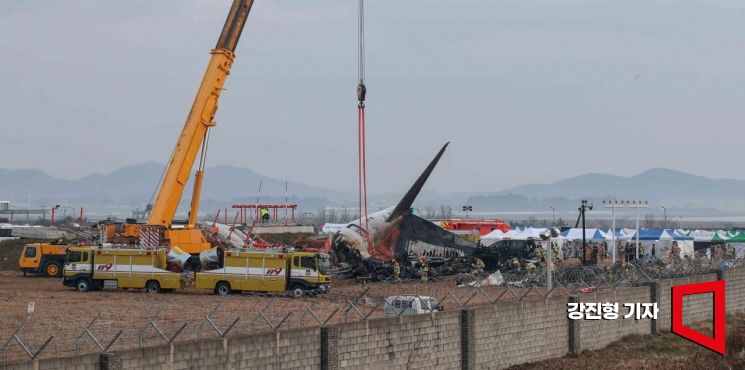 Firefighters are searching for fuel items at the site of the Jeju Air passenger plane collision and explosion accident that occurred on the 30th at Muan International Airport, Jeonnam. Photo by Kang Jin-hyeong
The Ministry of Land, Infrastructure and Transport (MOLIT) stated on the 30th that the controversy over the Jeju Air passenger plane accident at Muan International Airport in Jeollanam-do, which escalated due to the aircraft body colliding with the concrete azimuth (localizer), is unfounded, clarifying that "the localizer at Muan Airport was installed in accordance with relevant regulations." The azimuth is a type of antenna that helps guide the aircraft to enter the center of the runway when approaching the airport runway.
MOLIT explained, "According to Article 23, Paragraph 3 of the Detailed Guidelines for Managing Aviation Obstacles under the Airport Facilities Act, 'all equipment or installations considered obstacles on airport premises must be mounted on breakable supports.' However, this applies only when located within the runway safety area or the runway end safety area."
It added, "For equipment or obstacles installed outside the runway end safety area, such as the localizer at Muan Airport, this regulation does not apply," and noted, "This is also stipulated similarly in related international regulations."
Furthermore, "The installation and technical standards for navigation safety radio facilities under the Airport Facilities Act only regulate the frequency and signal strength of the localizer, but do not specify the height or material of the antenna support structure," and "related international regulations also do not address these matters," MOLIT stated.
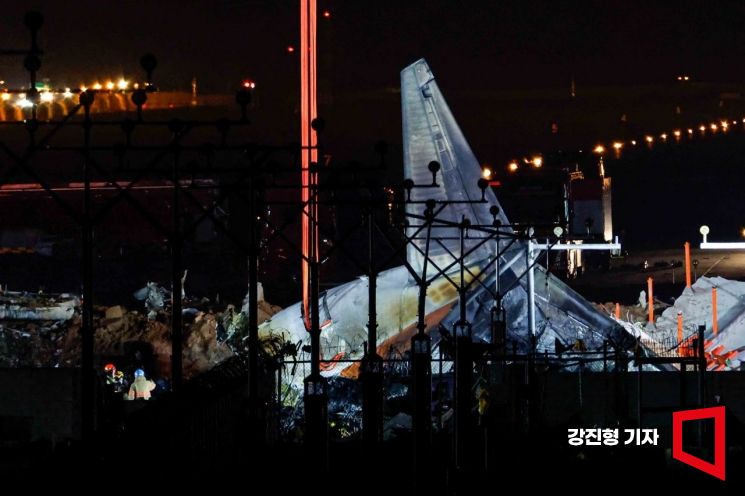 On the 29th, a Jeju Air passenger plane carrying 181 passengers collided with the outer wall of the runway while landing at Muan International Airport, causing a fire that resulted in a major disaster with most passengers dead. Firefighters are searching for missing persons among the wreckage of the accident aircraft on the runway at Muan International Airport, Jeonnam. Photo by Kang Jin-hyung
Joo Jong-wan, Director of the Aviation Policy Office at MOLIT, explained, “At Muan Airport, the azimuth facility is installed about 251 meters from the runway end outside the runway end safety area,” and added, “Azimuth facilities in concrete structure form also exist at Yeosu Airport, Jeju Airport, and Los Angeles Airport in the United States.”
He also said, “The Aviation and Railway Accident Investigation Board plans to conduct a comprehensive investigation into the relationship between the facility and this accident.”
The azimuth facility at Muan Airport has a structure where a concrete foundation and antenna are installed on top of an earthen mound. While azimuths are mainly made of metal, experts explain that it is rare for them to be constructed as protruding concrete structures like at Muan Airport. The accident aircraft collided consecutively with the azimuth facility and then a retaining wall during its landing attempt, causing the fuselage to split in two and catch fire.
Aviation expert David Learmount appeared on the UK’s Sky News after the accident and claimed, “Passengers died after hitting a solid structure located just off the end of the runway, a place where such a hard structure should not have been.” He added, “The aircraft slid off the runway with almost no damage to the fuselage until then,” and said, “The occupants lost their lives when the aircraft hit the mound and caught fire.”
© The Asia Business Daily(www.asiae.co.kr). All rights reserved.
![Clutching a Stolen Dior Bag, Saying "I Hate Being Poor but Real"... The Grotesque Con of a "Human Knockoff" [Slate]](https://cwcontent.asiae.co.kr/asiaresize/183/2026021902243444107_1771435474.jpg)

















