Since the emergency martial law situation on December 3, the exchange rate has been fluctuating amid a series of adverse factors. The won-dollar exchange rate, which hovered around 1,400 won at the beginning of the month, surged nearly 70 won (about 5%) in a month. Even government-funded research institutes have raised the possibility of the exchange rate surpassing 1,500 won. Although the foreign exchange authorities' fine-tuning limited the rise in the exchange rate in the last trading session of the year, it still maintains a high rate in the 1,470 won range.
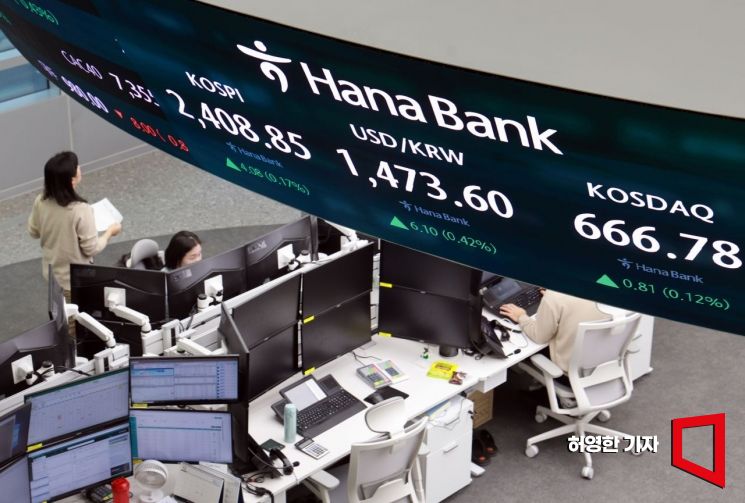 On the 30th, the last trading day of the year, the KOSPI and KOSDAQ started with a slight decline but then turned to a rebound. The won-dollar exchange rate rose again to the mid-1470 won range. Employees are working in the dealing room at the Hana Bank headquarters in Euljiro, Seoul. Photo by Heo Young-han
On the 30th, in the Seoul foreign exchange market, the closing price of the won-dollar exchange rate at 2 a.m. on the 31st was 1,472.3 won. This is an increase of 4.8 won compared to the weekly trading closing price (3:30 p.m.) of 1,467.5 won. It is interpreted that the foreign exchange authorities' fine-tuning and the month-end negotiation inflow from export companies limited the rise in the exchange rate.
The exchange rate continued its upward trend after surpassing 1,400 won following the election victory of U.S. President-elect Trump last month. The won-dollar exchange rate recorded 1,403.50 won based on the weekly trading closing price on the 12th of last month, then seemed to stabilize by returning to the 1,390 won range, but returned to the 1,400 won range again on the 2nd (1,401.30 won).
Subsequently, the declaration of emergency martial law on the 3rd increased political uncertainty, fueling the rise in the exchange rate. During night trading on the 3rd, the won-dollar exchange rate soared to 1,442 won. After the emergency martial law was lifted within six hours, the exchange rate moved in the 1,410?1,420 won range, but with the failure of the first impeachment vote against President Yoon, it recorded the 1,430 won range again on the 9th. On the 19th, when the U.S. Federal Reserve (Fed) hinted at caution regarding interest rate cuts at the Federal Open Market Committee (FOMC), it rose to the 1,450 won range. On the 27th, when the impeachment of Acting Prime Minister Han Duck-soo was passed, it rose to the 1,480 won range. Although the foreign exchange authorities are striving to stabilize the market by supplying unlimited liquidity and expanding the scale of foreign exchange swaps with the National Pension Service, the exchange rate still maintains a high point in the 1,470 won range.
The value of the won has depreciated more than major currencies this month. According to the Bank of Korea, based on the weekly trading closing prices from the 29th of last month to the 27th, the depreciation rate of the won against the dollar was 4.96%, higher than major currencies such as the Australian dollar (4.32%), Japanese yen (4.03%), euro (1.24%), Indian rupee (0.92%), and Taiwanese yuan (0.70%).
There is still a possibility of further exchange rate increases next year due to concerns over the prolonged impeachment political situation. Park Sang-hyun, a researcher at iM Securities, said, "Concerns over prolonged domestic political instability are spreading worries about further exchange rate increases," adding, "Amid various domestic and international adverse factors expected to increase upward pressure on the won-dollar exchange rate, government market intervention is also expected to strengthen, leading to continued volatility."
Wi Jae-hyun, a researcher at NH Futures, said, "The possibility of a prolonged impeachment phase, rather than a temporary government vacuum, is a factor that will consistently exert upward pressure on the exchange rate," but added, "However, intervention volumes by authorities and investors' caution against rapid exchange rate rises will support the upper limit."
Government-funded research institutes have also warned that the exchange rate could rise to 1,500 won. According to data submitted by the Korea Development Institute (KDI) to Lee In-young of the Democratic Party, KDI stated, "A 3?4% exchange rate fluctuation is common, so it is difficult to rule out the possibility of the won-dollar exchange rate reaching 1,500 won," and suggested, "Since Korea adopts a floating exchange rate system, it is necessary to refrain from foreign exchange market intervention by authorities."
There is an analysis that if the won's value continues to fall as it is now, it will be impossible to prevent a contraction in corporate activities. The Korea Institute for Industrial Economics & Trade (KIEP) estimated, "If the real effective exchange rate falls by 10% (exchange rate rises), the operating profit margin of large corporate groups will decrease by 0.29 percentage points." This means that the cost increase due to rising import prices may have a greater impact than the sales increase effect from the exchange rate rise.
© The Asia Business Daily(www.asiae.co.kr). All rights reserved.
![Clutching a Stolen Dior Bag, Saying "I Hate Being Poor but Real"... The Grotesque Con of a "Human Knockoff" [Slate]](https://cwcontent.asiae.co.kr/asiaresize/183/2026021902243444107_1771435474.jpg)
















