Four Consecutive Quarters of Reduced Hiring Plans
Approximately 6% Decrease Expected by Q1 Next Year
From the fourth quarter of this year to the first quarter of next year, the number of planned hires by domestic companies is expected to decrease by about 30,000 compared to the same period last year. Due to the poor economic conditions, the number of planned hires has been on a negative trend since the second quarter of last year.
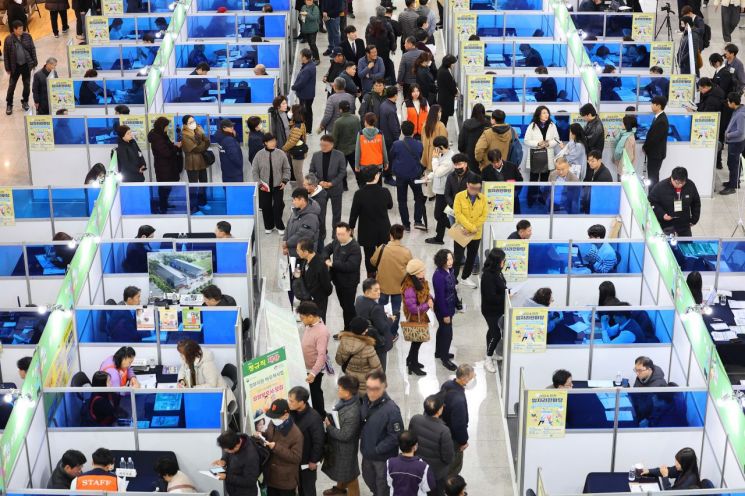 Job seekers are receiving recruitment consultations at the '2024 Incheon Job Fair' held last month in the central hall of Incheon City Hall, Namdong-gu, Incheon. This is unrelated to the article content. Photo by Yonhap News.
According to the '2024 Second Half Occupational Business Labor Force Survey Results' released by the Ministry of Employment and Labor on the 30th, the number of planned hires by domestic companies with one or more employees for the fourth quarter and the first quarter of next year (October 2024 to March 2025) is 527,000, a decrease of 33,000 (5.9%) compared to the same period last year.
The number of planned hires has shown a negative trend for four consecutive quarters since the second to third quarters of last year (-49,000). After recording a decrease of over 60,000 in the fourth quarter of last year to the first quarter of this year (-62,000), the rate of decline has slowed, but due to the poor economic conditions, it is difficult to find a turning point.
Kim Jae-hoon, head of the Labor Market Survey Division at the Ministry of Employment and Labor, explained, "Currently, the economy is not good, so the number of planned hires continues to decline," adding, "This is similar to the slowdown in the increase of the number of workers seen in the Business Labor Force Survey."
By industry, the number of planned hires was highest in manufacturing (115,000), health and social welfare services (65,000), wholesale and retail trade (62,000), accommodation and food services (53,000), and transportation and warehousing (44,000). However, compared to the same period last year, manufacturing decreased by 24,000, information and communication by 5,000, construction by 3,000, and wholesale and retail trade by 3,000.
By company size, the number of planned hires in companies with fewer than 300 employees was 478,000, a decrease of 32,000 compared to the same period last year, while companies with 300 or more employees (50,000) saw an increase of 1,000. When distinguishing between domestic and foreign workers, the number of planned hires for domestic workers (506,000) decreased by 5.0%, while foreign workers (21,000) sharply declined by 23.8%.
Regardless of hiring decisions or plans, the number of shortage personnel, meaning the number of workers necessary for normal business operations, production facility operation, and responding to customer orders, was 522,000 as of last October, a decrease of 23,000 (4.2%). The labor shortage rate also slightly fell by 0.1 percentage points to 2.8%.
Kim said, "If the number of shortage personnel decreases, it is highly likely that the economy is not doing well, so the number of planned hires is also likely to decrease," adding, "They are interconnected." Regarding the sharp decline in foreign worker hiring plans, he explained, "Because the denominator for foreigners is small, the decrease rate compared to domestic workers appears significant," but also noted, "Until last year, the number of foreign job openings and hires increased and the number of unfilled positions decreased, so there is not a great need for many workers."
The number of hires in the third quarter was 1,146,000, an increase of 57,000 (5.2%) compared to the same period last year. By industry, hiring increased in wholesale and retail trade (16,000), health and social welfare services (11,000), and education services (8,000). On the other hand, manufacturing (-3,000) and information and communication (-1,000) saw decreases. Construction hiring increased by 1,000 but job openings decreased by 1,000 simultaneously.
The number of unfilled positions, meaning the number of workers that companies actively sought to hire but could not, was 122,000 in the third quarter, a decrease of 18,000 (-13.1%). The unfilled rate fell by 1.8 percentage points to 9.6%. Industries with many unfilled positions included manufacturing (32,000), transportation and warehousing (20,000), and health and social welfare services (14,000).
© The Asia Business Daily(www.asiae.co.kr). All rights reserved.
![Clutching a Stolen Dior Bag, Saying "I Hate Being Poor but Real"... The Grotesque Con of a "Human Knockoff" [Slate]](https://cwcontent.asiae.co.kr/asiaresize/183/2026021902243444107_1771435474.jpg)















