Bank of Korea Foreign Exchange Operations Report
The Bank of Korea forecasted that the US dollar will strengthen noticeably in early next year. It is expected that the US Federal Reserve (Fed) will cut interest rates by only 0.25 to 0.50 percentage points next year.
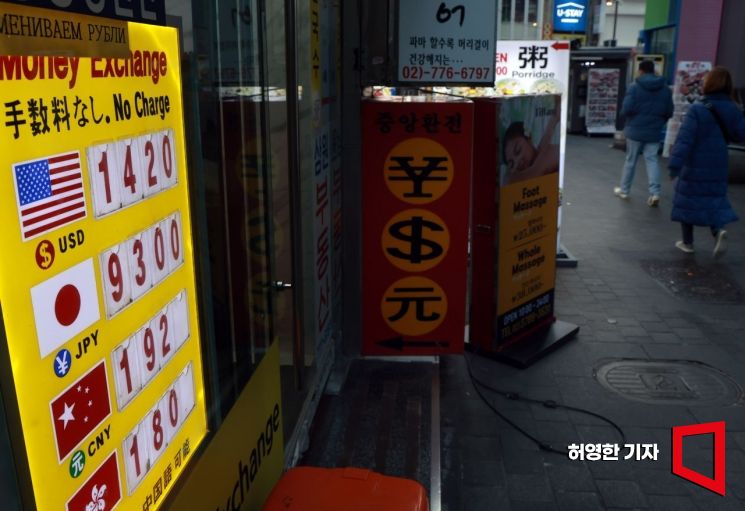 After the martial law situation, as exchange rates such as the won-dollar continue to rise, the won-dollar buying rate at a private exchange office in Myeongdong, Seoul, was displayed at 1,420 won on the 10th. Photo by Heo Young-han
According to the '2025 Global Economic Conditions and International Financial Market Outlook' report prepared by the Bank of Korea's foreign exchange management office on the 30th, the US dollar is expected to strengthen next year as the disinflation trend resulting from the Trump administration's policy implementation stagnates and concerns about inflation reigniting arise, raising the possibility of prolonged high interest rates by the Fed.
Additionally, the relatively robust fundamentals of the US economy compared to other countries, and the expected growth rate gap between countries due to economic sluggishness in major export countries such as the Eurozone and China caused by tariff impositions, are also diagnosed as factors contributing to the dollar's strength.
By period, the dollar's strength is expected to be prominent (overshooting) in early next year when expectations for the Trump administration's policies are high, but the strength is likely to ease somewhat due to limitations in policy implementation, constraints on policy effects, and the manifestation of interest rate cuts in other countries.
The report predicted that the US will cut interest rates only once or twice next year. Kim Ji-hyung, a manager of the Bank of Korea's operation strategy team who participated in writing the report, assessed that although the Fed is expected to lower policy rates next year, the rate cut will be limited to 25 to 50 basis points (1bp = 0.01 percentage points).
However, if the Trump administration's tariff policies become more concrete and act as additional inflationary factors, the possibility that the rate cut will be smaller or that rates will remain unchanged cannot be ruled out.
The foreign exchange management office forecasted that the Bank of Japan (BOJ) will raise its policy rate by an additional 50 to 70 basis points next year, reaching 0.75 to 1% by the end of next year. However, the BOJ is expected to proceed with further hikes while considering the establishment of a virtuous cycle between wages and prices and the trend of the yen-dollar exchange rate. Political uncertainties such as the House of Councillors election in July next year are also expected to influence the interest rate path.
© The Asia Business Daily(www.asiae.co.kr). All rights reserved.

















