Possibility of Chain Failures After Engine Bird Strike
Hydraulic System Also Fails Due to Flying Debris...Inoperable Condition
Potential Boeing 737 Intrinsic Defect...
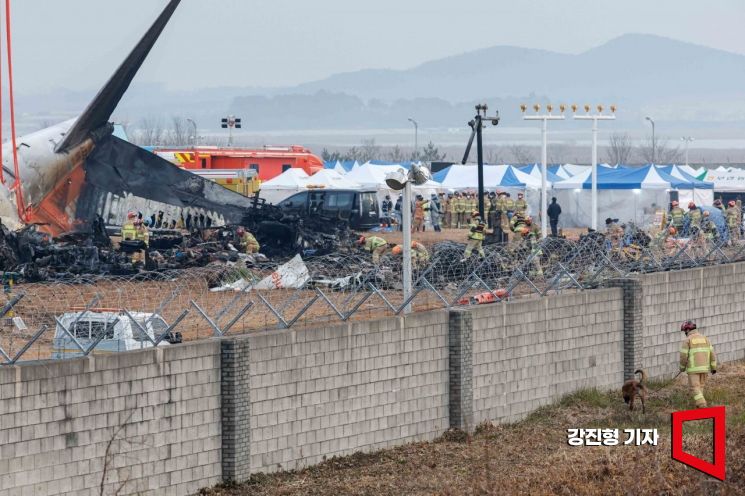 Firefighters are searching for fuel items at the site of the Jeju Air passenger plane collision and explosion accident that occurred at Muan International Airport, Jeonnam, 30 days ago. Photo by Kang Jin-hyung
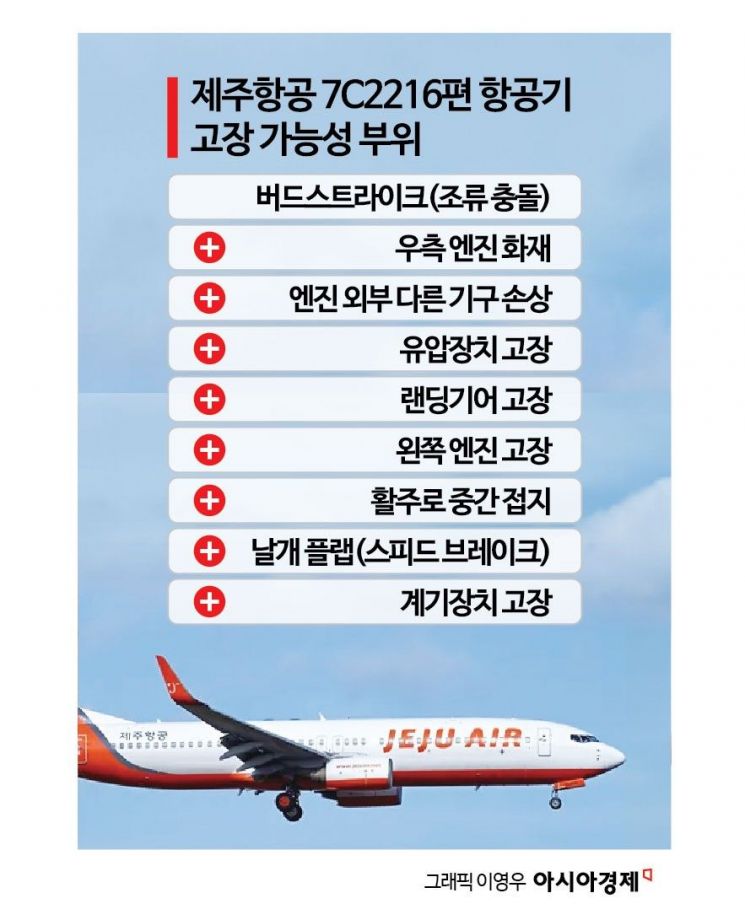
On the 29th, an analysis suggests that the Jeju Air flight 7C2216, which crashed at Jeonnam Muan International Airport, may have experienced multiple overlapping issues beyond just the failure to deploy the landing gear (the apparatus necessary for takeoff and landing, including the airplane wheels). After a 'bird strike'?where birds were sucked into the engine?there may have been a worst-case scenario of cascading failures including engine failure, hydraulic system malfunction, instrument errors, and wing flap breakdown. On the morning of the 30th, after another incident involving landing gear abnormalities on the same model of Jeju Air aircraft, the Ministry of Land, Infrastructure and Transport dispatched aviation safety inspectors to the company.
The Boeing 737-800 aircraft of Jeju Air that crashed the previous day attempted a belly landing because the landing gear could not be deployed. The fundamental cause is believed to be the bird strike. When the aircraft was approaching Muan Airport, birds were sucked into the right engine, causing visible sparks.
Multiple Failures from Engine to Wings
The engine is the source of all power for the airplane. As the engine runs, it generates hydraulic pressure and electrical power. Even if the engine temporarily shuts down, the internal battery can supply power for a short time, but if the engine completely fails, many systems cannot operate properly. This is why the accident is analyzed as more than just a landing gear failure.
The bird strike caused a fire that stopped the engine, and smoke entered the cabin, potentially causing various problems. Additionally, it is reported that the wing flaps, which rise at the rear of both wings to create air resistance and reduce speed, were found not to have operated. With the engine off, the hydraulic system failed, rendering the landing gear?which is essential for safe landing and deceleration on the ground?nonfunctional. In a situation where the engine fire prevented reverse thrust, all deceleration devices failed, creating a compounded disaster.
All three landing gears can be operated manually. However, experts believe that even this was likely impossible in this case. The pilot may have been too pressed for time to operate manually, or manual operation may have failed. Professor Choi Ki-young of Inha University’s Department of Aerospace Engineering explained, "Manual operation requires some margin. In the past, an aircraft flying from New York to Poland also failed to deploy the landing gear and prepared for a belly landing over a long period. At that time, there were no engine problems, sufficient time was available, and measures were taken to prevent fire spreading on the runway, preventing an accident." He added, "Even with manual operation, the landing gear may not have deployed due to jamming. Especially in this case, after the engine caught fire from the bird strike, parts broke, and something may have been thrown toward the landing gear, making manual operation impossible."
The belly landing site also contributed to the disaster. Although the landing itself was approached at a stable angle, the touchdown point was not at the runway end but somewhere in the middle. The aircraft model involved is known to be able to land on a runway about 1800 meters long. Muan Airport’s runway is 2800 meters long, shorter than Incheon or Gimpo Airports but longer than Cheongju or Daegu Airports. The Ministry of Land, Infrastructure and Transport explained that the runway length cannot be considered a cause of the accident based on this background. However, experts believe that due to the touchdown point, braking distance was insufficient regardless of runway length. An industry insider said, "If even one of the landing gear, wing flaps, or engine reverse thrust had worked, the scale of the tragedy might have been different," describing it as "a problem caused by multiple worst-case scenarios overlapping."
Persistent Issues with Boeing 737
Concerns have also been raised about defects inherent to the aircraft model itself. The Boeing 737 series has consistently experienced accidents and problems. The B737-800 involved in this accident is mainly used by domestic low-cost carriers (LCCs) in South Korea. According to the Ministry of Land, Infrastructure and Transport’s Aircraft Technology Information System, a total of 101 B737-800s have been introduced by domestic airlines. Korean Air operates 2 of these, while the remaining 99 are operated by domestic LCCs.
At 6:37 a.m. on the same day, Jeju Air flight 7C101, which departed from Gimpo Airport, returned to the airport after detecting a landing gear issue shortly after takeoff, circling over Pyeongtaek, Gyeonggi Province. This aircraft was the same B737-800 model as the one involved in the previous day’s accident. In March, an Alaska Airlines B737-800 heading to Phoenix returned to Portland Airport after smoke was detected in the cabin. In January, a related derivative model, the B737 Max 9, made an emergency landing after windows and parts of the fuselage detached during flight after takeoff from Portland International Airport in Oregon. In March 2019, an Ethiopian Airlines 737 Max 8 crashed six minutes after takeoff due to software defects, killing all 157 people on board.
There are also concerns about the absence of a Ram Air Turbine (RAT) on the B737, which supplies hydraulic or electrical power in emergencies. The RAT deploys a small propeller that spins with the aircraft’s speed to drive a generator or hydraulic pump. It is installed on major Airbus models such as the A320, A330, A350, and A380, as well as Boeing models like the B787 and B767. However, the B737 lacks a RAT because its engines provide power through aerodynamic forces when shut down.
© The Asia Business Daily(www.asiae.co.kr). All rights reserved.
![Clutching a Stolen Dior Bag, Saying "I Hate Being Poor but Real"... The Grotesque Con of a "Human Knockoff" [Slate]](https://cwcontent.asiae.co.kr/asiaresize/183/2026021902243444107_1771435474.jpg)
















