Plenary Meeting Concluded but No Significant Message
South Side Mention Omitted... Focus on Internal Unity Over External Affairs
Unlike last year when North Korea declared the 'theory of two hostile states,' it is spending the end of the year with a relatively cautious stance. Although it announced the toughest response strategy against the United States, it only maintained its existing hostile policy. It is expected to maintain an ambiguity strategy until the launch of the 'Trump 2nd term.'
According to the Ministry of Unification on the 30th, North Korea held a plenary meeting of the Workers' Party Central Committee from the 23rd to the 27th. North Korea announced that under the attendance of Chairman Kim Jong-un, it declared the 'strongest hardline strategy against the U.S. to be vigorously implemented for national interest and security.' The specific details of this strategy were not mentioned.
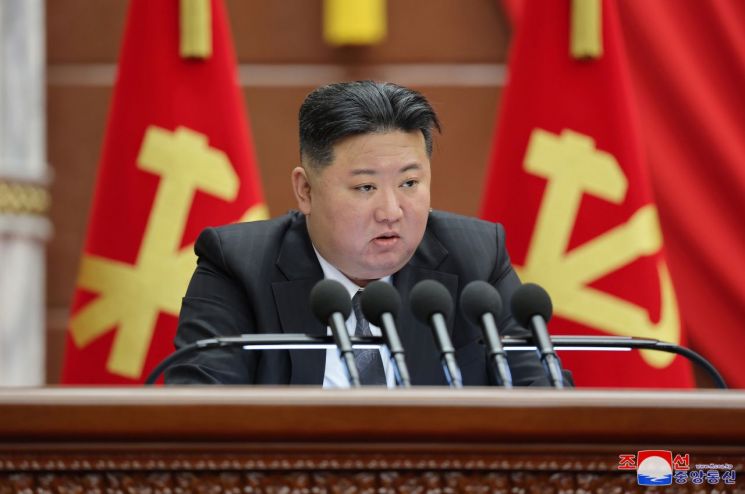 Kim Jong-un, Chairman of the State Affairs Commission of North Korea, presided over the 11th Plenary Meeting of the 8th Central Committee of the Workers' Party from the 23rd to the 27th. Yonhap News
Typically, the plenary meeting held at the end of the year evaluates the major policies of that year and presents the direction for the next year's struggle. The severance of ties with the South, which continued throughout this year, began with Chairman Kim's declaration of the 'theory of two hostile states' at last year's year-end plenary meeting. A notable point is that this year's plenary meeting was completed over five days without any reports announcing its holding, and was only reported the day before.
North Korea maintained the 'Tongmibongnam' (engaging the U.S. while ignoring the South) policy. In particular, it claimed that "the United States is the most reactionary national entity that continues to uphold anti-communism as an unchanging national policy," and that "the U.S.-Japan-South Korea alliance has expanded into an aggressive nuclear military bloc, and the Republic of Korea has become a thorough anti-communist forward base for the U.S., clearly indicating the direction we must take and what we must do."
No significant message toward the South was issued, and cooperation with Russia, including the dispatch of North Korean troops, was not mentioned. Chairman Kim Jong-un emphasized North Korea's elevated status on the anti-Western front and presented goals centered on military power enhancement such as 'strengthening self-defensive war deterrence' and 'advancement of defense science and technology.' It is highly likely that the policy to strengthen nuclear forces was also discussed, but it was not publicly disclosed externally.
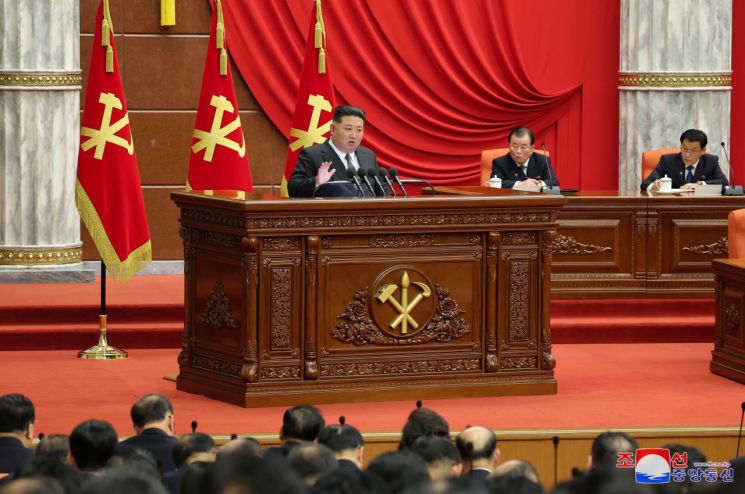 North Korean State Affairs Commission Chairman Kim Jong-un presided over the 11th plenary meeting of the 8th Central Committee of the Workers' Party from the 23rd to the 27th. Yonhap News
The government evaluated that North Korea focused on 'regime consolidation.' A Ministry of Unification official said, "They minimized external messages and did not mention specific tasks regarding the advancement of nuclear forces," adding, "They are observing the current situation for now but intend to specify and visualize their stance depending on future developments."
North Korea's ambiguous attitude is expected to continue until January next year when U.S. President-elect Donald Trump takes office and announces a new North Korea policy. The possibility of resuming North Korea-U.S. talks, which Trump has mentioned, and the early end of the Ukraine war are agendas expected to have a direct impact on North Korea.
There were also personnel changes among key officials. The Premier succeeding Chairman Kim was replaced from Kim Deok-hoon to Park Tae-sung, and military veteran Kim Jeong-gwan was appointed as Vice Premier. Park Tae-sung is one of Kim's closest aides who has consistently appeared alongside him, including at the North Korea-Russia summit in September last year.
Additionally, Foreign Minister Choe Son-hui and Chief of the General Staff Ri Yong-gil were newly elected as members of the Party Central Committee Political Bureau. It is presumed that the status of officials who have played roles in diplomacy and military aspects due to the close North Korea-Russia ties has been strengthened.
© The Asia Business Daily(www.asiae.co.kr). All rights reserved.


















