Runway Length Criticism: "It Was Sufficient... Not the Cause of the Accident"
Professor Jung Yoon-sik of the Department of Aviation Operations at Catholic Kwandong University explained that the large scale of the Jeju Air passenger plane disaster was due to "the aircraft colliding with ground objects at a very high speed similar to when it is flying in the air, causing an explosion," adding, "Such a large accident is very rare." The accident resulted in the deaths of 179 passengers and crew members.
Professor Jung, a former Asiana Airlines captain, expressed cautious opinions on the 30th on SBS Radio's 'Kim Tae-hyun's Political Show' and MBC Radio's 'Kim Jong-bae's Focus,' regarding the landing gear malfunction caused by a bird strike being pointed out as the cause of the accident. He said, "It is difficult to easily conclude the cause of an aviation accident, so we need to wait for the investigation results."
Professor Jung said, "People think the accident happened because the engine stopped in the air, but in reality, it often concludes as a lack of pilot control," adding, "Even if one of the two engines fails, the aircraft is designed to be operable." He continued, "Although the starting point of this accident is said to be a bird strike, other causes such as belly landing may be found, so it is still difficult to accurately determine the cause of the accident."
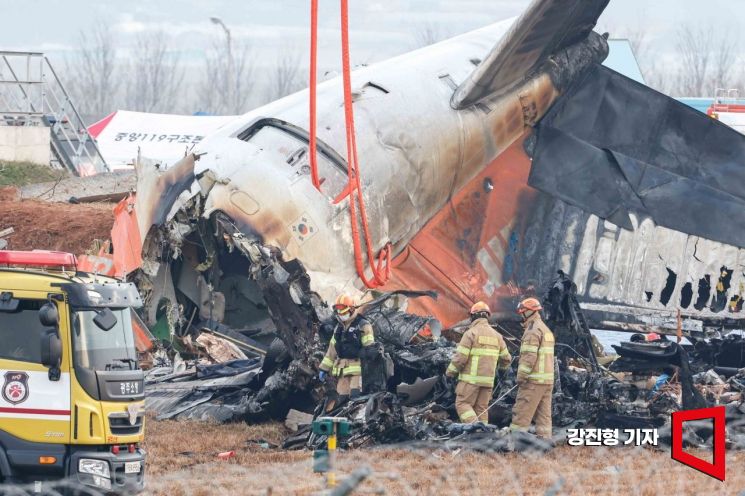 Firefighters are searching for fuel items at the site of the Jeju Air passenger plane collision and explosion accident that occurred at Muan International Airport, Jeonnam, on the 30th. Photo by Kang Jin-hyung
Regarding a passenger who boarded the accident aircraft a few days ago and reported to the media that "the engine stopped several times, causing anxiety," he said, "While the possibility of engine defects cannot be ruled out, the passenger may have misunderstood," adding, "If the engine had stopped on the ground or in the air after starting, it would be a mandatory report under the law, so such a report would not have been omitted."
On the speculation that the collision accident may have occurred due to the short runway length at Muan Airport, he responded, "No," adding, "The Boeing 737 model can operate sufficiently with just a 1,500m runway." Professor Jung said, "However, the fact that the aircraft touched down at about one-third of the runway could be problematic," adding, "Even if the runway is 10 km, if the pilot touches down at 9,800m, only 200m remains. Ultimately, this is an issue of aircraft operation, not a problem with Muan Airport's runway."
The Ministry of Land, Infrastructure and Transport also stated in a briefing the previous day, "The runway length at Muan Airport is 2,800m, and similar-sized aircraft have continuously operated there before," adding, "It is difficult to see the accident as caused by the runway length."
Regarding the aging of the Boeing 737-800 model being pointed out as a cause of the accident, he drew a line, saying, "Fifteen years is not that old for an aircraft," adding, "It is hard to say the accident happened because it was old." Professor Jung said, "Aircraft aging is always a recurring issue," adding, "For aged aircraft (aircraft over 20 years old), aviation authorities manage them with multiple layers of oversight."
© The Asia Business Daily(www.asiae.co.kr). All rights reserved.

















