Passenger Plane with 181 Onboard Faces Tragedy at Muan Airport at 9:03 AM
Collision with Bird Causes Aircraft Malfunction
Attempted Landing Without Landing Gear Leads to Crash Due to Inability to Reduce Speed
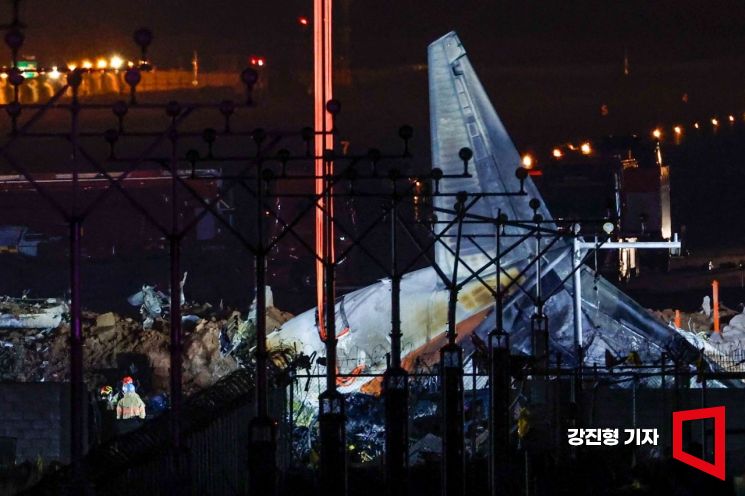 On the 29th, a Jeju Air passenger plane carrying 181 passengers collided with the outer wall of the runway while landing at Muan International Airport, causing a fire that resulted in a major disaster with most passengers dead. Firefighters are searching for missing persons among the wreckage of the accident aircraft on the runway at Muan International Airport, Jeonnam. Photo by Kang Jin-hyung
Muan Airport control tower granted landing permission to Jeju Air flight 7C2216 from Bangkok, Thailand, on runway 01.
8:57 AM
Muan Airport control tower issued a 'bird strike caution advisory' to the aircraft.
The aircraft attempted its first landing but failed.
8:59 AM
The pilot of Jeju Air flight 7C2216 declared a Mayday (distress call) due to a bird strike to the control tower.
A go-around maneuver was executed for landing.
9:00 AM
The pilot attempted to land on runway 19.
9:03 AM
The aircraft, which landed without landing gear and was unable to reduce speed, veered off the runway end.
Immediately after, it collided with a retaining wall, and the aircraft carrying 181 passengers was completely destroyed except for the tail section.
This is the timeline of the 'Muan passenger plane collision accident' revealed by the Ministry of Land, Infrastructure and Transport, the government agency responsible for aviation safety. The tragedy involving 181 passengers unfolded within 9 minutes from 'landing permission → bird warning → emergency landing → collision.'
According to Joo Jong-wan, Director of Aviation Policy, and Yoo Kyung-soo, Director of Aviation Safety Policy, who held a briefing at the Ministry’s Sejong office that day, the Muan Airport control tower granted landing permission to Jeju Air flight 7C2216 at 8:54 AM.
The aircraft received a 'bird activity (collision) warning' from the control tower around 8:57 AM while approaching the runway for its first landing attempt. This warning is typically issued when a large flock of birds or large birds are detected near the aircraft.
Subsequently, the pilot detected an abnormality in the aircraft and declared a 'Mayday' about two minutes later at 8:59 AM.
At 9:00 AM, the aircraft attempted to land via runway 19, which is the opposite direction of the originally intended runway 01. Then, at 9:03 AM, the aircraft tried to land without the landing gear deployed, causing friction between the fuselage and the runway, and was unable to reduce speed, resulting in the accident.
Director Joo explained, "The control tower granted landing permission in the opposite direction of the runway, and the pilot accepted this and during the landing process, the aircraft passed the runway and collided with the outer wall."
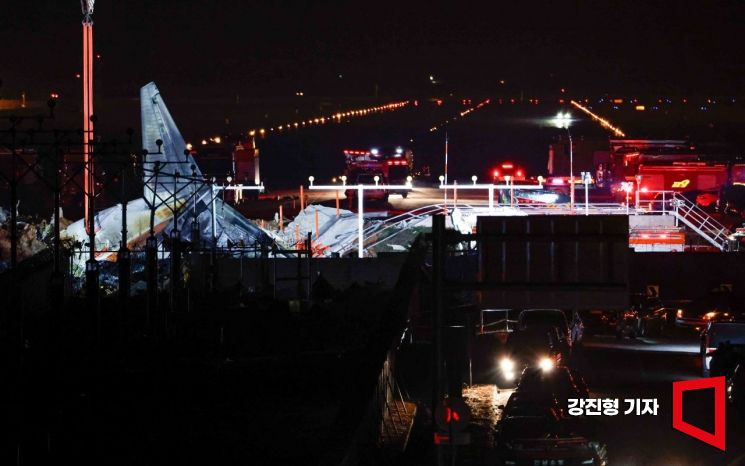 On the 29th, a Jeju Air passenger plane carrying 181 passengers collided with the outer wall of the runway while landing at Muan International Airport, causing a fire that resulted in a major disaster with most passengers dead. Firefighters are searching for missing persons among the wreckage of the accident aircraft on the runway at Muan International Airport, Jeonnam. Photo by Kang Jin-hyung
Regarding the analysis that the aircraft’s engine was damaged due to a bird strike, Director Joo stated, "Typically, engine failure is not linked to landing gear malfunction," adding, "Even if the landing gear malfunctions, it can be automatically deployed or manually operated during landing."
The Ministry of Land, Infrastructure and Transport announced that among the two black boxes of the aircraft, the voice recorder has been fully recovered, but the flight data recorder has not been fully recovered and is still being searched as of 8:30 PM.
Gwak Young-pil, a member of the Central Accident Response Headquarters, said, "Both the flight data recorder and voice recorder must be 100% secured to be transferred to the Accident Investigation Committee for analysis, but some parts of the flight data recorder, which were separated due to impact, have not yet been found, so the search is ongoing."
The Ministry denied claims that the 'short runway' at Muan Airport was the cause of the accident. Although Muan Airport’s runway is 2,800 meters long, about 300 meters were unavailable due to ongoing runway extension work scheduled to be completed next year. This means the usable length was about 2,500 meters.
A Ministry official said, "The accident aircraft model, B737-800, can safely land on runways of 1,500 to 1,600 meters. Since other aircraft have operated without issues so far, it is unreasonable to consider the runway length as the cause of the accident."
The Fire Agency reported that there were 177 fatalities and 2 missing persons due to this accident. The only survivors were two male and female crew members who were seated in the tail section of the aircraft.
© The Asia Business Daily(www.asiae.co.kr). All rights reserved.
![Clutching a Stolen Dior Bag, Saying "I Hate Being Poor but Real"... The Grotesque Con of a "Human Knockoff" [Slate]](https://cwcontent.asiae.co.kr/asiaresize/183/2026021902243444107_1771435474.jpg)

















