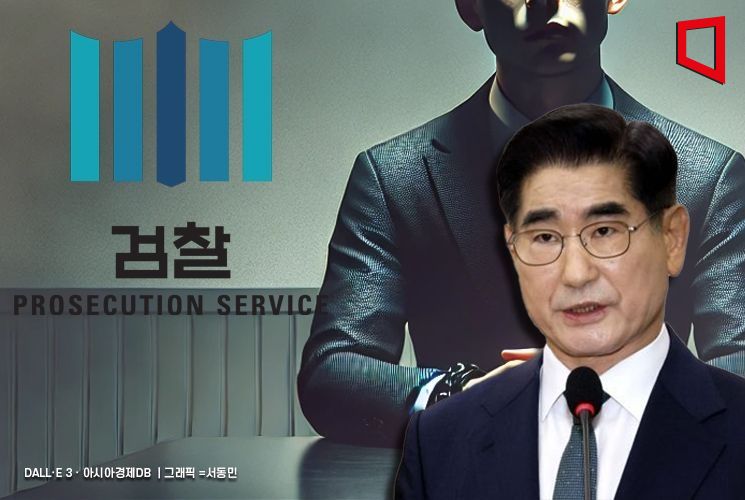
Former Minister of National Defense Kim Yong-hyun has been indicted on charges of engaging in important duties related to the internal rebellion in connection with the December 3 emergency martial law incident. Kim is the first person to be prosecuted in relation to this incident. The Special Investigation Headquarters for Emergency Martial Law (headed by Seoul High Prosecutors' Office Chief Park Se-hyun) has focused on reconstructing the orders and actions exchanged after President Yoon Seok-yeol declared martial law on the 3rd during the investigation of Kim.
According to the results identified so far through the investigation of former Minister Kim, the situation during the "Night of Martial Law" was even more severe. Over 4,700 military and police personnel were deployed to seize control of the National Assembly and the Central Election Commission, and the orders given by President Yoon and former Minister Kim to the military and police leadership contained many shocking elements unbefitting leaders of a liberal democratic country.
Yoon: "Arrest all the members of the National Assembly"... Tense National Assembly
According to the prosecution, shortly after President Yoon Seok-yeol declared martial law on the night of the 3rd, Police Commissioner General Jo Ji-ho and Seoul Police Chief Kim Bong-sik deployed six police riot squads to the entrances of the National Assembly at around 10:47 p.m. to prohibit entry. Later, at around 11:06 p.m., temporary access was allowed for members of the National Assembly and those with passes.
President Yoon then called Army Chief of Staff Park An-soo, who was appointed as the martial law commander, instructing him to "inform Commissioner Jo about the proclamation order." Former Minister Kim requested through General Park that Commissioner Jo "reinforce police at the National Assembly and block entry according to the proclamation order." Accordingly, from 11:37 p.m., the police again prohibited entry to the National Assembly, mobilizing 28 riot squads, 168 police buses, and 56 command vehicles to seal off the building.
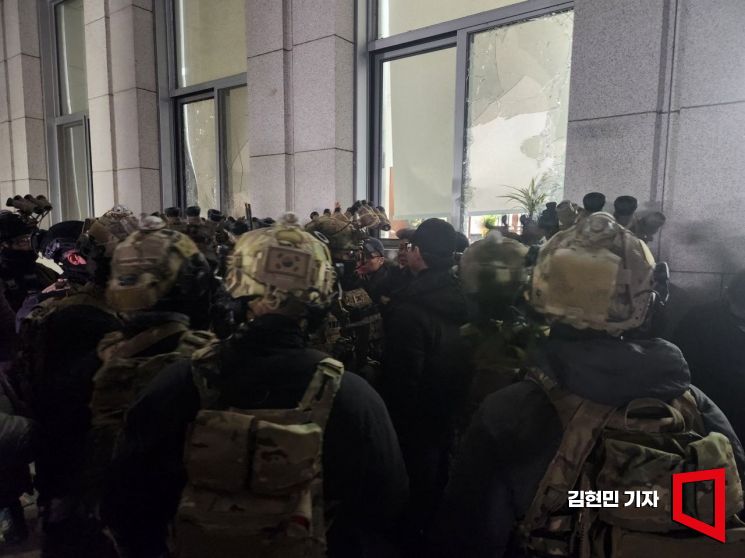 On the 4th, about 20 martial law troops attempted to break the glass windows and enter the main building of the National Assembly. Photo by Kim Hyun-min
From around the time the proclamation order was issued until the National Assembly voted to lift martial law, President Yoon repeatedly called Commissioner Jo, instructing him to "arrest all members of the National Assembly trying to enter. It’s a violation of the proclamation order."
Orders from President Yoon and former Minister Kim were also given to the military leadership. Former Minister Kim called Lee Jin-woo, Commander of the Capital Defense Command, instructing him to "block the National Assembly to prevent the passage of the motion to lift martial law." Commander Lee ordered his units to deploy to the National Assembly, with 136 armed personnel from the 1st Security Group and 76 from the Military Police Corps entering the premises.
President Yoon called Commander Lee to check the situation and ordered, "Go to the main assembly hall and carry out four people, one by one," and "Break down the door and drag them out. Even if you have to shoot, break down the door and drag them out." After the motion to lift martial law was passed at 1:03 a.m. on the 4th, President Yoon called Commander Lee again, instructing, "Even if martial law is lifted, I can declare martial law a second or third time, so continue the operation."
The prosecution found that the deployment of the Army’s elite Special Forces was also carried out under orders from President Yoon and former Minister Kim. Former Minister Kim instructed Special Forces Commander Kwak Jong-geun in the presidential reception room to deploy troops, and Commander Kwak sent armed forces to the National Assembly to attempt a blockade. President Yoon later asked Commander Kwak, "Where is the helicopter now?" and ordered, "Break the door with an axe if necessary and drag everyone out." Commander Kwak relayed these orders to the commander of the 707 Special Mission Unit and the commander of the 1st Airborne Special Forces Brigade as presidential instructions.
Subsequently, about 15 troops from the 707 Special Mission Unit moved to the right side of the National Assembly building, broke two glass windows with pre-prepared hammers, and infiltrated inside, while 38 troops from the 1st Airborne unit forcibly opened the rear gate and entered the building.
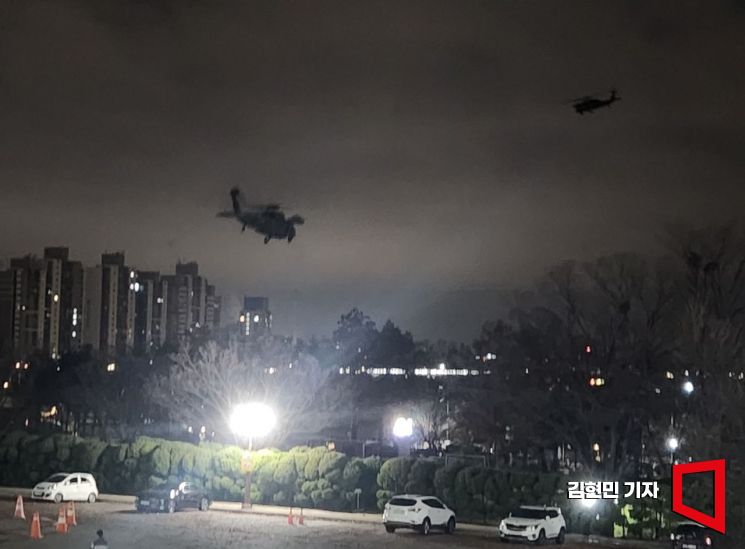 On the 4th, a military helicopter is flying over the main building of the National Assembly. Photo by Kim Hyun-min
Arrest squads of about 10 formed: "Arrest them all"
The formation of arrest squads targeting key figures was also uncovered during the prosecution’s investigation. Former Minister Kim instructed Counterintelligence Commander Yeo In-hyung to arrest and detain about 10 individuals, including National Assembly Speaker Woo Won-shik, Lee Jae-myung of the Democratic Party, and Han Dong-hoon, then leader of the People Power Party. President Yoon also instructed Hong Jang-won, First Deputy Director of the National Intelligence Service, to "arrest them all this time, clean them all up, and support the Counterintelligence unit first, as the National Intelligence Service will be given counter-espionage investigation authority."
Commander Yeo informed Commissioner Jo about the entry of martial law troops into three Central Election Commission (CEC) offices, requested support of 100 security investigation personnel, and tracking of about 10 arrest targets. He also requested 100 personnel from the Ministry of National Defense Investigation Headquarters. Furthermore, it was revealed that he instructed Counterintelligence Investigation Unit Chief Kim to "quickly arrest 14 people and transfer them to the Capital Defense Command B1 bunker detention facility."
As the National Assembly’s motion to lift martial law neared passage, former Minister Kim ordered Commander Yeo to "arrest Lee Jae-myung, Woo Won-shik, and Han Dong-hoon first." Commander Yeo relayed this to Chief Kim, who at around 12:38 a.m. on the 4th ordered all teams to "arrest Lee Jae-myung, Woo Won-shik, and Han Dong-hoon and transfer them to the detention facility." A message instructing the use of handcuffs and restraints was posted in the arrest squads’ group chat.
Attempt to seize CEC and arrest staff also uncovered
The prosecution also uncovered significant attempts to seize the Central Election Commission’s servers. Former Minister Kim ordered Commander Yeo, Intelligence Commander Moon Sang-ho, and former Intelligence Commander Noh Sang-won to seize the CEC and secure electronic data. Intelligence personnel took control of the CEC immediately after the martial law declaration, and Counterintelligence and Special Forces troops were dispatched to the CEC and other locations to attempt to remove servers.
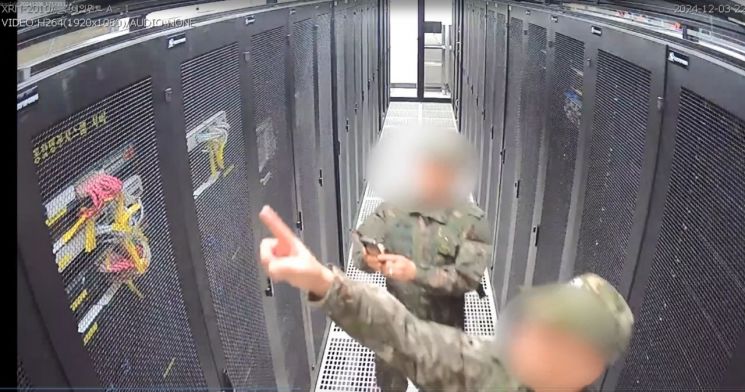 The National Assembly's Public Administration and Security Committee released CCTV footage on the 6th showing martial law troops deployed to the National Election Commission during the declaration of martial law on the 3rd photographing the Election Commission's system server. Yonhap News
The plan to seize the CEC was concretized from the so-called "Hamburger Meeting" in November. Commander Moon selected about 30 intelligence agents, and former Commander Noh assigned them the mission to arrest and detain CEC staff upon martial law declaration. On the 1st, Commander Moon and former Commander Noh instructed two intelligence colonels attending the meeting, "Go to the CEC’s electronic server room," revealing the president’s martial law declaration plan and mentioning that it was under orders from the president and former Minister Kim.
Commander Moon ordered the former Intelligence Planning Chief to dispatch personnel to the CEC and finalized about 30 staff members to be arrested and detained. Thirty-six intelligence agents were instructed to bind these individuals with restraints, cover their faces with masks, and transfer them to the Capital Defense Command bunker.
© The Asia Business Daily(www.asiae.co.kr). All rights reserved.



















