Won-Dollar Exchange Rate Closes at 1467.5 Won in Weekly Trading
Fluctuates About 20 Won in a Day... Rises Up to 1486.7 Won
As political instability prolongs, the won-dollar exchange rate surpassed the 1,480 won level during trading on the 27th, soaring to its highest level since the financial crisis. Although it somewhat stabilized to the 1,460 won range in the afternoon due to the foreign exchange authorities' vigilance, the political conflict, which is difficult to resolve easily, is escalating to an extreme standoff, making the exchange rate outlook critical around January to February next year.
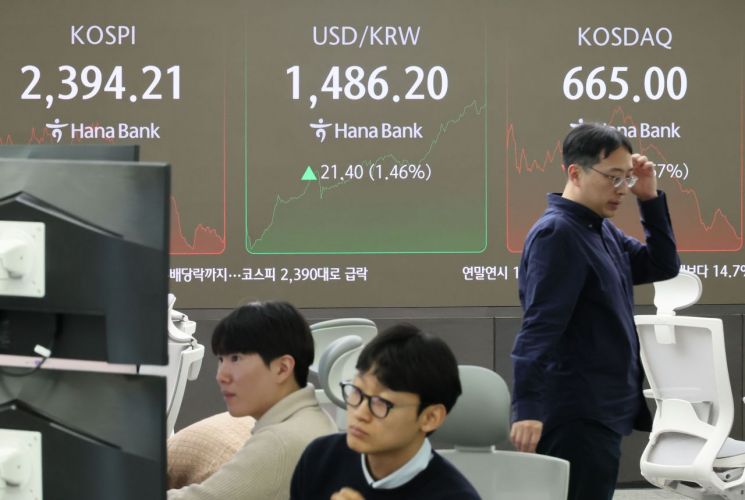
On that day, in the Seoul foreign exchange market, the won-dollar exchange rate opened at 1,467.5 won, up 2.7 won from the previous trading day's closing price, and surpassed 1,480 won around 10:55 a.m. It rose to 1,486.7 won around 11:30 a.m. This intraday high is the highest in 15 years and 9 months since March 16, 2009 (1,488.5 won).
In the afternoon, as concerns about market intervention by foreign exchange authorities spread, the rate somewhat calmed to the 1,460?1,470 won range and closed at 1,467.5 won in weekly trading. The won-dollar exchange rate experienced a nearly 20 won surge and fall within a single day during weekly trading.
The exchange rate surged in the afternoon as political uncertainty increased with the scheduled vote on the impeachment motion against Prime Minister and Acting President Han Deok-su in the National Assembly plenary session.
In response to the sharp rise in the exchange rate, financial and foreign exchange authorities heightened their vigilance. Deputy Prime Minister and Minister of Economy and Finance Choi Sang-mok held an emergency macroeconomic and financial issues meeting (F4) in the morning, attended by Bank of Korea Governor Lee Chang-yong, Financial Services Commission Chairman Kim Byung-hwan, and Financial Supervisory Service Senior Deputy Governor Lee Se-hoon, stating, "If excessive market concentration occurs, we will take resolute market stabilization measures." At an interim Cabinet meeting, they appealed to the National Assembly to reconsider the impeachment motion, saying, "The economic system and external credibility, which have just stabilized, must not be shaken again by the impeachment of Acting President and Prime Minister Han Deok-su."
The Financial Supervisory Service also held a financial situation review meeting in the morning, chaired by Senior Deputy Governor Lee Se-hoon, discussing countermeasures including the recent exchange rate surge and year-end fund market trends. The FSS judged that despite increased volatility in the foreign exchange market and timely corrective actions against some savings banks, the overall financial sector and corporate funding conditions remain stable. However, considering the possibility of market instability due to the exchange rate surge, they decided to actively support financial institutions and companies by communicating and addressing difficulties.
Political Risks Push Won-Dollar Exchange Rate Up by 50?60 Won... January?February Next Year Seen as Critical
The market expects the won-dollar exchange rate to face a critical point around January to February next year.
Researcher Jo Yong-gu of Shin Young Securities said, "The dollar index is rising in the global financial market, and additional depreciation pressure on the won is being reflected. Domestic political risks are reflected as a 30?35 won increase due to President Yoon's emergency decree and a 20?25 won increase due to the impeachment of Acting Prime Minister Han Deok-su, resulting in a 50?60 won rise caused by domestic factors."
He added, "Domestic factors are showing extreme standoff forms of political conflict that are difficult to resolve easily, making it hard to gauge, so the possibility of reaching around 1,500 won should be kept open. In the short term, January to February next year seems to be the critical period for the won-dollar exchange rate."
Researcher Jeon Kyu-yeon of Hana Securities said, "In the first half of next year, due to U.S. exceptionalism on exchange rates and intensified trade disputes under a second Trump administration, there is a high possibility of further increases in the won-dollar exchange rate. If the exchange rate does not stabilize, it is necessary to keep the 1,500 won range open next year."
He added, "Although foreign exchange authorities' market interventions and the National Pension Service's caution on currency hedging partially limit the upper bound of the exchange rate, market stabilization measures will not be able to change the upward trend of the exchange rate."
© The Asia Business Daily(www.asiae.co.kr). All rights reserved.
![Clutching a Stolen Dior Bag, Saying "I Hate Being Poor but Real"... The Grotesque Con of a "Human Knockoff" [Slate]](https://cwcontent.asiae.co.kr/asiaresize/183/2026021902243444107_1771435474.jpg)















