Exchange Rate Volatility Exceeds 20 Won on the Morning of the 27th
Major Commercial Banks Continue Daily Monitoring... Preparing for Additional Exchange Rate Surges
Concerns Over Financial Sector Soundness Ahead of Year-End Closing... Possible Decline in BIS and LCR Ratios
Estimated Foreign Currency Translation Losses Exceeding 100 Billion Won per Bank in Q4
Major Financial Holding Companies Anticipate Prolonged High Exchange Rates Next Year... Effectively in Emergency Management Mode
As political uncertainty expands with moves to push a vote on the impeachment of Acting President Han Deok-su, who is effectively exercising a veto over the National Assembly's decisions, the won-dollar exchange rate has surged to the highest level since the financial crisis, reaching the 1,486 won range. This increase in volatility is spreading anxiety throughout the financial sector. The atmosphere of unease is particularly growing ahead of the year-end closing. Although exchange rate volatility seemed to ease following the foreign exchange authorities' intervention after the declaration of martial law on the 3rd, volatility has increased again, with the daily exchange rate fluctuation exceeding 20 won on this day.
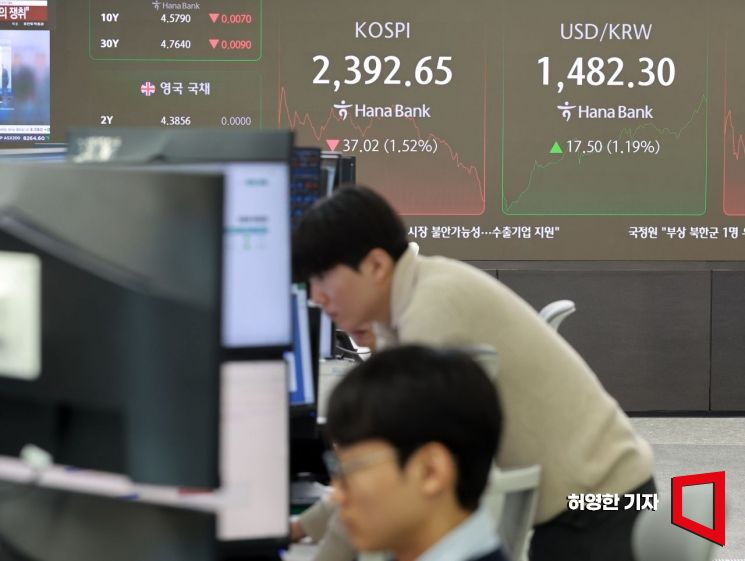 On the morning of the 27th, the won-dollar exchange rate surpassed 1,480 won. Exchange rates and other indices are displayed in the dealing room of Hana Bank in Euljiro, Seoul. Photo by Heo Young-han
According to the financial sector on the 27th, major commercial banks are conducting daily monitoring to prepare for any eventualities. Especially with only two trading days left this year, they are closely watching the potential impact on the year-end closing. On the morning of this day, the won-dollar exchange rate recorded a low of 1,465.50 won and a high of 1,486.70 won.
Shinhan Bank has issued guidelines for relevant departments to monitor the situation and prepare to respond to any circumstances that could affect customer assets. A Shinhan Bank official explained, "It is not a situation that requires changing the overall management plan," but added, "Related departments are conducting daily monitoring."
He continued, "Because rapid exchange rate fluctuations are likely to impact customer assets, we are instructing field staff to monitor customer assets on a weekly and daily basis to ensure there are no issues."
NongHyup Bank is strengthening monitoring of fund inflows and outflows while also preparing for situations where the exchange rate could surge further. A NongHyup Bank official said, "We have enhanced foreign currency liquidity management assuming a further rise in the exchange rate," adding, "We plan to respond immediately to increased financial market volatility through strengthened monitoring."
Management of corporate clients is also being intensified. A corporate finance official at a commercial bank said, "If the high exchange rate persists, export companies will inevitably face increased payment burdens, so we are closely watching the situation of corporate clients," explaining, "Although the government has urged support for export companies, those that have not hedged against exchange rate risks ahead of year-end payments will face increasing difficulties."
Financial Sector on Alert Ahead of Year-End Closing... Growing Concerns Over Soundness Indicators Due to Increase in Risk-Weighted Assets
Despite real-time response measures by frontline commercial banks, the impact of the exchange rate soaring to the highest level in 15 years since the financial crisis is likely to negatively affect soundness indicators. The exchange rate spike occurring just days before the year-end closing further heightens concerns.
For banks, the increase in the won-converted amount of risk-weighted assets (RWA) could lead to a decline in the total capital ratio. RWA is a revaluation of a bank's assets?such as loans, receivables, and overseas investments?based on their risk levels. A sharp rise in the exchange rate increases the won-converted amount of foreign currency RWA, worsening bank soundness indicators calculated based on won RWA, such as the total capital ratio and Common Equity Tier 1 (CET1) ratio.
According to the Bank of Korea, as of the third quarter, the scale of foreign currency RWA among domestic banks was 209.5 trillion won, accounting for 22.6% of total RWA. It is estimated that when the won depreciates by 10 won, the RWA of the five major financial holding companies increases by about 1.98 trillion won. Since this directly affects various indicators such as the Basel Committee on Banking Supervision (BIS) capital ratio, a soundness indicator, and the liquidity coverage ratio (LCR), a liquidity indicator, concerns inevitably grow. The BIS capital ratio is calculated by dividing capital by RWA, so when the exchange rate rises, the scale of foreign currency asset risk exposure increases, causing the ratio to decline. The foreign currency LCR ratio also falls as the burden of margin payments related to foreign exchange derivatives increases with a rising exchange rate.
In response, major domestic financial holding companies have already entered a de facto emergency management system, anticipating the possibility of a sustained high exchange rate next year. They are reportedly preparing response plans for next year, considering the inevitable negative impact of exchange rate increases on banks' capital ratios and profits and losses.
A Bank of Korea official said, "Attention should be paid to the possibility that some financial institutions may face difficulties in liquidity management if short-term funding demand coincides with a sharp rise in the exchange rate," adding, "It is also necessary to strengthen policy efforts, such as encouraging the extension of foreign exchange swap maturities, to prevent funding demand from concentrating in the short term during exchange rate surges."
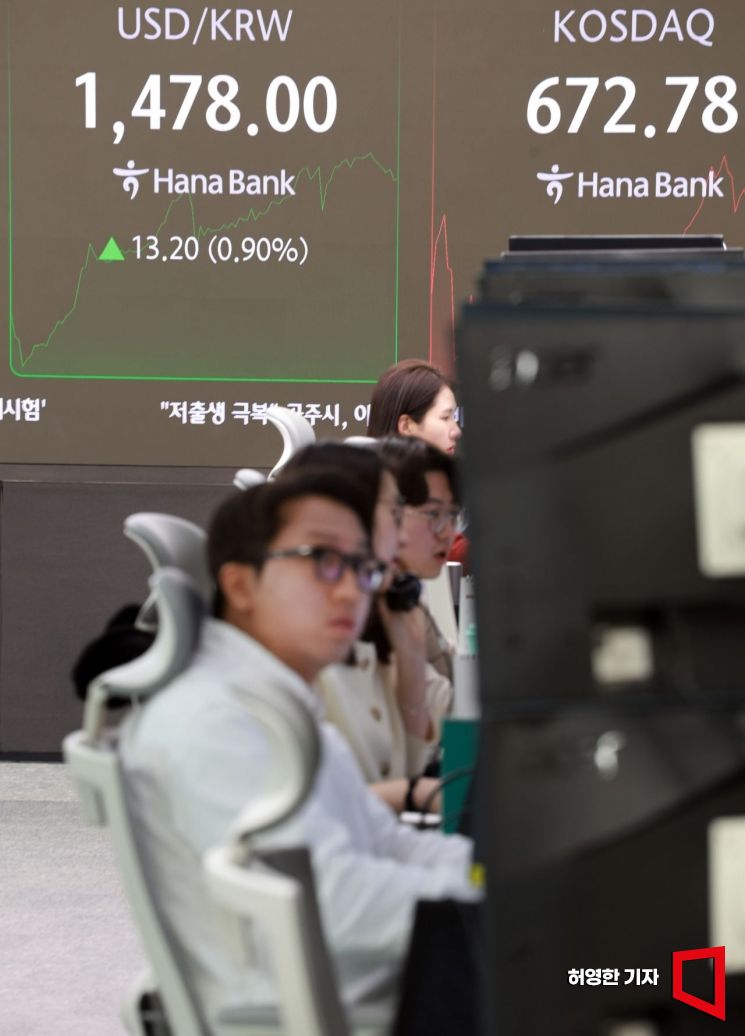 On the morning of the 27th, the won-dollar exchange rate surpassed 1,475 won and is approaching 1,480 won. Employees are working in the dealing room of Hana Bank in Euljiro, Seoul. Photo by Huh Young-han
© The Asia Business Daily(www.asiae.co.kr). All rights reserved.


















