Korea Land and Geospatial Informatix Corporation "Did Not Know It Was a Cultural Heritage"
Changwon City Plans Restoration with Experts
It has been revealed that public institution employees hammered iron nails into a large dolmen, the tomb of the ruler of the southern Korean Peninsula during the Bronze Age, under the pretext of surveying.
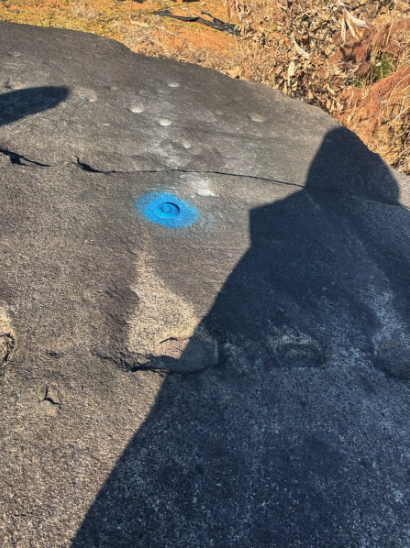 Employees from the Korea Land and Geospatial Informatix Corporation drove a 'cadastral datum point' in the form of a nail approximately 10 cm long into the No. 1 dolmen (stone tomb) located in Bongsan-ri, Dong-eup, Uichang-gu, Changwon City on October 21. The cadastral datum point is a reference mark used for surveying buildings and land. Provided by Changwon City
On the 26th, Yonhap News reported that employees of the Korea Land and Geospatial Informatix Corporation (LX) Gyeongnam Regional Headquarters hammered a 'cadastral control point' nail about 10 cm long and 1.5 cm in diameter into the capstone of the Bronze Age No. 1 dolmen located in Bongsan-ri, Dong-eup, Uichang-gu, downtown. After learning of this fact, institutions such as Changwon City and the National Changwon University Museum recently confirmed the damage and decided to begin restoration work.
Employees of the Land Information Corporation hammered a nail-shaped 'cadastral control point' about 10 cm long into the No. 1 dolmen (stone coffin) in Bongsan-ri, Dong-eup, Uichang-gu, Changwon City on October 21. A cadastral control point is a reference mark used for surveying buildings and land. It is installed by attaching a round plastic marker on top of an iron nail and hammering it into the ground, wall, or rock. Photos of the damaged capstone of the No. 1 dolmen released by Changwon City show the top part of the nail with a blue pigment marker hammered in, with blue pigment spreading around the mark.
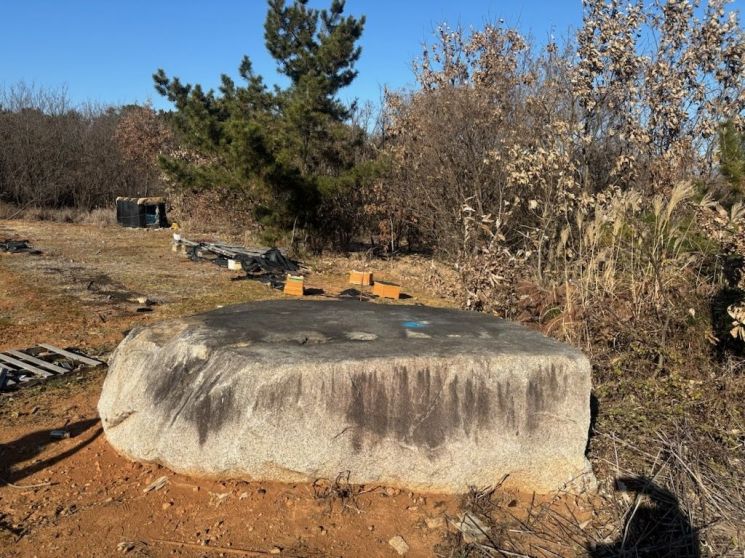 It has been revealed that public officials hammered iron nails into a large dolmen, the tomb of rulers in the southern Korean Peninsula during the Bronze Age, under the pretext of surveying. On the 26th, Yonhap News reported that employees of the Korea Land and Geospatial Informatix Corporation's Gyeongnam Regional Headquarters had hammered a 'cadastral triangulation point' approximately 10 cm long and 1.5 cm in diameter into the capstone of the Bronze Age No. 1 dolmen located in Bongsan-ri, Dong-eup, Uichang-gu, downtown. Provided by Changwon City
The corporation explained, "While conducting a cadastral re-survey for land measurement, the employees did not realize it was a dolmen and hammered the cadastral control point." They added, "The dolmen was an undesignated cultural heritage located in a privately owned field, and there was no nearby cultural heritage information sign, so they thought it was a large rock and proceeded with the work." The damaged No. 1 dolmen has a capstone measuring 350 cm in length, 285 cm in width, and 35?75 cm in thickness, and is part of a group of large and small dolmens scattered around Bongsan-ri. So far, eight dolmens in the Bongsan-ri area have been fully identified, but it is known that many more relics remain.
The dolmens here are characterized by burial grounds formed underneath and around the perimeter, revealing a unique tomb style of the ruling powers who controlled the ancient Changwon area around the 1st century BCE to the turn of the era. In particular, the No. 1 dolmen is large in scale and located on the highest hill among the local dolmens, marking it as the tomb of the highest-ranking regional leader.
However, since the excavation by the National Gimhae Museum in 2007?2008, it has not been designated as a local cultural asset and has been effectively neglected. Im Hak-jong, former director of the Gimhae Museum and head of the Bongsan-ri dolmen investigation, stated, "Considering that the Changwon Dahori site, a representative Iron Age cultural heritage of Korea, is nearby, the Bronze Age culture of the Bongsan-ri dolmens can be seen as succeeded by the later Dahori Iron Age culture." He emphasized, "Since it is a site of national historic value, it should first be officially designated as a local cultural asset and institutional preservation measures should be established." Changwon City plans to install a signboard indicating its status as a Bronze Age cultural heritage site along with the restoration work.
© The Asia Business Daily(www.asiae.co.kr). All rights reserved.
![Clutching a Stolen Dior Bag, Saying "I Hate Being Poor but Real"... The Grotesque Con of a "Human Knockoff" [Slate]](https://cwcontent.asiae.co.kr/asiaresize/183/2026021902243444107_1771435474.jpg)
















