Bank of Korea December All-Industry Business Sentiment Index
Corporate Sentiment Hits Worst in 4 Years 3 Months
SMEs and Domestic Market Firms Feel Even Worse
As political uncertainty expands, the business sentiment index has worsened to its lowest level in 4 years and 3 months. With consumer sentiment shrinking amid the impeachment turmoil, next month's business sentiment is expected to deteriorate further, especially in the non-manufacturing sector.
According to the "December Business Survey Results and Economic Sentiment Index (ESI)" released by the Bank of Korea on the 27th, the Composite Business Sentiment Index (CBSI) for all industries this month stood at 87.0, down 4.5 points from the previous month. This is the lowest level in 4 years and 3 months since September 2020 (83.0), when the COVID-19 pandemic was at its peak.
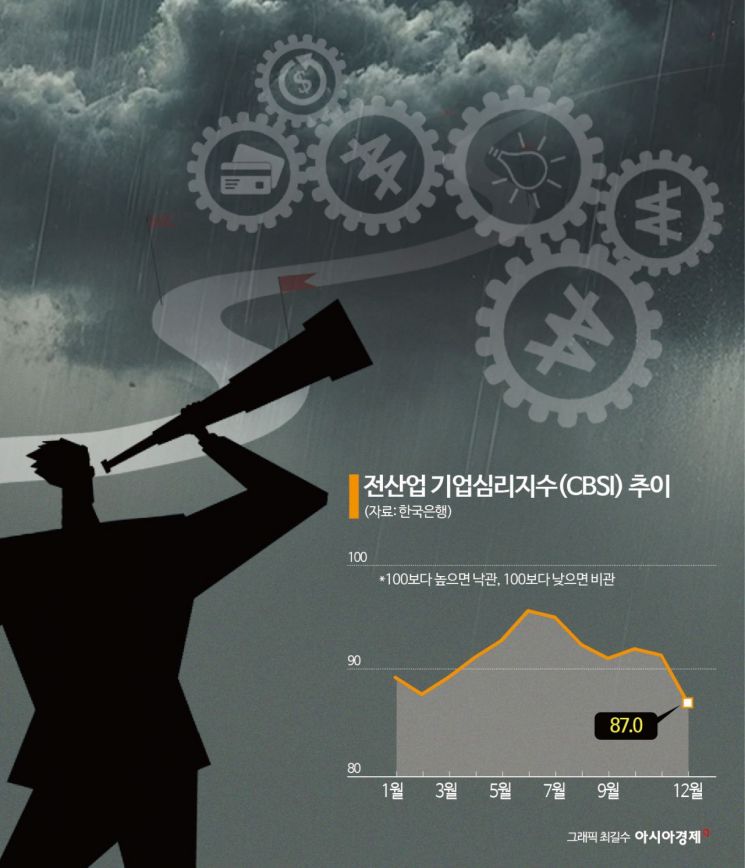
The CBSI is a business sentiment indicator calculated using key indices from the Business Survey Index (BSI). A value above 100 indicates that companies are more optimistic about economic conditions than in the past, while a value below 100 indicates pessimism.
The overall industry CBSI had declined for three consecutive months since July (95.1), then slightly improved in October after four months, but with the added uncertainty of the Trump administration's second term policies and the impeachment turmoil this month, it has fallen for two consecutive months since November.
This month, business sentiment worsened in both manufacturing and non-manufacturing sectors. The December manufacturing CBSI was 86.9, down 3.7 points from the previous month. Key factors included business conditions and financial situations. By sector, deterioration was centered on other manufacturing, electrical equipment, electronic, video and communication equipment, and metal processing. Mainly, exchange rate increases and slowdowns in consumption and exports contributed to the overall decline in business sentiment.
In particular, the business sentiment of small and medium-sized enterprises (SMEs) and domestic market-oriented companies worsened further. The December CBSI for large enterprises was 88.2, down 2.7 points from the previous month, and for export companies, it was 91.3, down 1.5 points. In contrast, the CBSI for SMEs was 85.3, down 5.2 points, and for domestic market companies, it was 85.1, down 5.1 points from the previous month.
The December non-manufacturing CBSI was 87.1, down 5.0 points from the previous month. Profitability and financial conditions were major factors in the decline. By sector, deterioration was centered on wholesale and retail trade, arts, sports and leisure-related services, and transportation and warehousing. The main causes were worsening consumer sentiment and a decrease in domestic and international cargo volumes, mainly in freight transport.
Hwang Hee-jin, head of the Price Statistics Team at the Bank of Korea's Economic Statistics Bureau, said, "Large enterprises and export companies had already reflected the business sentiment last month, but SMEs and domestic market companies were more affected by consumer sentiment, so their sentiment declined further."
Many companies expect next month's business conditions to worsen in both manufacturing and non-manufacturing sectors. The January CBSI forecast showed manufacturing down 3.7 points from the previous month to 85.2, and non-manufacturing down 10.0 points to 80.3. The manufacturing outlook worsened mainly in other manufacturing and electrical equipment, while the non-manufacturing outlook deteriorated mainly in wholesale and retail trade, business facility management, business support, and rental services.
Regarding the reason for the further deterioration in next month's outlook, Hwang explained, "The biggest impact came from psychological contraction due to political issues. Although some service sectors showed positive business sentiment this month due to year-end budget spending, this effect disappears at the beginning of the year, which also contributed to the worsening outlook."
On why the non-manufacturing outlook for next month worsened more than manufacturing, she explained, "There were many forecasts that the consumption sentiment contraction caused by the emergency martial law situation would negatively affect the domestic market. Especially by sector, business sentiment in non-manufacturing sectors directly linked to consumer sentiment, such as wholesale and retail trade and arts, sports and leisure-related services, worsened further."
The December Economic Sentiment Index (ESI), which reflects the Consumer Sentiment Index (CSI) in the BSI, recorded 83.1, down 9.6 points from the previous month. The seasonally adjusted cyclical component was 89.7, down 1.1 points from the previous month.
Meanwhile, this survey was conducted from the 11th to the 18th of last month targeting 3,524 corporate entities nationwide. The number of respondents was 3,292, with 1,848 in manufacturing and 1,444 in non-manufacturing.
© The Asia Business Daily(www.asiae.co.kr). All rights reserved.
![Clutching a Stolen Dior Bag, Saying "I Hate Being Poor but Real"... The Grotesque Con of a "Human Knockoff" [Slate]](https://cwcontent.asiae.co.kr/asiaresize/183/2026021902243444107_1771435474.jpg)















