7 VCs with Market Cap Over 100 Billion
"Unable to Preempt Rate Cut...
Current Stock Trend to Continue for Now"
The number of listed venture capital (VC) firms trading with a market capitalization of over 100 billion KRW has halved from 14 at the beginning of this year to just 7 recently. There have been ongoing concerns that their stock prices have been undervalued compared to other industries, but this year, the overall downturn in the domestic stock market combined with a harsh period for initial public offerings (IPOs) and venture investment markets has amplified the decline in their stock prices.
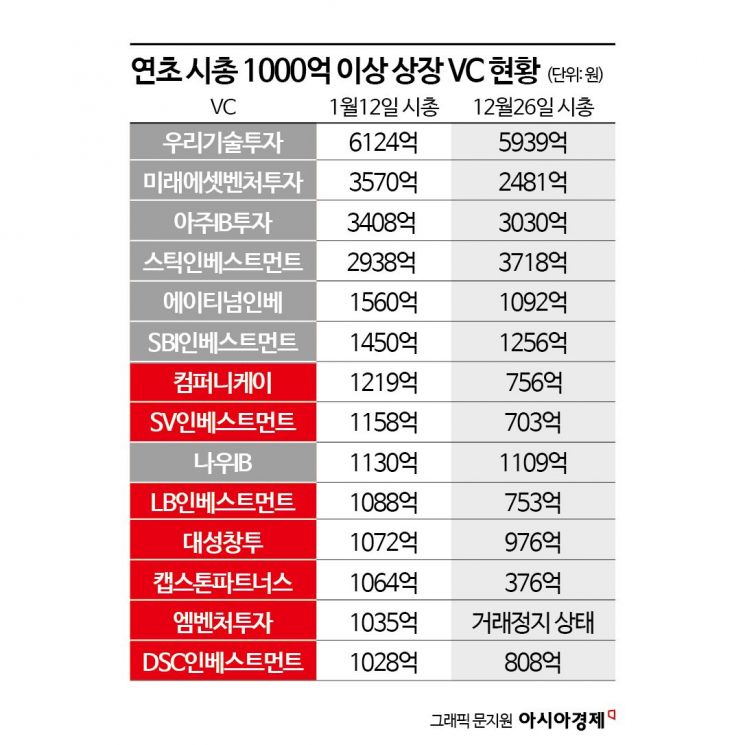
According to the Korea Exchange on the 27th, the VCs with a market capitalization exceeding 100 billion KRW traded in the domestic stock market as of the previous day were ▲Woori Technology Investment (market cap 593.9 billion KRW) ▲Stick Investment (371.8 billion KRW) ▲Aju IB Investment (303.0 billion KRW) ▲Mirae Asset Venture Investment (248.1 billion KRW) ▲SBI Investment (125.6 billion KRW) ▲Now IB (110.9 billion KRW) ▲Atinum Investment (109.2 billion KRW) and only 7 others.
Capstone Partners, which recorded a market capitalization of 106.4 billion KRW on January 12, shrank to 37.6 billion KRW as of the previous day, and ▲Daesung Venture Capital (97.6 billion KRW) ▲DSC Investment (80.8 billion KRW) ▲LB Investment (75.3 billion KRW) also fell below the 100 billion KRW market cap threshold. M Venture Investment has been suspended from trading since March due to a delisting cause triggered by a rejected audit opinion on its 2023 financial statements. Although the audit opinion has since been changed to 'unqualified,' the Korea Exchange announced last month that "the trading suspension will continue until a decision is made on whether the delisting cause applies."
This year, VC stocks in the domestic market have continued to carry the label of "risk capital" and have remained generally weak. Despite the Korea discount controversy, financial investment income tax and corporate governance debates, and uncertainties surrounding the U.S. presidential election, which caused the overall stock market to struggle within a narrow range, the VC sector, already experiencing sluggish business conditions, failed to see any meaningful rebound. Additionally, the prolonged high-interest-rate environment caused a venture investment freeze, a series of IPO disappointments, and the impact of the year-end martial law situation further dealt blows.
Accordingly, among the 20 listed VCs in the stock market (including the trading-suspended M Venture Investment), only Stick Investment saw its stock price rise compared to the opening price on January 2 this year (6,930 KRW → 8,920 KRW). Stocks that originally had market capitalizations below 100 billion KRW, such as ▲Lindeman Asia (4,865 KRW → 4,110 KRW), ▲Stonebridge Ventures (4,380 KRW → 3,985 KRW), ▲TS Investment (1,408 KRW → 907 KRW), ▲Plutos Investment (659 KRW → 290 KRW), and ▲Q Capital (358 KRW → 238 KRW), also saw their stock prices decline during the same period. HB Investment, which was listed on January 25, saw its stock price fall about 85% from its high on the listing day (11,400 KRW) to 1,644 KRW as of the previous day.
Yoon Yudong, a researcher at NH Investment & Securities, said, "the external environment remains unfavorable for the venture industry. As of October, the cumulative amount of new fund formations in the VC industry this year was 4.7 trillion KRW, a 2.8% increase compared to the same period last year, showing little change," adding, "While stock prices of other industries have already factored in interest rate cuts, VCs have relatively longer cycles for funding, investment, and exit, and it will take time for the IPO market to revitalize. Therefore, similar levels of performance and stock prices are expected next year as well."
Within the industry, there are also forecasts that an immediate stock price rebound will be difficult, accompanied by assessments that efforts such as dividend expansion need to be supported. A representative of a listed VC said, "While stock prices can be seen as the market's evaluation, it is also true that most VCs that have undergone IPOs are undervalued," adding, "Even if they generate hundreds of billions of KRW in profits annually, the market perception of the business's volatility seems to be greater. Since information is not provided immediately even if a VC performs well, I think investment accessibility is lower from the perspective of institutional or individual investors."
He continued, "Although the limitations of information disclosure and IPOs may seem mismatched, fundamentally, it is about revealing the transparency of the house," and said, "If the trend of dividend expansion and securing market trust continues, I believe the valuation (stock price level relative to corporate value) of VCs themselves will also increase."
© The Asia Business Daily(www.asiae.co.kr). All rights reserved.

















