Major Shareholder Misuse Cases 'Treasury Stock Magic' Principally Prohibited
Disclosure Burden for Holdings Over 5%... Strengthened Director Responsibility
Securities Industry "Possible to Prevent Shareholder Rights Infringement"
Starting next year, when listed companies undergo a spin-off, the allocation of new shares to treasury stock (own shares) will be prohibited, and disclosure obligations related to treasury stock holdings will be increased, leading to heightened expectations in the securities industry. This is because the practical benefits gained by major shareholders through the so-called 'treasury stock magic' by misusing treasury shares will be reduced. As companies' incentives to hold treasury stock decrease, it is also expected that share cancellations will naturally increase.
According to the government and the financial investment industry on the 27th, the revised enforcement decree for improving the treasury stock system of listed companies, containing these provisions, passed the Cabinet meeting on the 24th. This came about six months after the Financial Services Commission announced the draft enforcement decree and regulations for public comment in June.
The core of this system improvement is ▲restricting the allocation of new shares to treasury stock during spin-offs and mergers, and ▲strengthening disclosure of treasury stock holdings and disposals. If a listed company holds treasury stock exceeding 5% of the total issued shares, it must prepare a report detailing the status of treasury stock holdings, the purpose of holding, and future disposal plans, obtain board approval, and publicly disclose it. This emphasizes the responsibility of directors. Additionally, ▲the same regulations will apply to the acquisition and disposal of treasury stock through direct acquisition and trust methods, eliminating regulatory arbitrage.
Unlike in Korea, overseas, the basic procedure after acquiring treasury stock is considered to be cancellation. According to materials presented by Professor Junhyuk Jeong of Seoul National University Law School at last year's 'Seminar on Improving the Treasury Stock System of Listed Companies,' California in the United States mandates the cancellation of treasury stock. States like Delaware and New York, which do not enforce cancellation, do not recognize rights over treasury stock and require the same procedures as issuing new shares upon disposal, so holding or utilizing treasury stock does not yield significant benefits. A representative company is Apple. Apple spent over 100 trillion won annually on treasury stock repurchases and cancellations from 2021 to 2023. Thanks to enhancing corporate value and an active shareholder return policy, Apple's market capitalization is approaching $4 trillion.
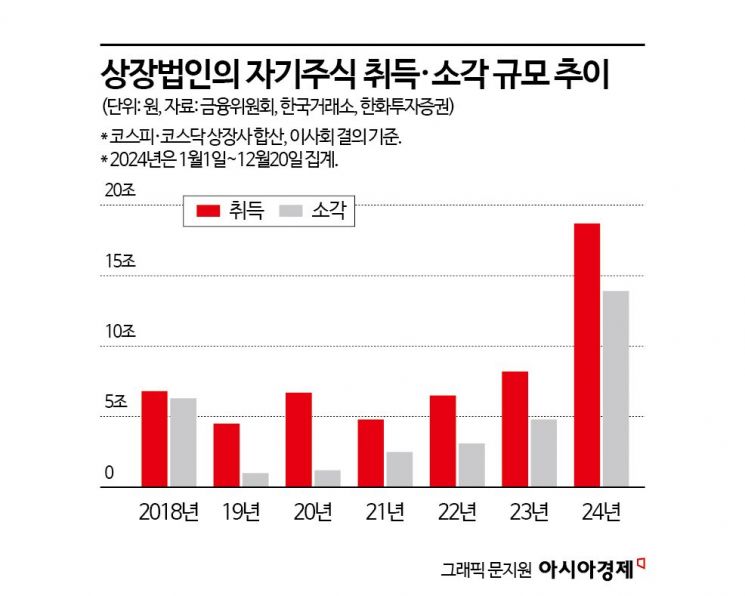
This year, supported by the government's value-up (corporate value enhancement) policy, companies' treasury stock cancellations have noticeably increased, but the cancellation amount is still less than the amount of new acquisitions. According to the Financial Services Commission and Korea Exchange, from January 1 to December 20 this year, the amount spent by domestic listed companies on treasury stock acquisitions was 18.7 trillion won, 2.28 times higher than the previous year. During the same period, the cancellation amount was 13.9 trillion won, a 2.9-fold increase.
This is the background for the expectations emerging in the securities industry due to the revision of the Capital Market Act enforcement decree. Sujin Eom, a researcher at Hanwha Investment & Securities, said, "It has become possible to prevent various shareholder rights infringements that could occur based on spin-offs, such as mergers with profitable affiliates to support struggling subsidiaries or the expansion of major shareholders' control through loopholes. We expect an increase in companies immediately canceling treasury stock upon repurchase and an overall increase in the scale of treasury stock cancellations in the market."
Min-guk Kim, CEO of VIP Asset Management, said, "From the perspective of strengthening disclosure during the holding or disposal of treasury stock, I think companies now have a 'checklist' for self-assessment. It provides companies with an opportunity to reconsider the purpose of holding treasury stock, and from investors' standpoint, it becomes a clear occasion to understand the handling and holding purposes, so it is expected to be positive."
© The Asia Business Daily(www.asiae.co.kr). All rights reserved.
![Clutching a Stolen Dior Bag, Saying "I Hate Being Poor but Real"... The Grotesque Con of a "Human Knockoff" [Slate]](https://cwcontent.asiae.co.kr/asiaresize/183/2026021902243444107_1771435474.jpg)















