National AI Committee Includes Basis for Establishing Safety Research Institute
Government to Formulate Basic Plans and Support Measures Every 3 Years
Yoo Sang-im "Enactment of AI Basic Act Is Not the End but the Beginning"
The AI Basic Act, which includes the establishment basis for the National Artificial Intelligence (AI) Committee, government support measures for the AI industry, and provisions to prevent risks that may arise from AI, passed the National Assembly plenary session on the 26th.
The Ministry of Science and ICT announced that the bill for the "Basic Act on the Development of Artificial Intelligence and the Establishment of a Trust-Based Foundation (AI Basic Act)" was approved at the plenary session on the same day.
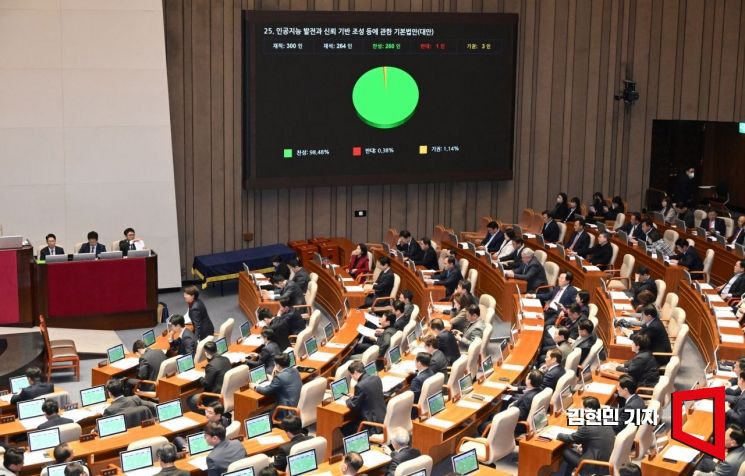 On the 26th, the 'Basic Act on the Development of Artificial Intelligence and the Establishment of a Trust-Based System (AI Basic Act)' was passed at the National Assembly plenary session. Photo by Kim Hyun-min
Under the consensus that a basic law is necessary to enhance national AI competitiveness and establish a trustworthy AI utilization foundation, the government has been promoting the enactment of the AI Basic Act considering domestic economic and social conditions.
Since the bill was first proposed in July 2020, various opinions have been collected, and through bipartisan agreement in the 22nd National Assembly, 19 bills were merged to create the final version.
The AI Basic Act is composed of provisions to establish a national-level governance system for AI, systematically foster the AI industry, and prevent risks that may arise from AI in advance.
Looking closely at the law's contents, the Minister of Science and ICT is authorized to establish and implement an AI Basic Plan every three years. It also includes the legal basis for operating the National AI Committee and the AI Safety Research Institute.
To foster the AI industry, the government can provide various supports such as research and development (R&D) assistance, standardization, formulation of policies for learning data, and AI adoption and utilization. Additionally, it promotes the development of the domestic AI ecosystem through the creation of AI clusters, implementation of AI data center policies, and promotion of AI convergence. Provisions to nurture talent and promote the growth of small and medium enterprises and startups are also included.
Furthermore, to establish a safe and trustworthy AI industry foundation, obligations to ensure transparency and safety and responsibilities of business operators are stipulated. The law also provides a basis for government support for private sector-led safety and reliability certification and AI impact assessments.
The AI Basic Act is scheduled to take effect in January 2026. Meanwhile, the government plans to carry out follow-up measures such as preparing subordinate laws and guidelines to ensure the law is quickly established in the market.
Minister Yoo Sang-im of the Ministry of Science and ICT stated, "The enactment of the AI Basic Act is not the end but the beginning," adding, "We will speedily proceed with the establishment of subordinate laws and various industrial support policies, and make our best efforts to promptly build the national AI computing infrastructure."
© The Asia Business Daily(www.asiae.co.kr). All rights reserved.
![Clutching a Stolen Dior Bag, Saying "I Hate Being Poor but Real"... The Grotesque Con of a "Human Knockoff" [Slate]](https://cwcontent.asiae.co.kr/asiaresize/183/2026021902243444107_1771435474.jpg)















