Medical Reform Special Committee to Resume Discussions on Non-Covered Services and Indemnity Insurance on the 26th
Preparation for Postponed Public Hearing... Debate on Revitalizing Secondary Hospitals
Medical Community Protests "Field Voices Not Reflected Amid Impeachment Crisis"
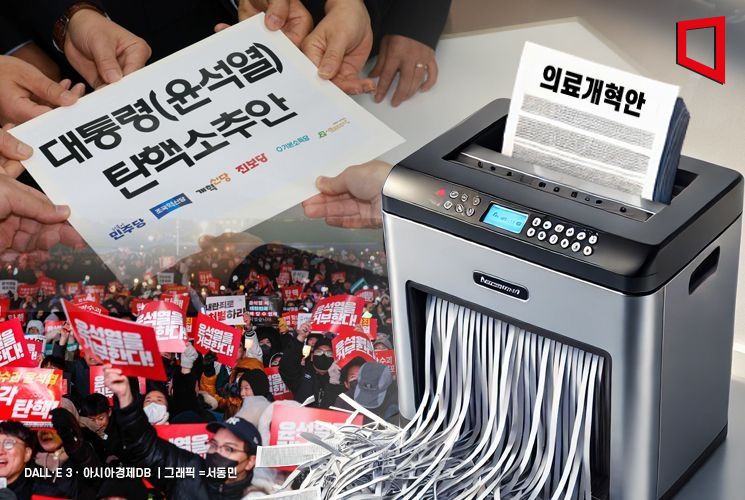
Discussions on medical reform, which had been halted due to President Yoon Suk-yeol's declaration of emergency martial law on December 3 and the aftermath of impeachment, are set to resume. The government plans to continue pushing forward with policies that were already in preparation, emphasizing that medical reform is an urgent task that cannot be postponed.
According to the Ministry of Health and Welfare and the medical community on the 27th, the "Essential Medical Care and Fair Compensation Expert Committee" under the Presidential Medical Reform Special Committee (Uigae Special Committee) held its 12th meeting the day before, discussing "Improvement Measures for Non-Reimbursed Medical Services Management" and "Reform Plans for Actual Expense Insurance."
A government official stated at the meeting, "There was a consensus that there is a lack of management mechanisms for non-severe excessive non-reimbursed medical services, and especially that this, combined with actual expense insurance, has led to medical overuse and unbalanced compensation among medical institutions." The official added, "There were also opinions presented that a system focusing on managing the prices and treatment standards of non-reimbursed services with high risk of abuse is necessary, along with a management system linked to value-based fees."
In discussions on reforming actual expense insurance, the need to restructure the self-pay system of actual expense insurance to encourage desirable medical use was raised. To minimize disruption to the medical system caused by actual expense insurance, it was suggested that coverage for non-severe non-reimbursed services should be rationalized, while complementary measures should ensure proper coverage for severe and rare diseases. A Ministry of Health and Welfare official explained, "Once discussions related to the medical accident safety net are finalized and the final plan is released, a public hearing and opinion collection process scheduled for January 9 next year will follow, and a concrete second phase medical reform implementation plan could be presented as early as the beginning of next year."
Previously, the government reduced approximately 3,600 general hospital beds by involving all 47 advanced general hospitals nationwide in the "Advanced General Hospital Structural Transformation Project," which aims to operate tertiary hospitals focusing on severe, emergency, and rare disease patients. At the same time, intensive care units, special beds, pediatric, high-risk delivery, and emergency wards and facilities were maintained or even expanded. Medical staff who had been engaged in treating mild patients naturally shifted their focus more toward treating severe patients.
Furthermore, the government plans to improve the structure of local clinics and general hospitals within regions. Although the schedule has not yet been finalized, a forum to revitalize secondary hospitals is being prepared for the end of this month.
However, opinions differ between the government and the medical community on whether medical reform can continue to be pursued. Relations between the two sides have significantly deteriorated since the emergency martial law, with the medical community strongly opposing government policies. The medical community is particularly concerned that the government has not even engaged in dialogue regarding the withdrawal of medical school admissions increases for the 2025 academic year, fearing that the chaotic impeachment situation is being exploited to shake the medical market. Earlier, the Korean Medical Association Emergency Committee stated at the National Medical Representatives Meeting on the 22nd, "We cannot accept medical policies that do not reflect the experiences and voices from the field," and demanded the withdrawal of medical reform measures promoted by the government since last February, including the Essential Medical Care Policy Package.
Expectations that medical reform will accelerate the depletion of health insurance finances also act as a variable. On the 25th, the National Assembly Budget Office released a report titled "Health Insurance Financial Outlook Reflecting Medical Reform and Emergency Medical Measures," analyzing that due to the government's "First Phase Medical Reform Implementation Plan" and emergency medical measures, health insurance finances will turn to deficit starting next year, and accumulated reserves will be depleted by 2028. Previously, it was expected that health insurance finances would turn to deficit in 2026 and reserves would be depleted by 2030 before medical reform.
A Ministry of Health and Welfare official said, "Since policies such as the structural transformation of advanced hospitals and the reorganization of non-reimbursed medical services are supported by the medical community and recognized by the public as necessary, they will be continuously pursued," adding, "We will collect opinions from the medical community on reform tasks and further develop them through discussions in the Uigae Special Committee."
© The Asia Business Daily(www.asiae.co.kr). All rights reserved.

















