Creating a 'Breakwater Against Livelihood Cold Wave' with Expanded Fiscal Policy
Expanding Support for Low Birthrate, SMEs, and Universal Welfare
Preparing for the Future by Growing the 'Consumption Base' for Economic Growth
Y Project Opens Era of 30 Million Users
■Song's New Year Address... Announcing 'This Year's Achievements and Next Year's Plans'
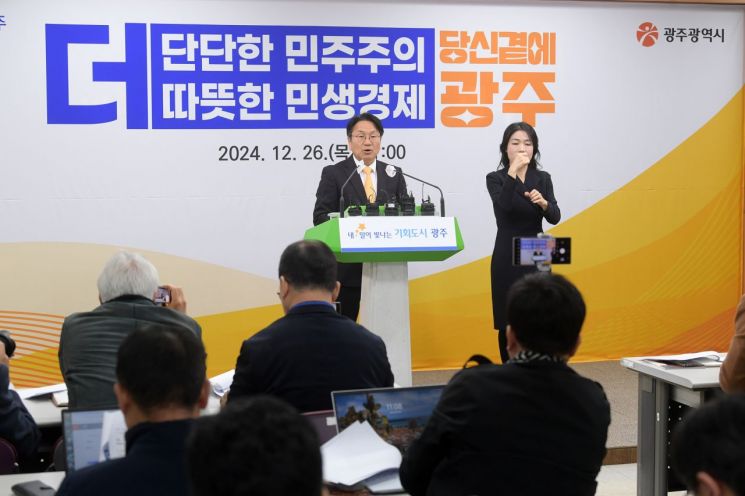 Kang Kijeong, mayor of Gwangju, held a year-end and New Year press conference on the morning of the 26th at the city hall briefing room, announcing the "2024 Administrative Achievements and 2025 Administrative Plan." Provided by Gwangju City
On the 26th, Gwangju Mayor Kang Gijung stated, "2024 was the year when 'Gwangju of yesterday protected Korea of today,'" and added, "Now, 'Gwangju of today will make Korea of tomorrow even stronger.'"
Mayor Kang held a "Year-end and New Year Press Conference" at the city hall briefing room on this day, announcing "Gwangju City's 2024 Administrative Achievements and 2025 Administrative Plans."
Mayor Kang evaluated, "2024 was a year when the concentrated 'power of Gwangju' exploded." The power of Gwangju is the "DNA of resistance and solidarity" and the "spirit of sharing and coexistence." Sometimes through literature and culture, sometimes through life-risking struggles, this energy has been accumulated over a long period. This energy led to the first-ever "National Assembly, Gwangju Day," author Han Kang winning the Nobel Prize in Literature, the KIA Tigers' victory in the Korean Series, Gwangju FC's first entry into the AFC Champions League Elite, GGM (Gwangju Global Motors) exporting to 64 countries, sweeping the four major special zones in the era of local autonomy, being selected as the only metropolitan city for outstanding investment attraction, winning the Government Innovation Award for Gwangju-style Integrated Care, and more.
As this year's achievements, Mayor Kang cited "Gwangju's representative policies for a better life." The "Gwangju-style Integrated Care" policy, implemented for the first time nationwide, and the "24-hour Public Nighttime Children's Hospital" set national standards for care and medical services. The "10 a.m. Work Start for Parents of Elementary School Students," "Grandchild Family Caregiver," and "Breakfast Provision for Industrial Complex Workers" projects are spreading as basic social models, while the "Public Delivery App Activation" has become a catalyst for nationwide expansion.
Gwangju expanded its industrial base by attracting the Future Mobility National Industrial Complex and revitalizing the AI (Artificial Intelligence) industry, and worked to create new jobs by strengthening the semiconductor and startup ecosystems. The AI industry produced results, with the National AI Data Center supporting over 2,000 corporate projects and providing demonstrations for 288 companies and 5,432 citizens. The city signed investment attraction agreements with 252 AI-related companies, establishing itself as an "AI innovation hub," and Gwangju's leading companies are achieving results such as winning five innovation awards, including the top innovation award, at "CES 2025."
A "talent development ladder" is being built in various fields such as AI, semiconductors, and content. The "500 billion won Startup Fund" goal was achieved early, demonstration spaces have expanded to over 80 locations throughout the city, and infrastructure such as the "Startup Station" is being established, allowing Gwangju's startups and demonstrations to flourish.
Progress is being made on the construction of a large-scale complex shopping mall, Gwangju's status as an international city of culture and arts is being strengthened through the Gwangju Biennale and Pavilion, the activation of ACC (Asia Culture Center), designation of the first local garden at the Lake Ecological Park, promotion of 24 urban parks, and the Yeongsangang and Hwangryonggang Y Project, all of which are opening the era of "30 million urban users."
With the smooth progress of the first phase of Urban Railway Line 2 construction, the full-scale start of phase two, the new "Gwangcheon-Sangmu Line" to resolve areas excluded from urban rail and establish a small circular line, and the full-scale promotion of the "Daejabo Urban Project," Gwangju's urban space is gradually transforming into a vibrant and attractive place.
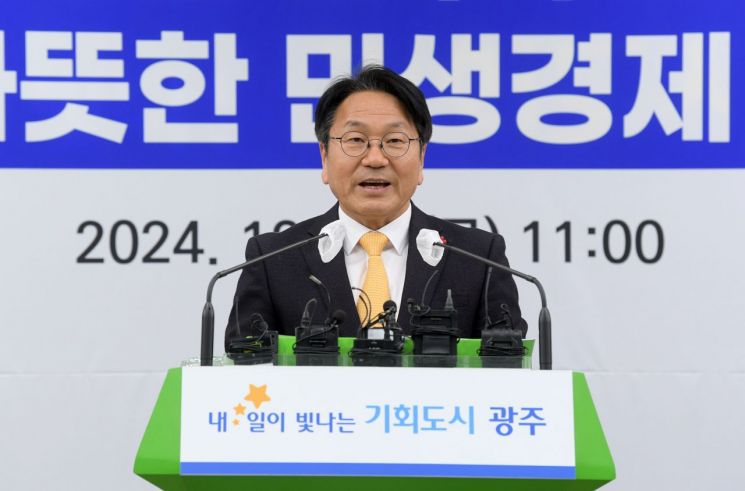 Kang Kijeong, mayor of Gwangju, held a year-end and New Year press conference on the morning of the 26th at the city hall briefing room, announcing the "2024 Administrative Achievements and 2025 Administrative Plans." Provided by Gwangju City
Next year, due to factors such as "entrenched low growth," "Trump's protectionism," and "impeachment politics," the livelihood economy is expected to become even more challenging. Accordingly, the city plans to create a "breakwater against the cold wave of livelihood" with expansionary fiscal policy and expand the "consumption vessel" to stabilize livelihoods and inject vitality into the uncertain economic situation. To this end, next year's main budget has been set at 7.6 trillion won, including 108.2 billion won for economic recovery.
To revitalize the stagnant local economy, the city will expand the discount rate for the "coexistence card" throughout January next year following the year-end "public delivery app special discount promotion," and will launch the public transportation discount system "Gwangju G-Pass" in earnest from January next year.
Projects such as the "Coexistence Card for Newborn Families" and "Incentives for Parental Leave Replacement Workers" will be promoted to address low birth rates. In addition, the special guarantee scale for small business owners will be expanded, support for loan interest from local financial institutions will be increased, traditional market and shopping district specialization projects will be promoted, and financial support for small and medium-sized enterprises will be expanded.
Next year marks the 45th anniversary of the May 18 Democratization Movement and the World Human Rights Cities Forum, the 10th anniversary of the opening of the ACC, the Design Biennale, and the World Archery Championships, making it a "year of festivals" in Gwangju. The city will promote the "Year of Visiting Gwangju" by activating sports tourism, strengthening the Nobel Prize city brand, and connecting with the Gwangju G-Festa.
In particular, the "AX (AI Transformation) Demonstration Valley Project" (AI Phase 2) will be promoted in earnest, laying the foundation for the future mobility industry through autonomous driving performance evaluation and certification, expanding autonomous driving demonstrations, and advancing new technologies to create a new industry ecosystem. The city also plans to foster the future aviation mobility and drone industries.
To establish itself as a "RE100 leading city," GGM and the Future Mobility National Industrial Complex will be developed as the nation's first "RE100 Industrial Complexes," and the "RE100 Convergence Project Group" will be operated from next year using distributed energy.
The "Daejabo Urban Project" will also be promoted in earnest as part of the journey toward "Gwangju, a carbon-neutral city by 2045." Next year, the first phase of Urban Railway Line 2 will be completed, and the public transportation system centered on rail and buses will be completed through a comprehensive study of city bus route reorganization. At the same time, the introduction of trunk BRT and express buses, as well as the full-scale start of the Gwangcheon-Sangmu urban railway line, will begin.
Mayor Kang emphasized, "Gwangju is a precious 'value' embodying the spirit of sharing and coexistence, and that is the pride in the name Gwangju. Just as Gwangju of the past saved Korea of today, now Gwangju of today will make Korea of tomorrow even stronger. I will move forward hand in hand with citizens so that the name Gwangju can become a beacon of hope for Korea in the coming year."
© The Asia Business Daily(www.asiae.co.kr). All rights reserved.
![Clutching a Stolen Dior Bag, Saying "I Hate Being Poor but Real"... The Grotesque Con of a "Human Knockoff" [Slate]](https://cwcontent.asiae.co.kr/asiaresize/183/2026021902243444107_1771435474.jpg)
















