High Incineration Capacity Overestimation, Omission of Air Quality Impact Assessment Items, and Conflicts with Carbon Neutrality Highlight Numerous Issues
Fundamental Waste Policies Such as Reducing Household Waste, Increasing Recycling Rates, and Modernizing Existing Incinerators Must Be Prioritized
Mapo-gu, Seoul (Mayor Park Kang-su) demanded that Seoul City supplement inappropriate or omitted investigation, prediction, and evaluation contents based on the expert advisory results of the policy advisory group on the draft environmental impact assessment report for the 'Seoul Metropolitan Resource Recovery Facility Construction Project.'
The district pointed out specific problems in Seoul City's investigation and evaluation and submitted opinions with logical grounds on the matter.
First, the district pointed out that the estimated processing capacity of the new incineration plant was set too high.
According to the "Revised Guidebook for Installation and Operation of Municipal Waste Incineration Facilities" (Ministry of Environment Resource Circulation Bureau, October 2012), population estimation should be based on the cohort-component method used by Statistics Korea.
However, Seoul City projected the population by adjusting and comparing the recent three-year (2018?2020) population trends (resident population) from Statistics Korea, resulting in a higher population projection than Statistics Korea's estimate, thereby overestimating the processing capacity of the incineration facility.
Seoul City projected the population in 2027 to be 9,410,974, whereas applying Statistics Korea's population estimate results in 9,097,319, reducing the processing capacity by 142.2 tons/day.
Additionally, some items were omitted in the process of predicting and evaluating air quality impacts.
The draft environmental impact assessment by Seoul City did not include predictions of air pollutant emission concentrations from the chimney during the operation of the new incineration plant, cumulative air quality evaluation with five incinerators in Seoul, prediction and evaluation of dioxins according to the operation status of the incineration facility, and on-site air quality investigation of the Sangam-dong apartment complex in autumn (September to November), when the southeast wind has a significant influence according to the autumn wind direction data from the Seoul Meteorological Observatory.
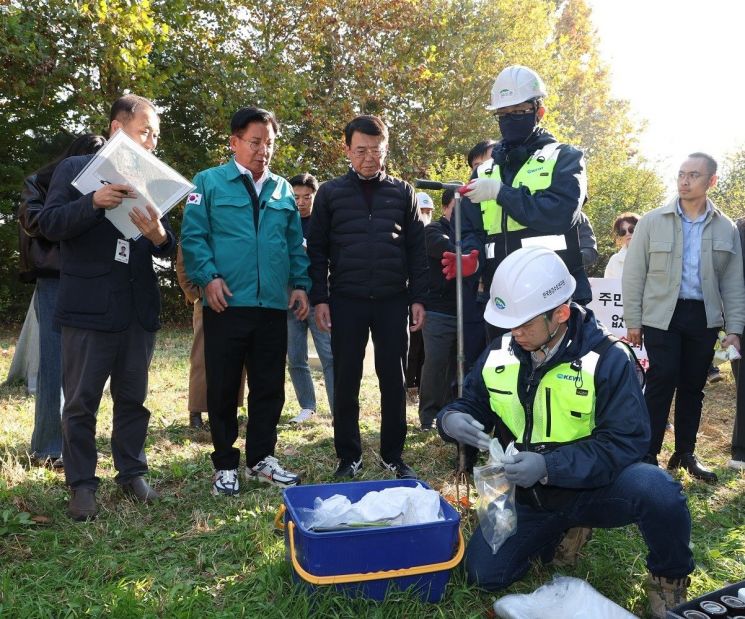
In particular, the omission of dioxins in the health impact assessment was raised as an issue.
It was submitted that the dioxin investigation method using accumulation in vegetation (pine needles, eggs, milk, crops, etc.) within the impact area is more accurate than air inhalation surveys, and additional investigation is necessary.
Furthermore, the district emphasized that the construction of the incineration plant conflicts with the national and Seoul City's carbon neutrality goals.
According to the "National Strategy for Carbon Neutral Green Growth and the 1st National Basic Plan," the recycling rate of municipal waste is set at 83% by 2030, and the "Seoul City Carbon Neutral Green Growth Basic Plan (2024?2033)" sets the greenhouse gas reduction target in the waste sector at 370,000 tons CO2eq compared to the 2033 BAU (business-as-usual) projection.
However, considering that the annual greenhouse gas emissions from the additional incineration plant would be 362,000 tons CO2eq, the additional construction conflicts with the higher-level plans.
Also, Seoul City did not consider the "National Basic Plan for Carbon Neutral Green Growth" and the "Seoul City Carbon Neutral Basic Plan" as important factors in the 'alternative setting and evaluation' during the preparation of the draft environmental impact assessment report as stipulated by the Environmental Impact Assessment Act.
Along with this, the district argued that the incineration method needs improvement from the perspective of reducing air pollution.
Seoul City chose the stoker incineration method for safety and economic reasons, but the district suggested that switching to the pyrolysis-melting method would be more effective in reducing air pollution.
▲ Stoker method: A method where waste fed onto a grate is stirred and transported by the reciprocating motion of the grate and incinerated.
▲ Pyrolysis-melting method: A method where waste is compressed and carbonized under low oxygen conditions, then the carbonized waste is melted at high temperatures above 1,000℃ to minimize the generation of harmful substances such as dioxins.
Park Kang-su, Mayor of Mapo-gu, stated, "Fundamental waste treatment policies such as reducing municipal waste, increasing recycling rates, and modernizing existing incinerators should take priority," and expressed a strong will, saying, "We oppose the additional construction of incinerators that infringe on the health rights of Mapo residents and will use all possible means together with the residents to prevent this."
© The Asia Business Daily(www.asiae.co.kr). All rights reserved.
![Clutching a Stolen Dior Bag, Saying "I Hate Being Poor but Real"... The Grotesque Con of a "Human Knockoff" [Slate]](https://cwcontent.asiae.co.kr/asiaresize/183/2026021902243444107_1771435474.jpg)















