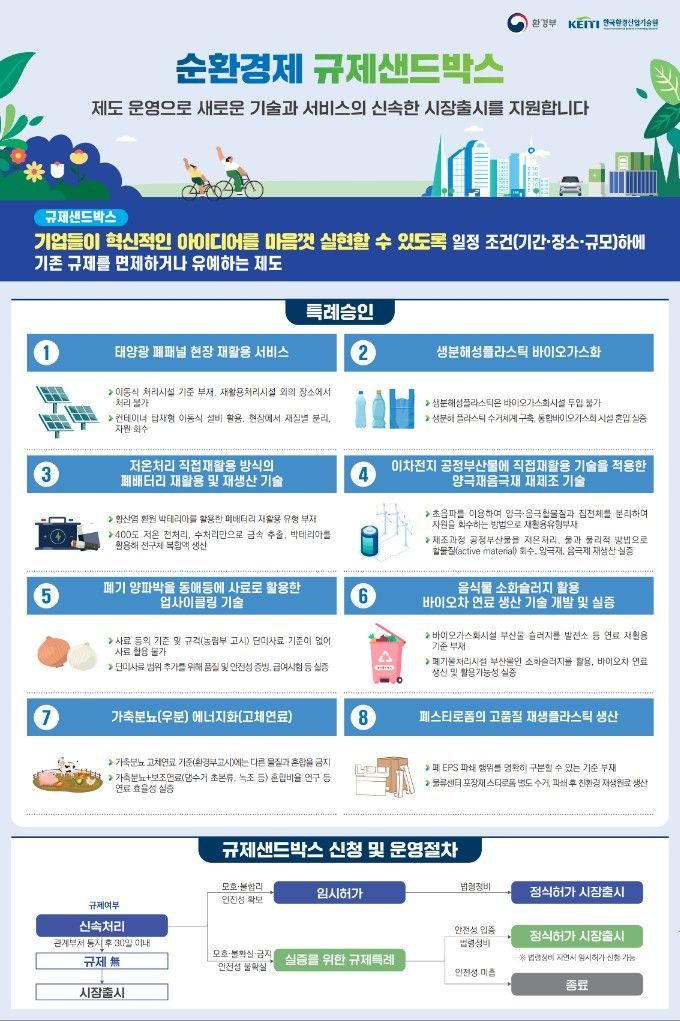
The Ministry of Environment announced on the 26th that it has introduced the 'Circular Economy Regulatory Sandbox' system and granted exemptions to nine areas utilizing waste resources such as solar power and waste batteries.
The regulatory sandbox is a system that allows demonstration tests of new technologies and services within limited periods, locations, and scales. If effectiveness and safety are proven, related regulations are changed or supplemented.
With this measure, the 'solar waste panel recycling business' will receive regulatory exemptions. Under domestic law, it was impossible to separate and recover useful resources from solar waste panels on-site. This was because there were no regulations or standards related to permits for mobile waste. Once commercialized, the transportation volume of solar waste panels will decrease, reducing the transport cost burden on emitters. Currently, transporting 100 tons of waste panels costs about 85 million KRW, but with the regulatory exemption applied, the expected transport cost will decrease to 35 million KRW.
Two areas in waste battery recycling were also selected for regulatory exemptions. Businesses that pre-treat waste batteries at low temperatures (400℃), extract metals, and regenerate precursor composite solutions will benefit. Using this technology can drastically reduce energy consumption, and since sulfuric acid is not used in the metal extraction process, there is no wastewater discharge. Technologies for remanufacturing cathode and anode materials are also included. These technologies process and productize by-products generated during manufacturing, not used batteries.
The integrated biogasification project for biodegradable plastics was also included in the regulatory exemptions. This project involves mixing products such as bags or containers with food waste in biogas facilities. Under current law, only food waste and sewage sludge can be input into biogas facilities; other materials are not allowed.
The Ministry of Environment plans to proactively design and introduce regulatory exemptions starting next year. Until now, the approach was passive, with individual companies applying for exemptions and the government reviewing them. Going forward, the government will first identify key circular resources and recruit businesses to demonstrate them.
Ahn Se-chang, Director of the Climate and Carbon Office at the Ministry of Environment, emphasized, “To achieve carbon neutrality, establishing a resource circulation network and an eco-friendly circular economy system that minimizes resources and energy is essential. We will provide practical support to companies that boldly challenge unreasonable regulations blocking new technologies or services.”
© The Asia Business Daily(www.asiae.co.kr). All rights reserved.
![Clutching a Stolen Dior Bag, Saying "I Hate Being Poor but Real"... The Grotesque Con of a "Human Knockoff" [Slate]](https://cwcontent.asiae.co.kr/asiaresize/183/2026021902243444107_1771435474.jpg)















