Ministry of Science and ICT Releases Second Half of This Year's Electromagnetic Wave Measurement Results
Household Products and Facility Environments All Meet Human Protection Standards
The Ministry of Science and ICT announced on the 26th that the electromagnetic wave exposure levels of nine household products, including microwave ovens and motion beds, as well as 6,388 living environment locations such as educational, residential, and public facilities, all met the human protection standards.

Since 2019, the Ministry of Science and ICT has been selecting measurement targets based on social interest among domestic distributed information and communication technology (ICT) products and major living space facilities every six months to alleviate concerns and anxiety about electromagnetic waves in daily life, and has been disclosing the measurement results of electromagnetic waves.
The human protection standards adopted in Korea follow the recommended standards of the World Health Organization (WHO) International Commission on Non-Ionizing Radiation Protection. For the 30 Hz frequency band, the limit is 1666 mG or less; for 60 Hz, 833 mG or less; and for 200 Hz, 250 mG or less.
In the second half of this year, a total of nine products were selected through the 'Electromagnetic Waves in Daily Life Committee,' including four products requested by the public, four seasonal products, and one self-selected product, and a total of 22 products were measured. The National Radio Research Agency conducted precise measurements and analyses of the electromagnetic wave intensity of these products over one month according to the measurement standards.
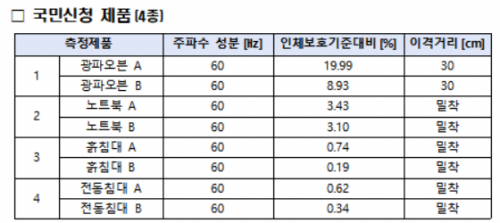 Measurement Results of Electromagnetic Waves for Four Publicly Requested Products / Data = Ministry of Science and ICT
The measurement results showed that the electromagnetic waves emitted from public-requested product groups such as microwave ovens, laptops, soil beds, and electric beds ranged from 0.19% to 19.99% of the human protection standards. Seasonal products used in winter were measured at 0.19% to 3.10% of the human protection standards, showing the lowest values among the measured products this time.
The microwave oven, a self-selected product by the 'Electromagnetic Waves in Daily Life Committee,' showed levels ranging from 7.56% to 13.02% of the human protection standards.
Major living facilities and spaces measured electromagnetic wave signals such as mobile communications (4G, 5G), Wi-Fi, and terrestrial broadcasting at 5,656 living environments directly requested by the public, including public transportation and daycare centers, as well as 732 IoT and 5G network-based convergence facilities.
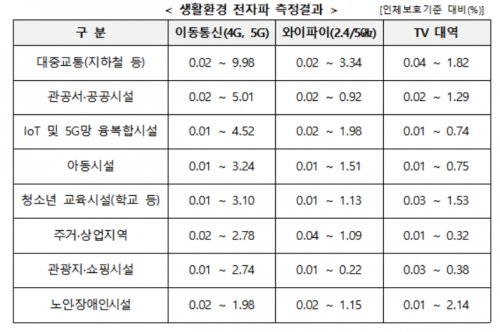 Measurement Results of Electromagnetic Waves in Living Environment / Data from Ministry of Science and ICT
As a result, the exposure levels were measured at 0.01% to 9.98% of the human protection standards. Specifically, public transportation such as subways and high-speed trains showed 0.02% to 9.98% of the human protection standards. Although various wireless facilities operated in convergence facilities such as smart factories and campuses based on IoT technologies like Eum 5G, the electromagnetic wave exposure levels were similar to other facilities, ranging from 0.92% to 4.52% of the human protection standards.
Facilities for children and adolescents, who frequently use digital devices such as tablet PCs, were measured at 0.01% to 3.24% of the standards, and residential and commercial areas where IoT-based electronic product usage is increasing were measured at 0.01% to 2.78% of the standards.
Choi Byung-taek, Director of the Radio Policy Bureau at the Ministry of Science and ICT, stated, "We will systematically and meticulously establish and implement related policies to create a safe radio environment until all citizens can use digital technology safely and conveniently with peace of mind."
© The Asia Business Daily(www.asiae.co.kr). All rights reserved.
![Clutching a Stolen Dior Bag, Saying "I Hate Being Poor but Real"... The Grotesque Con of a "Human Knockoff" [Slate]](https://cwcontent.asiae.co.kr/asiaresize/183/2026021902243444107_1771435474.jpg)
















