KCCI Advanced Strategic Industry Regulation Perception Survey
54% of Companies Say "Regulations Excessive Compared to Competitors"
Future Improvement Areas: Technology, Workforce, Finance, Environment Order
A survey revealed that more than half of companies in advanced strategic industries such as semiconductors consider South Korea's regulations, including the 52-hour workweek system, to be more excessive than those of competing countries.
The Korea Chamber of Commerce and Industry (KCCI) announced on the 25th that, based on a recent 'Advanced Strategic Industry Regulation Perception Survey' conducted among 433 companies in advanced strategic industries such as semiconductors, secondary batteries, bio, and displays, 53.7% of companies perceived South Korea's advanced industry regulations as more excessive compared to competing countries. Companies that responded that the regulations were similar accounted for 23.7%, while 22.6% said they were not excessive.
By industry, the proportion of companies perceiving regulations as stricter than those of competing countries was 58.2% for secondary batteries, 56.4% for bio, 54.9% for semiconductors, and 45.5% for displays.
 Daehan Chamber of Commerce and Industry Building, Jung-gu, Seoul. Provided by Daehan Chamber of Commerce and Industry
Regarding the burden of regulatory compliance, 72.9% answered that it was burdensome. By industry, bio was the highest at 83.6%. Secondary batteries accounted for 73.6%, and semiconductors and displays each accounted for 67.3%.
The most common reason cited for difficulty in complying with regulations was "too many regulations" (32.8%). This was followed by "high standards of regulatory compliance" (23.1%), "excessive burden of data submission" (21.8%), and "excessive mandatory requirements such as training" (11.1%).
Negative opinions prevailed regarding expectations that the regulatory environment would improve. When asked whether the regulatory environment had improved compared to the previous year, 42.7% answered no. Regarding whether it would improve in the future, 46.5% responded negatively.
Companies identified technology (29.6%), workforce (17.8%), finance (14.7%), and environment (12.6%) as the key areas for future regulatory improvements in advanced industries.
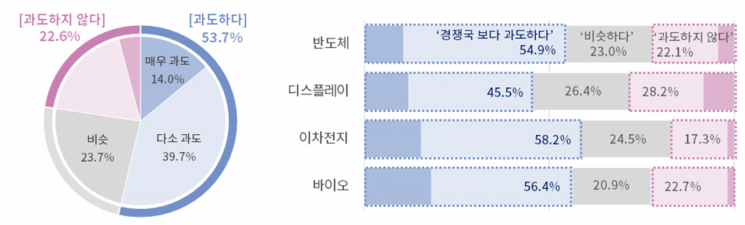 Corporate Perceptions of South Korea's Advanced Industry Regulation Levels Compared to Competing Countries. Provided by the Korea Chamber of Commerce and Industry.
The area most frequently selected by companies as a priority for regulatory improvement was so-called "technology regulations" related to research and development (R&D), certification, and inspection. In particular, 43.6% of bio companies responded that improving technology regulations was important. A representative from Company A said, "We developed a blood collection device capable of AI-based blood sugar measurement and diagnosis, but it was classified as a complex product combining medical devices and diagnostic medical devices, requiring overlapping certifications such as medical device testing and diagnostic medical device testing," adding, "The costs and time involved were quite burdensome."
"Workforce regulations" followed. Due to the nature of advanced strategic industries, securing skilled professionals is essential, but there are many restrictions due to the 52-hour workweek system. A representative from Company B said, "Taiwanese foundry (semiconductor contract manufacturing) company TSMC can extend daily working hours up to 12 hours if agreed upon by labor and management, allowing them to work overnight on R&D, but we are held back by the 52-hour workweek system," adding, "We hope that at least for advanced strategic industries nurtured by the government, exceptions can be applied to issues related to working hours, overtime, and special work."
The KCCI plans to continuously identify and propose improvement tasks to enhance the competitiveness of advanced industries. In particular, environmental regulations will utilize the Corporate Environment Policy Council (a joint body of KCCI and the Ministry of Environment), which has been achieving tangible results annually, as a channel for improving environmental regulations in advanced industries, and will continuously identify on-site difficulties faced by companies and consult with relevant ministries.
The Advanced Strategic Industry Regulation Perception Survey, conducted for the first time this time, will be regularized annually. It plans to quantify corporate perceptions and the level of regulatory burden in advanced strategic industries, compare and analyze the level and intensity of regulations, and present policy tasks for continuous regulatory improvement.
Kang Seok-gu, head of the KCCI Research Department, said, "We will work closely with the government to ensure that regulatory improvements in the advanced strategic industry sector are carried out efficiently," adding, "Since advanced strategic industries are key sectors responsible for the future of the national economy, prompt passage of support bills such as the 'Advanced Strategic Industry Fund Act,' 'Semiconductor Special Act,' and 'Tax Incentives Limitation Act,' which are pending in the National Assembly, is necessary."
© The Asia Business Daily(www.asiae.co.kr). All rights reserved.
![Clutching a Stolen Dior Bag, Saying "I Hate Being Poor but Real"... The Grotesque Con of a "Human Knockoff" [Slate]](https://cwcontent.asiae.co.kr/asiaresize/183/2026021902243444107_1771435474.jpg)

















