PNAS Paper: "Children Caught in the Middle" Show Strong Cooperation Skills
A study has found that second-born children exhibit stronger cooperation skills than first-born or youngest siblings. This contrasts with previous research suggesting little personality difference related to birth order, except for intellectual traits.
On the 24th, Yonhap News reported a paper by Professor Michael Ashton of the Department of Psychology at Brock University in Ontario, Canada, and Professor Ki-beom Lee of the Department of Psychology at the University of Calgary in Alberta, citing the Proceedings of the National Academy of Sciences (PNAS) in the United States.

The paper is titled "Personality Differences by Birth Order Type and Number of Siblings." In this study, the authors analyzed responses from a large sample of about 700,000 individuals regarding birth order types and about 70,000 individuals regarding the number of siblings. However, most respondents were residents of English-speaking countries.
The authors noted significant differences in other personality traits as well. They found that the more siblings one has, the higher the tendency to exhibit traits related to cooperation, such as "Honesty-Humility" and "Agreeableness." When controlling for variables such as upbringing and current religious activity, these differences decreased by about 25%. Additionally, when comparing individuals with the same number of siblings, differences due to birth order were relatively small.
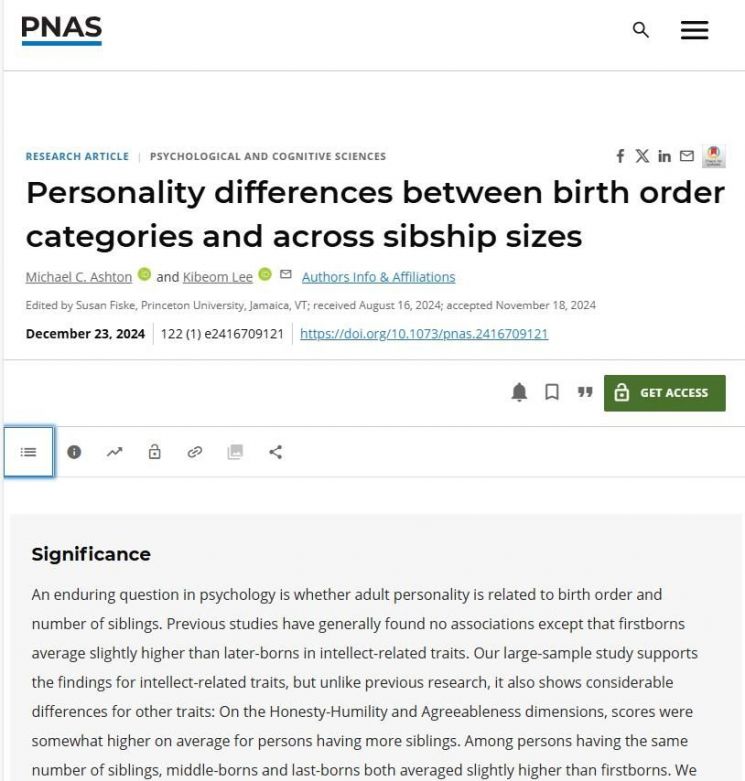 Personality Differences According to Birth Order and Number of Siblings: PNAS Homepage Capture Photo by Yonhap News
Second-born and later children tended to score higher on cooperation-related traits than first-borns. Among siblings, middle children?neither the eldest nor the youngest?scored the highest. Individuals without siblings showed higher "Openness" traits compared to those with siblings. First-borns were found to be more open than middle or youngest children.
The authors explained that their findings support the conclusion that personality traits vary according to birth order and number of siblings. Previous studies generally concluded that there are minimal personality differences based on birth order or sibling count, except that first-borns tend to score higher on intellectual traits.
According to the British daily newspaper The Guardian, research on whether personality differs by birth order has been ongoing for over 100 years.
Francis Galton, a British geneticist born as the youngest of nine children, reported in 1874 that the proportion of first-borns among British scientists was high. He speculated this was because first-borns received more parental attention, resulting in higher intellectual achievement.
Later, Austrian psychologist Alfred Adler (1870?1937) argued that first-borns are conscientious and responsible, youngest children develop independence and creativity to gain attention, and middle children excel at mediation.
© The Asia Business Daily(www.asiae.co.kr). All rights reserved.


















