Refusal to Appoint Judges and Participation in Insurrection as Grounds for Impeachment
Realistic Voting Possible Only on the 27th
Regarding the Possibility of a Plenary Session on the 27th, "Just Let Woo Won-sik Respond"
The Democratic Party of Korea adopted a party resolution to impeach Han Deok-soo, Acting President and Prime Minister, who postponed the submission of the so-called double special prosecution law (special prosecution laws on general rebellion and on Mrs. Kim Geon-hee) to the Cabinet meeting. Considering the schedule for the impeachment vote, the only day the National Assembly can vote on the impeachment motion against Acting President Han is the 27th, but the Democratic Party expected Speaker Woo Won-shik to convene a plenary session.
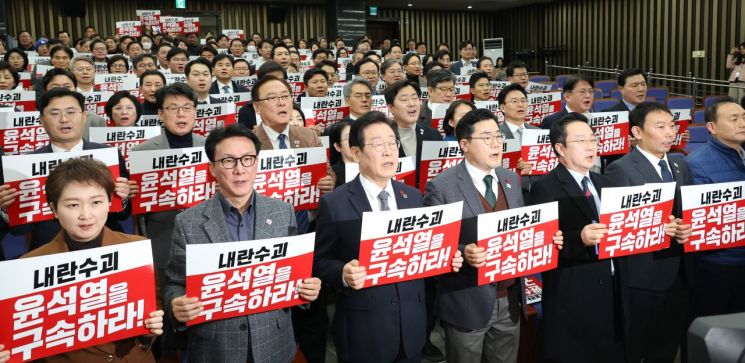 Democratic Party of Korea leader Lee Jae-myung (third from the left in the front row) and floor leader Park Chan-dae, along with other lawmakers, are holding placards that read "Arrest the Traitor Yoon Seok-youl!" and shouting slogans ahead of a party meeting held at the National Assembly on the afternoon of the 24th. Photo by Yonhap News Agency
On the 24th, Yoon Jong-gun, the Democratic Party floor spokesperson, met with reporters after a party members' meeting held at the National Assembly main building in Yeouido, Seoul, and said, "The impeachment motion against Acting President Han was unanimously adopted as a party resolution," adding, "It will be proposed today and reported to the plenary session on the 26th." The Democratic Party plans to submit the impeachment motion against Acting President Han to the National Assembly Secretariat's procedural office around 5:30 p.m. that day.
The Democratic Party pointed out that there are five grounds for impeachment: three as Prime Minister and two as Acting President. The first reason was that while serving as Prime Minister, Han recommended a veto on the special prosecution laws on Corporal Chae and Mrs. Kim Geon-hee despite potential conflicts of interest with President Yoon Seok-yeol. The second reason was that on the 3rd of this month, Acting President Han convened a Cabinet meeting himself, which was considered an active act of participation in the rebellion, supplementing procedural defects in the declaration of martial law.
The third reason was the issue of Acting President Han and Han Dong-hoon, leader of the People Power Party, jointly presenting a national governance plan despite President Yoon’s presidential authority not having ended. The fourth reason was neglecting the appointment of a permanent special prosecutor for 11 days, thereby obstructing the investigation of the rebellion. Lastly, it was pointed out that Acting President Han avoided the duty to promptly end the rebellion by deciding not to appoint a constitutional court justice recommended by the National Assembly.
Cho Seung-rae, chief spokesperson for the Democratic Party, said, "Acting President Han’s remarks at the Cabinet meeting effectively mean that if the People Power Party does not agree, neither the promulgation of the special prosecution law nor the appointment of constitutional court justices will proceed," adding, "We shared the view that this is an attempt to suspend the constitutional institution of the National Assembly, which is an intolerable situation." On the same day, Acting President Han stated at the Cabinet meeting that political issues such as the special prosecution law and the appointment of constitutional court justices require compromise between the ruling and opposition parties.
It was predicted that there would be no backlash even if the impeachment of Acting President Han is attempted. Cho said, "There is no cautious opinion within the party," explaining, "It is true that there were voices within the party expecting him to act as a stable manager through a series of processes, but that expectation has been completely shattered." He added, "There was no opinion to leave some room for discretion."
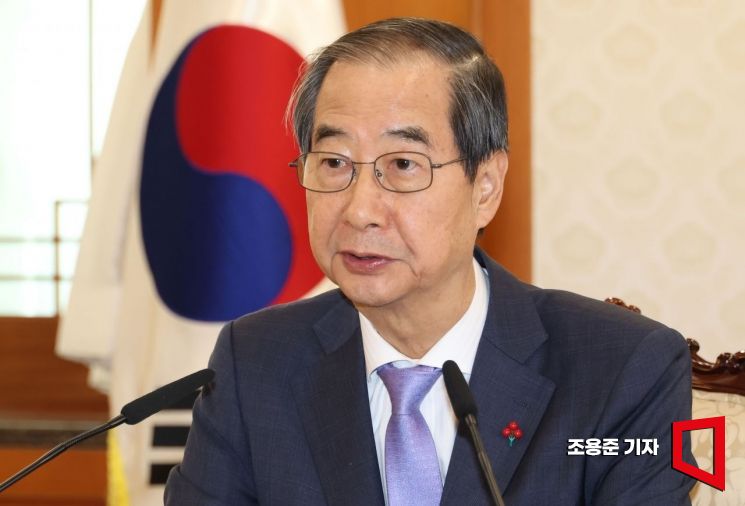 Prime Minister Han Duck-soo is attending and speaking at the National Intellectual Property Committee held at the Government Seoul Office in Jongno-gu, Seoul on the 12th. Photo by Jo Yong-jun
The key issue is the timing of the impeachment vote. The impeachment motion must be reported to the plenary session and voted on no earlier than 24 hours and no later than 72 hours after the report. If reported on the 26th, the vote can take place between the 27th and 29th. However, since the 28th and 29th are holidays, the only realistic date for the vote is the 27th. The plenary session schedule agreed upon by both parties includes only the 26th and 31st.
The Democratic Party has requested Speaker Woo to convene a plenary session on the 27th. The opposition parties, including the Democratic Party, passed a resolution alone at the full meeting of the National Assembly Steering Committee the previous day to add plenary session dates for government questioning on the martial law situation. The plenary session dates approved by the opposition are the 27th and 30th of this month, and the 2nd and 3rd of next month. Cho said, "The Steering Committee approved and requested the additional plenary session dates," adding, "It is up to Speaker Woo to respond to the request. It will probably be convened."
They also argued that the quorum for the impeachment vote against Acting President Han is a majority of the total members, i.e., at least 151 members. According to Article 62, Paragraph 2 of the Constitution, the quorum for impeachment votes against Cabinet members excluding the President is a majority of the total members, whereas for the President, a two-thirds majority of the total members, i.e., at least 200 votes, is required. The ruling party claims that since Acting President Han is considered the President, at least 200 votes are needed to pass the impeachment motion, but the opposition argues that since Acting President Han is not an elected official, only 151 votes are necessary. Cho explained, "There is no constitutional position called Acting President; the Prime Minister acts as the President."
© The Asia Business Daily(www.asiae.co.kr). All rights reserved.


















