Tenants Who Moved Out After 2 Years in Private Rentals Protest Jungheung's Charges
Restoration Fees Charged from 840,000 to 3,730,000 KRW
Requests for Curtain Box Drilling Restoration, Wallpaper Labor Costs of 250,000 KRW per Household
LH Does Not Charge Separate Labor Fees Upon Public Rental Move-Out
Tenants of the public support private rental apartments in Goyang Deogeun District, constructed and operated by Jungheung Togeon, are struggling with the construction company's excessive charges for restoration costs. These apartments are complexes leased by private construction companies with public support to allow low-income residents to live at prices lower than the surrounding market rates. Tenants are required to pay restoration costs when moving out, but tenants are raising objections, claiming that Jungheung Togeon has set repair costs excessively high per household. In particular, there are criticisms that Jungheung Togeon is profiting from repair fees targeting low-income residents, as some previous tenants paid restoration fees but the company did not carry out defect repairs before bringing in new tenants.
Evicted Tenants: "Jungheung Togeon’s Restoration Fees Are Excessive"
According to tenants of Jungheung S-Class in Goyang Deogeun District on the 27th, among the 63 households moving out from the end of last month to this month, about 20 households raised objections, claiming that the restoration costs notified by Jungheung Togeon were excessive. These 20 households did not receive their restoration deposit (5 million KRW) back. The restoration fees charged to tenants ranged from a minimum of 840,000 KRW to a maximum of 3,730,000 KRW.
Tenants pointed out that the material and labor costs proposed by the construction company were excessive. Kwon Byung-jun, chairman of the Jungheung S-Class Tenant Council in Goyang Deogeun, said, "There was no prior notice about the cost of each restoration item before moving in, and after moving out, the amounts were handwritten and communicated, making it difficult for tenants to accept. When we suggested directly repairing the damages ourselves due to the high costs on the invoice, they did not provide a clear response on this matter either."
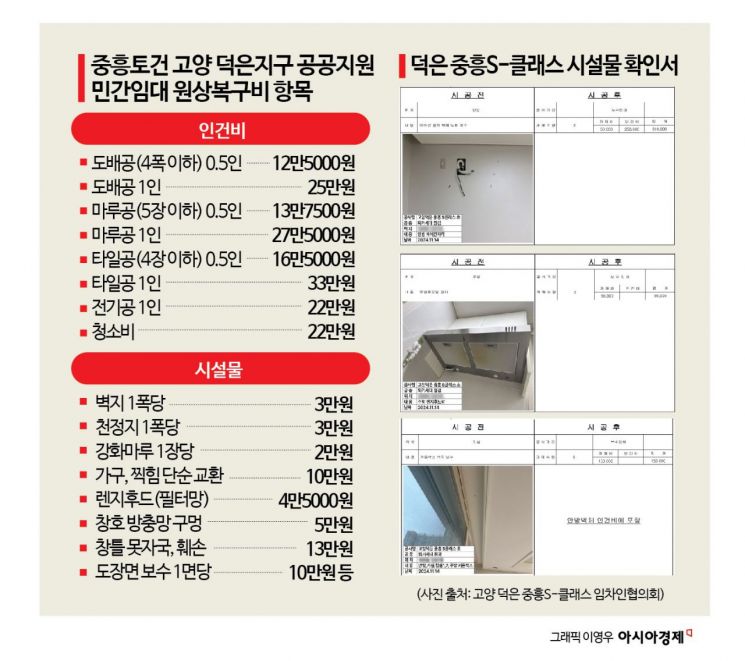
Jungheung Togeon charged 250,000 KRW in labor costs for wallpapering per household even if the wallpaper was only partially stained or damaged. For households that had installed a system air conditioner on the wall, they charged a total of 310,000 KRW, including 250,000 KRW labor and 60,000 KRW material costs. Repair costs for curtain box wallpaper in the living room or master bedroom were charged at 30,000 KRW per location, totaling 150,000 KRW for five locations. The cost to replace a kitchen hood mesh was 45,000 KRW each, more than three times the market price of hood meshes (10,000 to 15,000 KRW). Additionally, cleaning fees (labor costs) for bathrooms were set at 220,000 KRW. Repair costs for floor dents were 25,000 KRW per spot, and floor labor costs were 275,000 KRW.
The Korea Land and Housing Corporation (LH), which builds public rental housing, does not charge tenants for labor costs. An LH official stated, "For public rental apartments, repair cost responsibilities and restoration standards are explained at the time of lease contract, and repair costs are notified considering the facility’s age, etc. The repair cost includes labor costs but they are not separately itemized and charged."
Compared to Jungheung Togeon, LH’s 2023 standard restoration costs for vacating households are cheaper: wallpapering at 14,100 KRW per square meter, vinyl flooring at 20,600 KRW, plywood flooring at 64,900 KRW, outlets at 15,200 KRW each, and switches at 11,600 KRW each.
According to the 2024 construction industry wage survey released by the Korea Construction Association in September, wallpapering workers earn 221,362 KRW, and tilers earn 279,575 KRW. Using platforms like Soomgo to hire wallpaper workers for a single wall in a household typically costs between 100,000 and 150,000 KRW.
Another tenant, Mr. Jeon, said, "When I asked the person in charge of restoration fee billing for the basis of the charges, they said it was an internal standard and told me to talk to the head office. When I asked the head office, they said the site took these measures and there was nothing they could do, passing the responsibility back."
A 60-year-old tenant who moved out said, "The wallpaper labor cost of 250,000 KRW must be a full day’s wage, and they could handle 20 households a day, so charging 250,000 KRW per household is excessive. The damage to the master bedroom door frame was visible during the move-in inspection and was not fixed after moving in, but after moving out, they charged 150,000 KRW again for restoration. I want to ask if this is appropriate for a business operator specially licensed by the government for rental projects."
An industry insider working at construction sites said, "Even during defect repair periods, construction companies usually group several houses together and perform work at once, so charging 250,000 KRW per house seems suspicious as if the company is trying to profit in the middle."
"Restoration Fees Charged but Repairs Not Done"
There were also opinions that Jungheung Togeon collects restoration fees but does not carry out defect repairs as claimed. One tenant explained, "Some tenants raised objections to the restoration fee items, but they did not receive any response from the construction company. I even heard from other tenants who moved into vacated units that curtain holes remain and there are scribbles in the bathtub, indicating that defect repairs were not properly done."
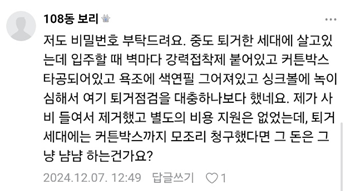 A tenant who moved in after the previous occupant's departure at Goyang Deok-eun Jungheung S-Class resident cafe stated that defect repairs were not properly completed. Provided by the Tenants' Association.
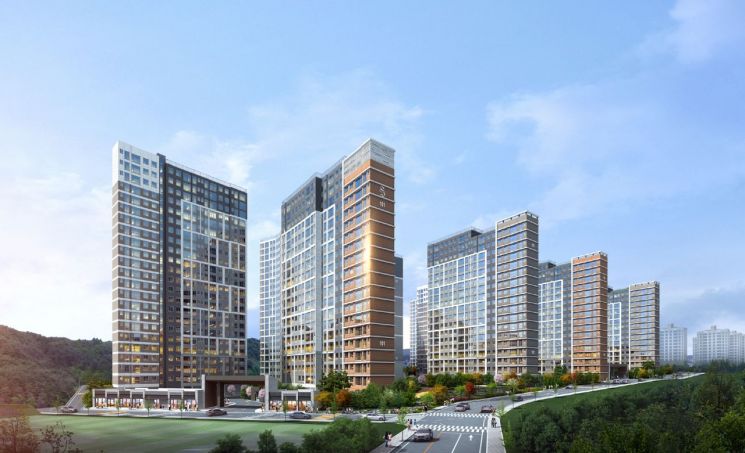
Jungheung S-Class Park City in Goyang Deogeun District is a complex of 894 households built on Block A2 of the Goyang Deogeun Urban Development Zone. It was developed by Jungbong Construction, a subsidiary of the Jungheung Construction Group, and constructed by the parent company Jungheung Togeon as a public support private rental (8 years) apartment. Out of 894 households, 391 were supplied for rent. Move-in began in November 2022, and move-outs started last month after two years.
Public support private rental housing refers to housing constructed and rented with public support such as investment from the Housing and Urban Fund and relaxed floor area ratio regulations. Initial rent is set at 85-95% of the surrounding market price, and rent increases are limited to within 5%. The tenant recruitment announcement states, "Tenants must exchange or compensate for loss or damage of items listed in the facility handover document completed at initial move-in with products of equal quality at their own expense." It also specifies the types of materials and repair cycles, but does not clearly state whether labor costs are included.
A Jungheung Togeon official responded to these criticisms, saying, "If tenants restore the property themselves, it may cost more, so we provided estimates and guidance. If tenant complaints continue, we believe it is appropriate to make improvements."
© The Asia Business Daily(www.asiae.co.kr). All rights reserved.
![Clutching a Stolen Dior Bag, Saying "I Hate Being Poor but Real"... The Grotesque Con of a "Human Knockoff" [Slate]](https://cwcontent.asiae.co.kr/asiaresize/183/2026021902243444107_1771435474.jpg)


















