Despite a hot rally and consecutive record-breaking performances this year, the Japanese stock market's returns in dollar terms remained in the single digits due to the depreciation of the yen.
As of the 24th, the Nikkei 225 Average Stock Price Index (Nikkei Index), Japan's representative stock index, and the Tokyo Stock Price Index (TOPIX) showed year-to-date returns of 16.65% and 15.24%, respectively, reflecting double-digit growth. However, when converted to dollar terms, the returns for these two indices were 4.83% and 3.55%, respectively, remaining in the single digits. This contrasts with the Hong Kong H-Share Index (Hang Seng China Enterprises Index, HSCEI), which recorded a year-to-date return of 26.62%, rising to 27.31% when converted to dollar terms during the same period.
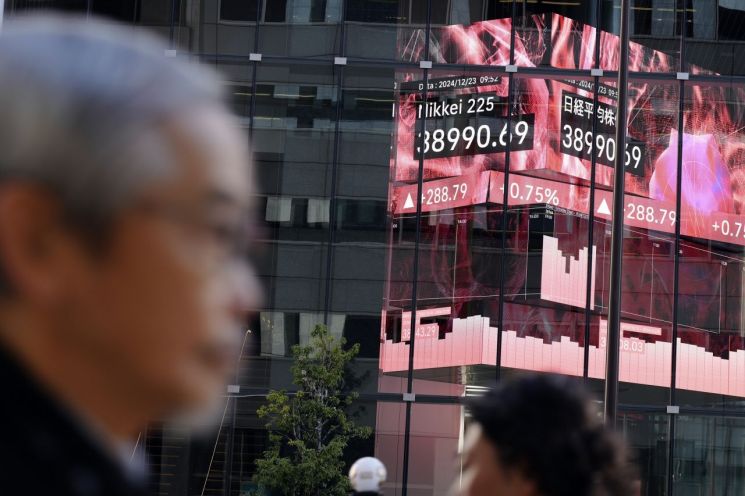
The cause of this phenomenon is attributed to the "weak yen." While the depreciation of the yen improved the earnings of Japanese exporters and the Bank of Japan's (BOJ) interest rate hikes supported a rally in financial stocks, the volatility of the yen's value and the interest rate gap between the U.S. and Japan hindered foreign investors from entering the stock market. Additionally, the weak yen raised import prices, causing inflation to rebound and placing a burden on the economy.
Bloomberg reported, "The yen depreciated about 10% against the dollar this year," adding, "The Japanese stock market had a very good year in 2024, but the situation was different for dollar-based investors, whose returns were meager."
Comments from Japanese financial authorities with a "dovish" stance, which put upward pressure on the yen-dollar exchange rate (yen depreciation), also reinforce expectations that the Japanese stock indices' dollar-denominated returns will continue to be weak. Last week, BOJ Governor Kazuo Ueda explained the background for the third consecutive hold of the benchmark interest rate (0.25%) by stating, "More information on future wage increase trends, such as next year's spring labor negotiations (shunto), is needed to make a decision on raising rates."
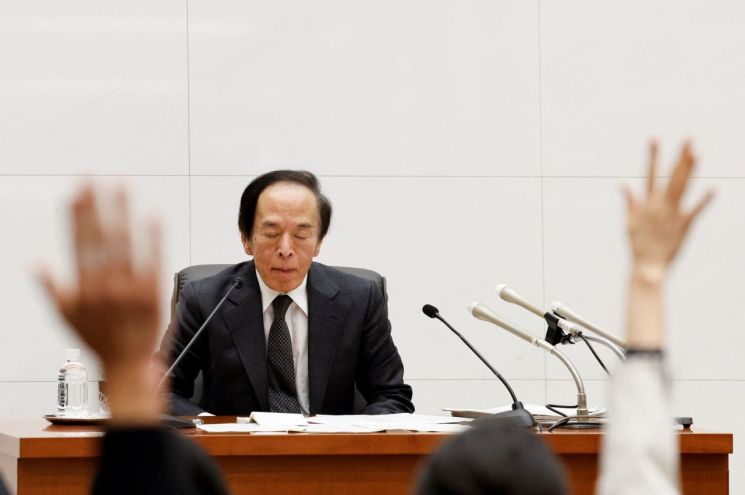
Governor Ueda's remarks led the market to retreat from expectations of an early rate hike and to anticipate that it will take more time for the U.S.-Japan interest rate gap to narrow. Consequently, the yen-dollar (JPY/USD) exchange rate approached the 158 yen level on the 20th, marking the highest level in five months. In response to the rapid yen depreciation, Japanese Finance Minister Katsunobu Kato expressed deep concern about recent exchange rate movements, including speculative forces, and hinted at possible intervention in the foreign exchange market if the yen's value falls beyond a certain level.
Amir Anbarzadeh, Japan equity strategist at Asymmetric Advisors, pointed out, "Recent signals from the BOJ are weakening the yen and raising import prices while encouraging foreign investors to hedge more against currency risk when investing in Japan, causing harm. Foreign investors have already invested significant amounts in Japan, but the results have been very disappointing."
Meanwhile, according to the October labor statistics survey released by Japan's Ministry of Health, Labour and Welfare on the same day, the real wages per worker at companies with five or more employees decreased by 0.4% compared to a year ago, marking the third consecutive month of decline. Japan's real wages, which recorded a record-long decline for 26 consecutive months from April 2022 to May this year, briefly rebounded in June and July due to increased summer bonuses but turned negative again from August.
© The Asia Business Daily(www.asiae.co.kr). All rights reserved.
![Clutching a Stolen Dior Bag, Saying "I Hate Being Poor but Real"... The Grotesque Con of a "Human Knockoff" [Slate]](https://cwcontent.asiae.co.kr/asiaresize/183/2026021902243444107_1771435474.jpg)

















