Bank of Korea Decides on Monetary and Credit Policy Operation Direction for 2025
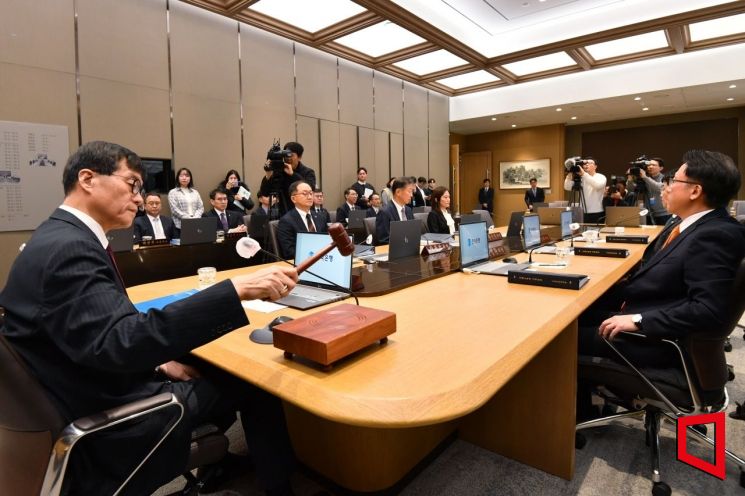 Lee Chang-yong, Governor of the Bank of Korea, is striking the gavel at the Monetary Policy Committee meeting held at the Bank of Korea in Jung-gu, Seoul, on the 28th of last month. Photo by Joint Press Corps
The Bank of Korea announced that it will further lower the base interest rate next year in response to changes in the economic situation.
The Monetary Policy Committee (MPC) of the Bank of Korea announced on the 25th that it had resolved the "2025 Monetary and Credit Policy Operation Direction" containing this content.
Regarding next year's base interest rate, the Bank of Korea explained that it will further reduce the rate in accordance with changes in the economic situation while paying attention to financial stability risks.
It emphasized that the decision was made considering the expanded downside risks to the economy due to increased political uncertainty, intensified global competition in key industries, and changes in the trade environment, while inflation is expected to continue on a stable path.
From the perspective of financial stability, it pointed out that macroprudential policies are expected to function smoothly, leading to a continued slowdown in household debt, but it is necessary to continuously monitor the effects of interest rate cuts and other factors.
It also added that attention should be paid to the impact of changes in major countries' monetary policies and domestic and international political uncertainties on exchange rate volatility.
The pace of future interest rate cuts will be flexibly determined by closely examining the development of domestic and external risk factors, the resulting inflation and growth trends, changes in financial stability, and the conflicting relationships among policy variables.
It announced that improvements to the Bank of Korea's lending system to strengthen its financial stability role will also be continuously pursued. It plans to develop IT systems and establish related regulations to allow financial institutions' loan receivables to be used as eligible collateral for Bank of Korea loans.
It added that related laws and systems will be continuously improved to supply liquidity promptly to non-bank deposit-taking institutions when necessary.
© The Asia Business Daily(www.asiae.co.kr). All rights reserved.
![Clutching a Stolen Dior Bag, Saying "I Hate Being Poor but Real"... The Grotesque Con of a "Human Knockoff" [Slate]](https://cwcontent.asiae.co.kr/asiaresize/183/2026021902243444107_1771435474.jpg)















