YouGov Survey Results for U.S. Adults
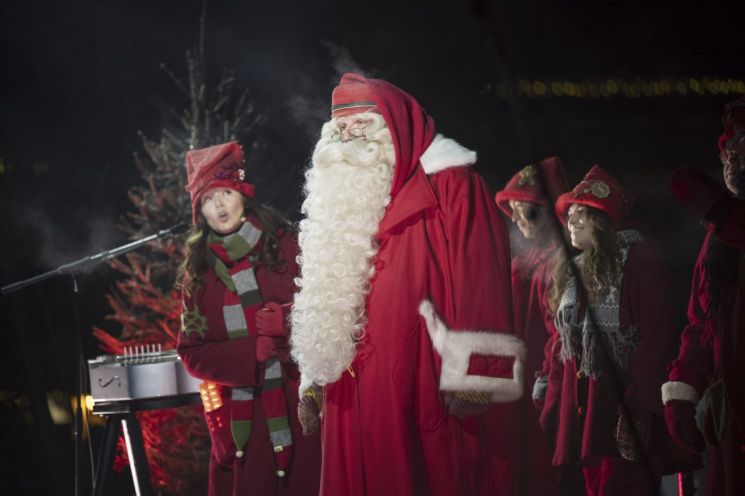
Grandfather Santa Claus, dressed in red clothes with a rich white beard and a thick belly, is a figure symbolizing Christmas. Every year in Lapland, northern Finland, known as the 'Santa Village,' Santa Claus sets off on a reindeer-drawn sleigh to deliver gifts to children around the world. Parents who have explained the existence of Santa Claus to their children are busy preparing gifts in advance.
On the 23rd (local time), The New York Times (NYT) reported that a global polling organization YouGov surveyed 1,107 American adults, and 58% of respondents with children under 18 answered "yes" to the question, "Does your child believe that Santa Claus exists?" In 2022, the affirmative response rate to the same question was 65%, showing a slight decline over two years.
Surveys on children’s belief in the existence of Santa Claus have been conducted in various places for a long time. NYT published on the front page on December 24, 1985, Christmas Eve, the results of a survey of 261 children aged 3 to 10. In this survey, 87% of children said they believed in Santa Claus. At that time, children imagined Santa Claus in their own way as "someone who loves children and never dies," "a kind and loving person," "someone who likes the color red, enjoys food, and lives in the North Pole."
Although no additional surveys targeting children were conducted, NYT reported that some surveys asked parents whether their children believed in Santa Claus. In 2013, the Pew Research Center surveyed parents with children under 18, and 58% of respondents said their children believed in Santa Claus.
Surveys about whether parents themselves believed in Santa Claus during their childhood showed even higher response rates. In this year’s YouGov survey, 81% of respondents said they believed in Santa Claus as children, and 76% said their parents or guardians acted as if Santa Claus visited on Christmas Eve or Christmas Day. In 2022, the rate of respondents who believed in Santa Claus during childhood was also high at 76%.
When asked when they realized that Santa Claus does not actually exist, 25% answered "I don’t know," which was the highest response, followed by 13% who said "around age 10." Regarding how they found out that Santa Claus does not exist, 36% said they discovered it on their own, the most common answer. Many respondents felt disappointed (34%) or sad (26%) upon learning this fact.
In this year’s survey, 52% answered "yes" to the question of whether they plan to pretend that Santa Claus visited their children. This was down 14 percentage points from 66% in 2022. For children who believe in Santa Claus this year, 65% said they would hang stockings to hold gifts, and 45% said they would leave cookies or milk for Santa Claus.
Meanwhile, among the American middle class, it was found that the cost spent on Christmas holiday gifts has decreased due to high inflation. Polling organization Gallup reported at the end of last month that American households with an annual income of $40,000 to $100,000 (approximately 58 million to 145 million KRW) said they would reduce their Christmas holiday gift expenses by an average of 20% compared to a year ago.
© The Asia Business Daily(www.asiae.co.kr). All rights reserved.
![Clutching a Stolen Dior Bag, Saying "I Hate Being Poor but Real"... The Grotesque Con of a "Human Knockoff" [Slate]](https://cwcontent.asiae.co.kr/asiaresize/183/2026021902243444107_1771435474.jpg)
















