Pressure to Lower Tolls Despite Panama Government Opposition
Concerns Over Blockades Spread Amid China's Growing Influence
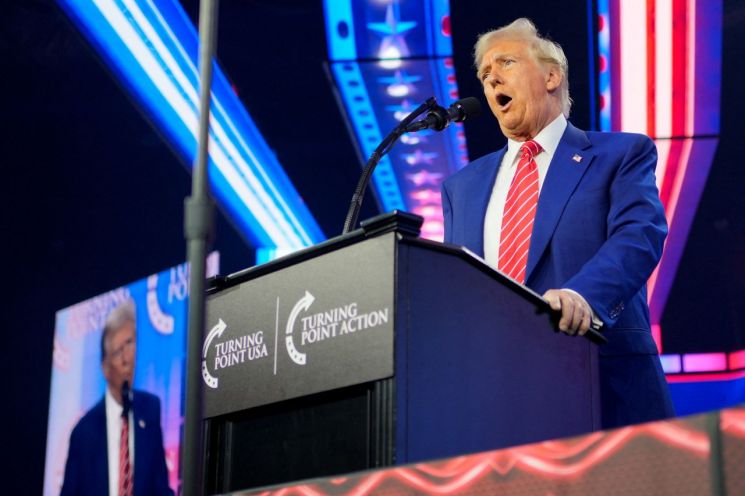 On the 22nd (local time), Donald Trump, the President-elect of the United States, attended and delivered a speech at an event hosted by the American youth conservative organization 'Turning Point USA.' In the speech, President-elect Trump warned the Panamanian government that if the toll fees for the Panama Canal are not reduced, he would move to reclaim ownership of the canal. Photo by Reuters and Yonhap News.
President-elect of the United States, Donald Trump, is pressuring the Panamanian government by demanding a reduction in the toll fees of the Panama Canal. On the surface, this appears to be an economic dispute aimed at lowering import prices by reducing canal tolls, but analysts suggest that the underlying motive is to counter the expanding influence of China inside and outside Panama. Concerns have been raised within and outside the U.S. political sphere that if Panama fully aligns itself as a pro-China country, the use of the canal could become difficult in times of emergency.
Trump: "If tolls are not lowered, we will demand return"…Panamanian government: "Not even 1㎥ will be given" ? Diplomatic tensions escalate
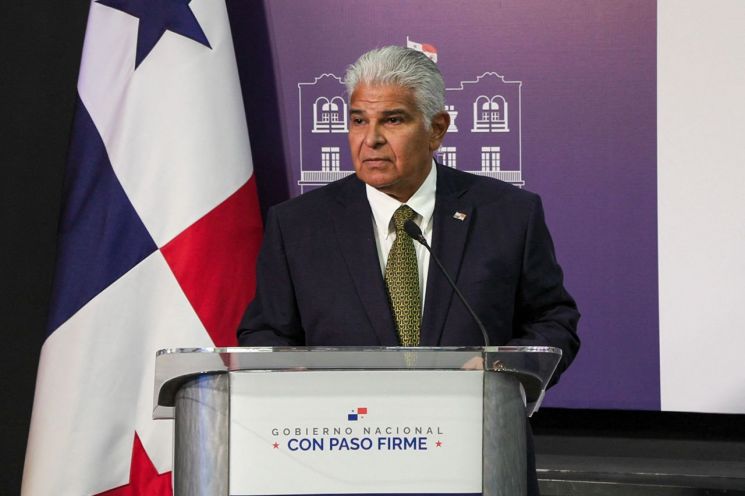 President Jos? Ra?l Mulino of Panama holding a press conference on the 19th (local time). Photo by AFP and Yonhap News.
Panamanian President Jos? Ra?l Mulino emphasized in a national address video posted on social media platform X (formerly Twitter) on the 22nd (local time), "The Panama Canal is an exclusive asset of our nation, and we cannot concede even 1㎥," adding, "Territorial sovereignty is not subject to compromise."
The video was posted shortly after President-elect Trump stated that he would push for the return of the canal if toll fees were not reduced. At an event hosted by the American youth conservative group Turning Point USA on the 22nd, Trump said, "The tolls Panama charges on U.S. warships and commercial vessels are outrageously expensive and unfair," and warned, "If Panama does not stop extorting the U.S. and uphold moral and legal principles regarding generous gifts, we will demand the return of the Panama Canal."
The Panama Canal, where tensions between the two countries have surfaced, was constructed in Panama in 1914 by the United States to enable ships from the U.S. East Coast and Atlantic to quickly reach the Pacific, facilitating U.S. expansion into the Pacific region including the Philippines and China. The U.S. managed and exercised ownership until the Carter administration in 1977, when a treaty was signed to return the canal to Panama, which was fully handed over in 1999. Since a major expansion project in 2007, the Panamanian government has continuously raised toll fees.
China's influence grows after U.S. return in 1999…Concerns over blockade in emergencies
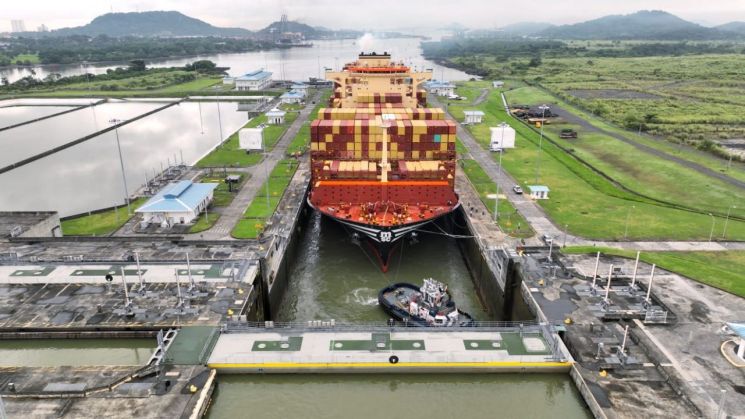 On August 30th (local time), a large cargo ship was waiting to pass through the Panama Canal. The Panama Canal has recently experienced increasingly severe droughts due to climate change, causing water levels to gradually drop and making it difficult for large cargo ships to pass through. Photo by AFP and Yonhap News Agency
Some point out that behind the friction between the U.S. and Panamanian governments over canal tolls lies a purpose to check China's influence. Panama, a strategically important location both economically and militarily, has recently shown signs of shifting toward a pro-China stance.
In 2017, Panama severed diplomatic ties with Taiwan and formally established relations with China. Following this, the Chinese government attempted to purchase land near the entrance of the Panama Canal to build a new embassy starting in 2018, but strong opposition from the U.S. government prevented this. To date, the Chinese embassy operates temporarily in a commercial district within Panama. CNN reported that since then, there has been significant concern within U.S. political circles about the strengthening of Chinese influence in Panama.
Currently, two of the five major ports near the Panama Canal are operated by Hong Kong-based company CK Hutchison. Additionally, the Chinese government and companies have invested over $1 billion (approximately 1.45 trillion KRW) in infrastructure projects such as constructing a new bridge across the canal. As China’s economic influence grows in Panama, there are fears that Panama, traditionally a pro-U.S. country, may shift toward becoming pro-China.
Within the U.S. Republican Party, voices warning against the expansion of Chinese influence continue to emerge. Matt Gaetz, a former congressman who was recently nominated but rejected as the new Trump administration’s Attorney General, emphasized, "We are not reclaiming the canal from Panama, but from China." Mike Davis, a former senior legal counsel responsible for Senate Judiciary Committee confirmation hearings and known as a close associate of President-elect Trump, also warned, "China is occupying the Panama Canal, and we cannot allow that to happen."
© The Asia Business Daily(www.asiae.co.kr). All rights reserved.
![Clutching a Stolen Dior Bag, Saying "I Hate Being Poor but Real"... The Grotesque Con of a "Human Knockoff" [Slate]](https://cwcontent.asiae.co.kr/asiaresize/183/2026021902243444107_1771435474.jpg)


















