The won-dollar exchange rate has surged sharply, casting a shadow over banks that have recently increased corporate loans rapidly. Delinquency rates were already rising due to the economic downturn, and to make matters worse, the soaring exchange rate is causing a rapid deterioration in business prospects for companies.
According to Seoul Foreign Exchange Brokerage on the 24th, the won-dollar exchange rate closed at 1,452.0 won as of 3:30 PM on the 23rd. This is a rise of 50.7 won compared to 1,401.3 won on the 2nd, about two weeks ago. This is also the highest level in 15 years since the 2009 global financial crisis.
As the exchange rate surged, the five major financial holding companies (KB, Shinhan, Hana, Woori, NH Nonghyup) are reviewing revisions to their management plans. Not only has the exchange rate, which was predicted to be in the 1,300 won range, exceeded 1,450 won, but there are also growing forecasts that it could rise even higher. Financial holding companies are reportedly considering scenarios where next year's upper exchange rate reaches the high 1,400 won range or even the 1,500 won range.
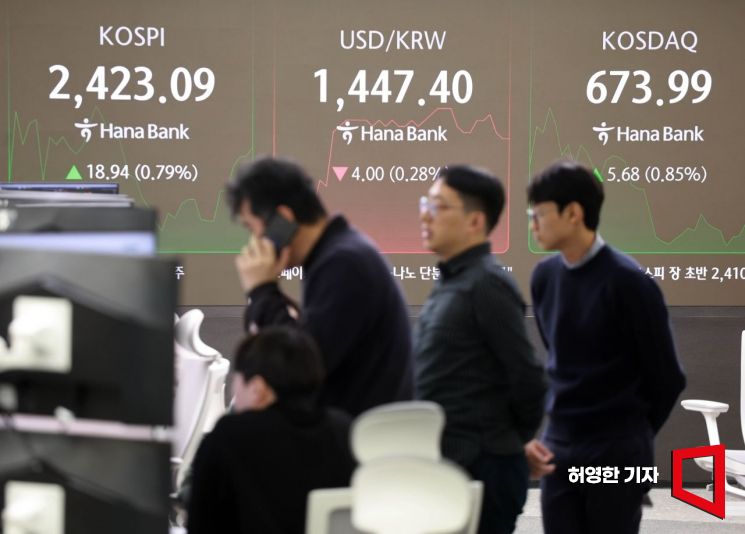 The KOSPI, which was struggling around the 2400 level, opened higher on the 23rd at 2423.36 points, up 19.21 points (0.80%), starting strong along with the KOSDAQ. The USD-KRW exchange rate slightly fell below the 1450 won mark. Various indices are displayed in the dealing room of Hana Bank in Euljiro, Seoul. Photo by Heo Young-han
The financial sector is concerned about a decline in the Common Equity Tier 1 (CET1) ratio, a key soundness indicator for financial companies. Financial authorities recommend that financial holding companies maintain a CET1 ratio of 13% or higher, and it is generally known that CET1 decreases by about 0.1 to 0.3 basis points (1bp = 0.01%) for every 10 won increase in the won-dollar exchange rate.
However, financial holding companies say they still have sufficient buffers. Except for some financial holding companies, all others have CET1 ratios exceeding 13%. A representative from a financial holding company said, "Except for Woori Financial Group, the others have CET1 ratios above 13%, so even if the exchange rate rises somewhat, there is a buffer to withstand it," adding, "Based on 1,300 won, we believe the 13% CET1 ratio can be maintained even with an additional increase of about 200 to 300 won."
What they are more concerned about is the potential deterioration in the quality of loan assets due to the sharp rise in the exchange rate. Typically, when the won-dollar exchange rate rises, import prices surge, significantly impacting import companies or export-import companies that import raw materials from overseas, reprocess them, and export them.
In particular, the financial sector has rapidly increased corporate loans over the past several years. This is because the growth of household loans has reached its limit, leading to a growth strategy focused on corporate loans. In fact, the outstanding balance of small and medium-sized enterprise loans at the five major commercial banks was 598.2095 trillion won at the end of 2022, 630.8855 trillion won at the end of 2023, and 665.9608 trillion won as of the end of November this year, rising sharply by about 32 to 35 trillion won each year.
Already, the banking sector is seeing an expansion in corporate loan delinquencies due to the economic downturn. According to the Financial Supervisory Service, the delinquency rate for small and medium-sized enterprise loans was 0.70% at the end of October, up 0.15 percentage points from 0.55% at the end of the same month last year. Among these, the delinquency rate for small and medium-sized corporations excluding individual business owners was even higher at 0.74%.
A representative from a commercial bank said, "Small and medium-sized export-import companies tend to be vulnerable to exchange rate hedging and often bear the full brunt of the soaring exchange rate," adding, "As the focus has been on corporate loans, the increase in non-performing loans is likely to be significant in order."
© The Asia Business Daily(www.asiae.co.kr). All rights reserved.

















