KRX300 Financial Index Down 10% in Last 3 Weeks
Sharp Drop Amid Doubts on Shareholder Return Sustainability
"Limited Impact on Capital Ratio Due to Rapid Exchange Rate Surge"
As financial stocks recently plunged due to uncertainties surrounding value-up policies, an analysis suggests that price attractiveness has emerged. It is difficult for financial companies such as banks and insurers to reverse the value-up disclosures they have already made, and the sharp rise in exchange rates is expected to only slightly impair their ability to carry out shareholder returns.
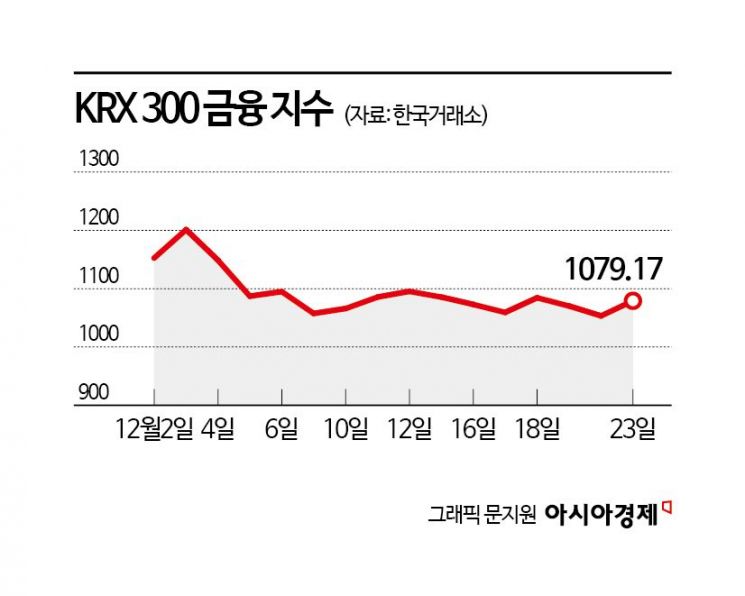
According to the Korea Exchange on the 24th, the KRX300 Financial Index, composed of major domestic banks and insurance companies, rebounded by 25.86 points (2.46%) from the previous closing price to 1079.17, outperforming the KOSPI’s 1.57% increase. However, compared to the peak on the 3rd when martial law was declared, it still remains down by 10.17%. Financial stocks had been highlighted as representative beneficiaries of value-up policies in this year’s stock market and continued their rally, but concerns over the collapse of value-up policies amid the impeachment crisis following President Yoon Seok-yeol’s declaration of emergency martial law, as well as worries about the capacity to fulfill shareholder returns due to unstable KRW-USD exchange rates, have spread in the market, leading to recent sharp declines.
While some point out that value-up policies have lost momentum, there is an analysis that these uncertainties should be seen as buying opportunities. Hyejin Park, a researcher at Daishin Securities, said, “Financial holding companies have repeatedly expressed their willingness to increase dividends to boost stock prices, but due to the financial authorities’ emphasis on the role of D-SIBs (Domestic Systemically Important Banks), they were unable to expand dividends. However, in recent years, dividend policies of financial holding companies, such as interim dividends and quarterly equal dividends, have improved faster than expected, and thanks to value-up policies, the total payout ratio of financial holding companies has reached 50%.” She added, “Reversing value-up disclosures in this situation would represent the peak of credibility decline. It is not easy for financial companies to reverse value-up disclosures.”
She further stated, “In such a chaotic time, financial stocks can be a good alternative. We recommend buying during price corrections for KB Financial, the leading bank stock; Meritz Financial Group, which has solid fundamentals in the fire insurance sector and is expected to strengthen overseas stocks; and Samsung Fire & Marine Insurance, which is expected to expand its market share in the health insurance market next year.”
Among insurance stocks, Samsung Fire & Marine Insurance is particularly expected to show superior performance in profits and shareholder return ratios compared to competitors. Taejun Jung, a researcher at Mirae Asset Securities, said, “The biggest variable affecting the expected dividend yield is the decrease in Contractual Service Margin (CSM) due to changes in assumptions about lapse rates for no-surrender and low-surrender insurance policies. This is expected to significantly impact mainly the second-tier companies, while Samsung Fire & Marine Insurance’s impact will be limited.” He analyzed, “Based on overwhelming capital strength, it is leading the industry alone with a price competitiveness-focused strategy. It is expected to continuously maintain its profit growth advantage.”
Regarding bank stocks, concerns have been raised that the sharp rise in exchange rates has greatly impaired their capacity for shareholder returns. However, the securities industry analyzes that the rise in exchange rates alone does not eliminate the possibility of fulfilling value-up disclosures. While the exchange rate increase causes foreign currency translation losses and raises the growth rate of risk-weighted assets (RWA), thereby lowering the Common Equity Tier 1 (CET1) ratio, considering other variables comprehensively, concerns about exchange rate fluctuations are excessive. Jaewoo Kim, a researcher at Samsung Securities, said, “Although the exchange rate rise burdens banks’ CET1, it is somewhat premature to worry about a reduction in shareholder returns due to this at the current stage.” He added, “Factors affecting RWA are not limited to exchange rates. Loan growth rates, loan mix, and growth in non-bank sectors, as well as risk management capabilities, must also be considered.” He explained, “Loan growth rates of banks are rapidly slowing down and may decline further. This is because banks have been making efforts such as suspending loan sales or abolishing preferential interest rates to manage total household loans until the end of the year.”
Furthermore, Kim pointed out the need to consider that if the RWA growth rate is lower than initially expected in the first half of next year, the speed of CET1 improvement could accelerate. He said, “Assuming an RWA growth rate of 1% compared to the beginning of the year, the CET1 of the three major financial holding companies is estimated to improve by up to 0.43 percentage points compared to the end of the year.” He forecasted, “Improvement in CET1 leads to an increase in shareholder return capacity. Additionally, if the KRW-USD exchange rate falls due to stabilization of the domestic economic environment next year, CET1 could improve further.”
© The Asia Business Daily(www.asiae.co.kr). All rights reserved.
![Clutching a Stolen Dior Bag, Saying "I Hate Being Poor but Real"... The Grotesque Con of a "Human Knockoff" [Slate]](https://cwcontent.asiae.co.kr/asiaresize/183/2026021902243444107_1771435474.jpg)















