Seorin Company’s Valuation Triples in One Year
Global Capital Inflow Sparks Cheers Amid Overheating Concerns
At Least 2-3 Years of 'Rosy Atmosphere' Expected to Continue
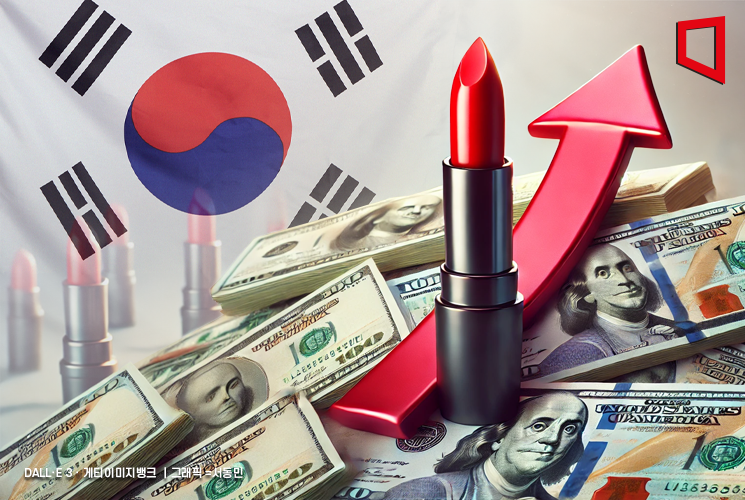
Thanks to the global growth momentum this year, the highest number of K-beauty mergers and acquisitions (M&A) deals in the past decade have been completed. Notably, a large influx of foreign capital has been observed. Alongside the overheated market atmosphere, concerns have also emerged that "valuations have reached their peak."
This year, there have been at least 15 known K-beauty company M&A deals. According to MMP, a consulting firm specializing in M&A for small and medium-sized enterprises, the year with the most M&A deals from 2015 through last year was 2018, with 13 deals. In 2018, the market atmosphere peaked, exemplified by the acquisition of Stylenanda by L'Or?al, the world's largest cosmetics company based in France. In 2021, 2022, and last year, there were 10 deals each. Looking back over the past decade, this year is the most active.
'K-beauty Glow' Captivates North America and Europe, Driving Up Valuations
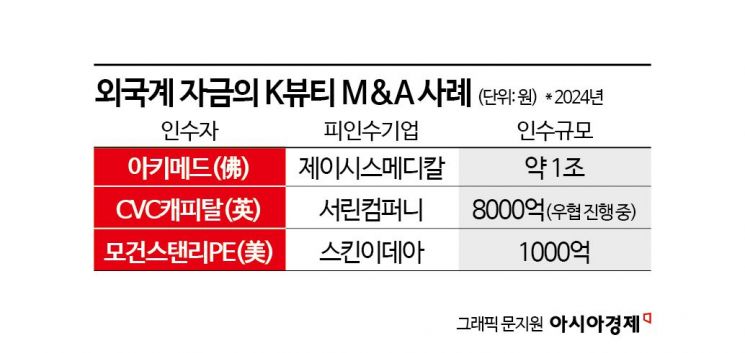
Examining the M&A landscape, acquirers ranged from private equity funds to cosmetics companies and pharmaceutical firms. A key feature is the massive inflow of foreign capital. It began in February when the U.S.-based private equity firm Morgan Stanley Private Equity (PE) acquired Skin Idea for about 100 billion KRW. In June, the French PE firm Archimed acquired JC's Medical for approximately 1 trillion KRW, and recently, the UK-based PE firm CVC Capital was selected as the preferred bidder for Seorin Company, with an expected sale price around 800 billion KRW. Calypso Capital and Meritz Securities, who acquired Seorin Company for about 240 billion KRW in July 2023, are now on the verge of recovering nearly three times their principal investment within just over a year.
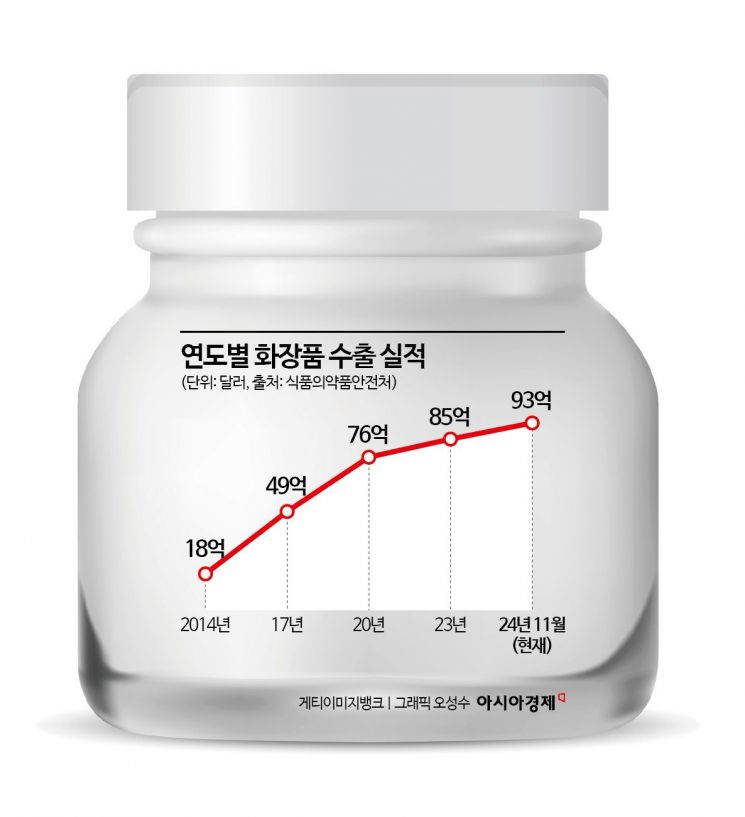
The current atmosphere recalls the period before COVID-19 when foreign capital poured into K-beauty. During that time, Cover Korea (2017), Stylenanda (2018), and Have & Be (2019) were successively acquired by global cosmetics companies. The difference now is that the domestic cosmetics industry has expanded its base beyond the Chinese market to dominate North America and Europe. Export volumes have also hit record highs. According to the Ministry of Food and Drug Safety, South Korea's cosmetics export volume totaled 9.3 billion USD from January to November this year, surpassing the previous record of 9.2 billion USD for the entire year of 2021.
"Is Valuation at Its Peak Now? Still Comfortable for 2-3 More Years"
While the seller's psychology of "selling when prices are high" is fueling market overheating, concerns that "valuations have reached their peak" remain. Although short-term sales growth across the domestic cosmetics industry is clear, questions about sustainability still linger. Yumi Kim, Executive Director at Samjong KPMG, said, "It appears that founders or private equity funds holding K-beauty companies see this as an exit timing and are actively pursuing recovery. Conversely, from the buyer's perspective, the won-dollar exchange rate is very high, creating an atmosphere where foreign capital can boldly bet."
The prevailing analysis is that the rosy atmosphere in the K-beauty M&A market will continue for the next 2 to 3 years. Currently, cosmetics original equipment manufacturers (OEMs) Hwaseong Cosmetic and GDK Cosmetics are seeking new owners. Classys, ranked in the top 10 by market capitalization on KOSDAQ, is also subject to ongoing rumors of management rights sales. The domestic cosmetics industry is viewed not as having peaked but as having significant growth potential. Jongdae Park, a researcher at Meritz Securities, said, "K-beauty is strengthening its resilience online and expanding into the main offline market in terms of channels. In terms of categories, in the U.S., the market is expanding from basic skincare to color cosmetics, indicating even greater medium- to long-term growth potential."
© The Asia Business Daily(www.asiae.co.kr). All rights reserved.
![Clutching a Stolen Dior Bag, Saying "I Hate Being Poor but Real"... The Grotesque Con of a "Human Knockoff" [Slate]](https://cwcontent.asiae.co.kr/asiaresize/183/2026021902243444107_1771435474.jpg)

















