Martial Arts, 2025 Global Maritime Freight Rate Outlook Survey
74.4% of Companies Expect "Maritime Freight Rates to Rise or Stay Steady"
Trade industry experts have forecasted that the global maritime freight rates, which surged due to geopolitical risks, may rise further next year. The increase in logistics costs could heighten export risks, causing concern within the industry.
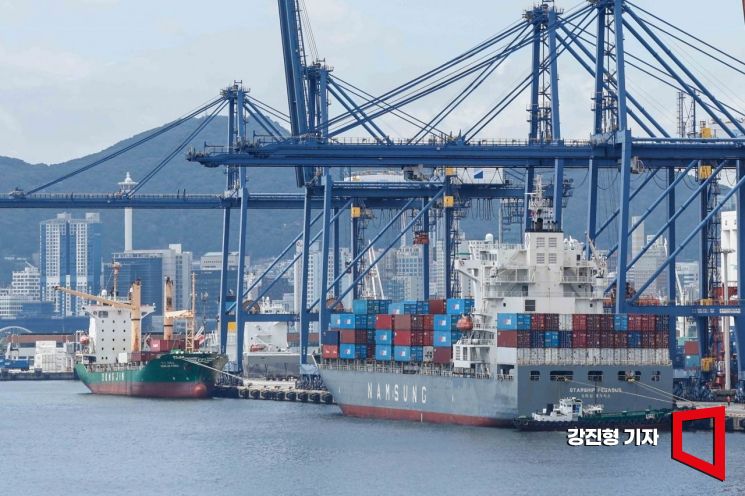
According to the "2025 Global Maritime Freight Rate Outlook Survey" released by the Korea International Trade Association (KITA) on the 23rd, 74.4% of the 413 respondents expected maritime freight rates to either increase (39.8%) or remain steady (34.6%) next year. The survey covered domestic exporters (shippers), shipping companies (shipowners), and international freight forwarders.
The Shanghai Containerized Freight Index (SCFI) peaked at 3,733 points in July this year after rising from 993 points in November last year, when Yemeni Houthi rebels attacked commercial vessels. After a decline, it has been on an upward trend for the past four consecutive weeks, currently standing at 2,384 points as of this month.
Factors driving companies' expectations of rising freight rates include the prolonged Middle East conflict (21.9%), global shipping companies' control of vessel capacity (21.8%), and increased Chinese export push volumes (14.2%).
Following the Middle East conflict, global shipping companies have rerouted vessels around the Cape of Good Hope instead of the Suez Canal, effectively reducing available vessel capacity and causing bottlenecks, which is expected to increase pressure on freight rates. Additionally, if shipping companies maximize profitability by limiting vessel supply through temporary cancellations and ship repairs, freight rates could rise.
The US-China conflict may also contribute to freight rate increases. If the US raises tariffs on China, the surge in Chinese export push volumes could cause a short-term spike in maritime freight rates.
Since the Biden administration announced tariff hikes on strategic Chinese goods in May, the SCFI jumped approximately 62% in two months, from 2,306 points on May 10 to 3,733 points on July 5.
Other factors cited for next year's freight rate increases include growth in global trade volume (13.2%), potential strikes at US East Coast ports (10.8%), and stricter carbon emission regulations (9.4%).
Freight rate outlooks by route diverged between exporters and logistics companies (shipping companies and forwarders). For the Americas route, exporters anticipated rate increases due to port strikes and protectionist policies, while logistics companies expected rates to fall due to increased vessel capacity. Both parties agreed on rising rates for the Europe route.
KITA predicted that the impact of new vessel capacity increases on freight rates would be limited. Although total vessel capacity is expected to grow by about 6% next year, considering the effective capacity reduction of 4-5% due to Cape of Good Hope rerouting and a 3.3% increase in global container throughput, the effect of capacity growth is not significant. A high freight rate trend is expected to continue.
KITA emphasized the need to expand maritime transport support programs for small and medium-sized enterprises and increase logistics voucher support limits. It also called for urgent measures to regulate global shipping companies' artificial supply control and to lift restrictions on container terminal inbound operations at Busan New Port (currently allowing container entry only three days before vessel arrival).
Lee In-ho, Vice Chairman of KITA, stated, "Given the significant uncertainty in maritime freight rates, public and private sectors must cooperate to secure stable export routes. KITA will work with the government to develop countermeasures."
© The Asia Business Daily(www.asiae.co.kr). All rights reserved.
![Clutching a Stolen Dior Bag, Saying "I Hate Being Poor but Real"... The Grotesque Con of a "Human Knockoff" [Slate]](https://cwcontent.asiae.co.kr/asiaresize/183/2026021902243444107_1771435474.jpg)
















