Keynote Speech at the Korean International Economic Association Winter Conference
Non-Reserve Currency Countries Face Limits in Price and Financial Stability with Monetary Policy Alone
Foreign Exchange Reserves of $400 Billion Are Sufficient... IMF Positively Evaluates Korea
Rebuttal of August Rate Cut Delay Theory... "If Cut, Household Debt Control Would Have Been Difficult"
Lee Chang-yong, Governor of the Bank of Korea, emphasized on the 23rd that "non-reserve currency countries find it difficult to achieve both price stability and financial stability through monetary policy alone," and stated that "an integrated policy framework utilizing various policy tools such as macroprudential policies and foreign exchange market interventions must be applied."
Governor Lee also reiterated his rebuttal against the theory of missed rate cuts in August, evaluating that "although I asked to be evaluated after one year, it seems that the pause then provided the capacity to lower interest rates twice consecutively in October and November."
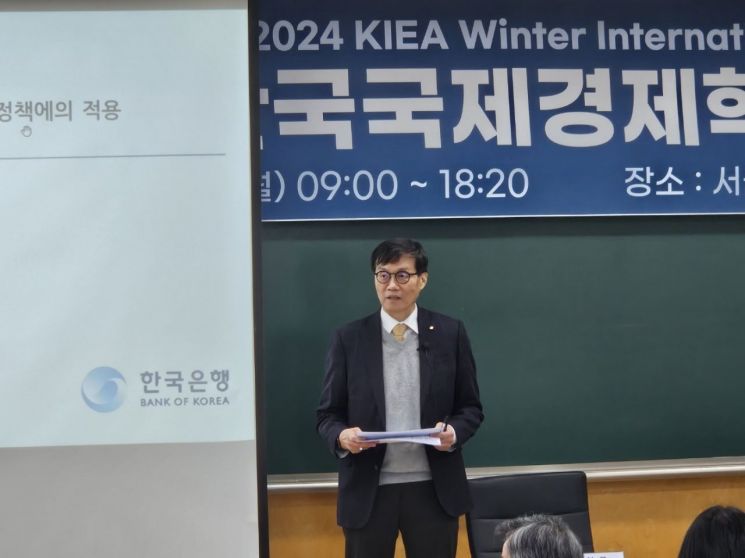 Lee Chang-yong, Governor of the Bank of Korea, is delivering the keynote speech at the "2024 Korean International Economic Association Winter Conference" held on the 23rd at the University of Seoul in Dongdaemun-gu, Seoul. (Photo by Park Jaehyun)
On the morning of the same day, Governor Lee attended the Winter Academic Conference of the Korean International Economic Association at the University of Seoul in Dongdaemun-gu, Seoul, where he delivered a keynote speech titled "Integrated Policy Framework: Application of Korean Monetary Policy."
He explained, "Non-reserve currency countries are highly sensitive to changes in the global financial environment, resulting in large volatility in capital flows and exchange rates, and their role as lenders of last resort in the foreign exchange market is limited," adding, "International organizations such as the International Monetary Fund (IMF) and the Bank for International Settlements (BIS) have begun analyzing that non-reserve currency countries can more effectively achieve price stability and financial stability by utilizing an integrated policy framework (IPF) that combines various policy tools such as macroprudential policies and foreign exchange market interventions."
According to the IMF and BIS, the policy tools available under the integrated policy framework are categorized into four types: monetary policy, macroprudential policy, capital flow management policy, and foreign exchange market intervention. Monetary policy includes interest rate adjustments and liquidity provision; macroprudential policy includes credit management measures such as loan-to-value (LTV) ratio and debt service ratio (DSR) regulations; capital flow management policy includes forward exchange position regulations and foreign exchange soundness charges.
Regarding foreign exchange market intervention, he assessed that the foreign exchange reserves of about 400 billion USD are sufficient. Governor Lee stated, "Although the won-dollar exchange rate surged above 1,400 won in the second half of 2022 over a short period, the more flexible response compared to the past was possible because of foreign exchange reserves exceeding 400 billion USD," and evaluated, "With the increase in residents' overseas investments, Korea has shifted to a net external asset country since 2014, significantly reducing the risk of default or financial crisis caused by exchange rate appreciation."
He added, "The IMF now considers it desirable to qualitatively evaluate Korea's foreign exchange reserve level rather than quantitatively assess it like emerging countries," and noted, "Since 2023, Korea has been excluded from the quantitative adequacy assessment of foreign exchange reserves applied to emerging countries."
He also reiterated his rebuttal against the theory of missed rate cuts in August. Governor Lee said, "In July and August, expectations of a pivot (monetary policy shift) by the U.S. Federal Reserve increased, and Korea's inflation fell below 2%, with market interest rates starting to decline in advance," adding, "I thought the interest rate should be lowered in August."
He continued, "However, Bank of Korea staff predicted from data in June and July that household debt would increase by 9 trillion won starting in September, and in fact, household debt exceeded 9 trillion won thereafter," evaluating, "If the interest rate had been lowered at that time (in August), it would have been difficult to control household debt and real estate." He said, "Although I asked to be evaluated after one year, it seems that the pause then provided the capacity to lower interest rates twice consecutively in October and November."
© The Asia Business Daily(www.asiae.co.kr). All rights reserved.
![Clutching a Stolen Dior Bag, Saying "I Hate Being Poor but Real"... The Grotesque Con of a "Human Knockoff" [Slate]](https://cwcontent.asiae.co.kr/asiaresize/183/2026021902243444107_1771435474.jpg)















