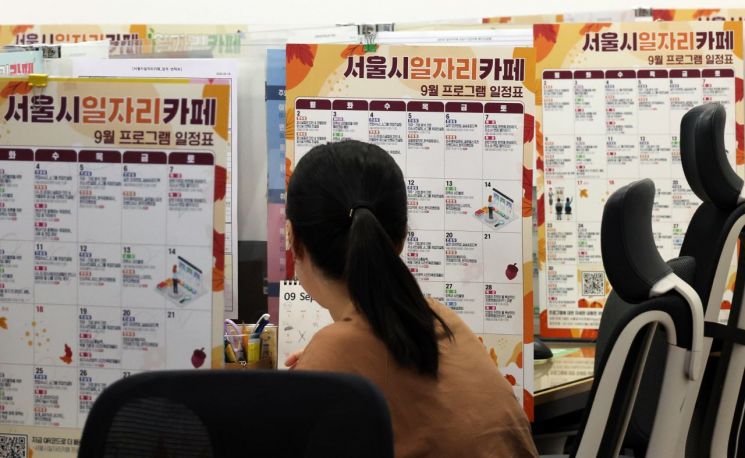
 An employee at the Seoul Youth Job Center is checking the schedule. Photo is unrelated to the article content. Photo by Yonhap News.
The number of young people with income has decreased by more than 200,000. The average annual income of the youth was about 30 million KRW, but one in three earned less than 10 million KRW.
According to Statistics Korea’s “2023 Administrative Statistics by Life Stage” released on the 23rd, the number of young people (aged 15-39) with income last year was counted at 10,993,000. The number of young earners decreased by 208,000 from 11,201,000 the previous year. The annual average income increased from 27.81 million KRW to 29.5 million KRW. By income bracket, those earning less than 10 million KRW accounted for the largest share at 32.5%, followed by those earning between 10 million KRW and less than 30 million KRW at 25.9%.
The annual average income of the middle-aged group was 42.59 million KRW, 1.4 times that of the youth. It increased by 1.75 million KRW from 40.84 million KRW the previous year. The number of middle-aged people reporting income was 16,069,000, up 119,000 from 15,950,000 the previous year. For the elderly, the average annual income rose by 750,000 KRW from 17.71 million KRW to 18.46 million KRW. The number of elderly earners increased from 3,489,000 to 3,793,000.
The highest average income was among those in their late 40s (ages 45-49) at 47.86 million KRW. The highest proportion of earners was in the early 30s, at 88.8%, surpassing other age groups. By gender, males had higher average incomes than females. Compared to females, males earned 1.4 times more in the youth group, twice as much in the middle-aged group, and 2.2 times more in the elderly group. Differences in average income were also observed by home ownership. Those who owned homes had 1.9 times higher average income in the youth group, 1.5 times higher in the middle-aged group, and 1.4 times higher in the elderly group compared to those who did not own homes.
More Earnings, More Loans... 11% of Youth Own Homes
As of November 1, based on the median loan balance in the financial sector, the middle-aged group had 60.34 million KRW, the youth group had 37.12 million KRW, and the elderly group had 33.14 million KRW in loans. The loan amount decreased most significantly among the youth. The median loan balance for the youth was 37.12 million KRW, down 2.88 million KRW (7.2%) from 40 million KRW the previous year. By age group, those in their late 30s had the highest loan balance at 78.2 million KRW. The highest proportion of loan holders was among those in their early 40s at 63.0%. Among homeowners, the youth had the largest loan balance at 146 million KRW, followed by the middle-aged group (102.99 million KRW) and the elderly group (5.17 million KRW).
Statistics Korea analyzed that in all life stages, loan balances tended to increase as income increased. Among the youth, those earning between 10 million KRW and less than 30 million KRW had the highest proportion without loans at half (49.6%). Conversely, youth earning over 100 million KRW had the lowest proportion without loans at 21.4%. The proportion with loans exceeding 300 million KRW was also highest at 25.1%. For the middle-aged and elderly groups, the proportion with loans over 300 million KRW was highest in the income bracket over 100 million KRW.
Home ownership was identified at 11.5% among the youth. Among the middle-aged group, 44.9% owned homes, and 45.3% of the elderly owned homes. The home ownership rate increased by 0.6 percentage points for the middle-aged and 0.8 percentage points for the elderly. However, only the youth group saw a 0.3 percentage point decrease in home ownership. Regarding housing asset value, the highest proportion for the youth and middle-aged groups was in the 150 million KRW to 300 million KRW range, while for the elderly it was in the 60 million KRW to 150 million KRW range. The proportion of home ownership relative to population increased gradually up to the early 70s (48.4%) and then declined.
Among health insurance subscribers, the annual medical expenses for those who received treatment were 5.245 million KRW for the elderly, 2.037 million KRW for the middle-aged, and 1.024 million KRW for the youth. The largest proportion of youth and middle-aged groups had medical expenses under 1 million KRW, while the elderly had a higher proportion in the 1 million KRW to 2 million KRW range. Annual medical expenses increased steadily with age, peaking at 7.262 million KRW for those aged 85 and older. Among the elderly aged 65 and above, the disease with the highest number of annual medical visits was “gingivitis and periodontal disease.”
Life expectancy increased for both men and women across all ages compared to the previous year. The elderly accounted for 81.2% of total deaths, and among the middle-aged, male deaths were 2.4 times higher than female deaths.
© The Asia Business Daily(www.asiae.co.kr). All rights reserved.
![Clutching a Stolen Dior Bag, Saying "I Hate Being Poor but Real"... The Grotesque Con of a "Human Knockoff" [Slate]](https://cwcontent.asiae.co.kr/asiaresize/183/2026021902243444107_1771435474.jpg)
















