NHK Analyzes 'Background of South Korea's Martial Law'
"Criticism of Distrust in Traditional Media"
Regarding the martial law situation in South Korea, Japanese media have expressed concerns about the way news is consumed through South Korea's social networking services (SNS). They pointed out South Korea's media environment, where unverified fake news easily spreads on platforms like YouTube and X (formerly Twitter). NHK emphasized the importance of fact-checking news circulating on the internet, noting that President Yoon Suk-yeol’s mention of possible election fraud as a reason for declaring martial law aligns with claims made by some YouTubers.
On the 23rd, NHK reported, "There are uncertain claims that election fraud is the reason behind President Yoon’s sudden declaration of martial law." This news was broadcast live on the Saturday 9 PM news program 'Saturday Watch 9' on the 21st under the title 'Background of South Korea’s Martial Law.'
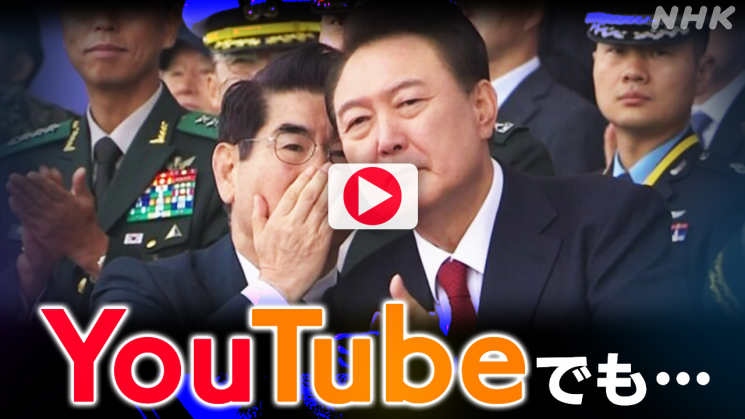
NHK pointed out, "In South Korea, conspiracy theories about election fraud, such as manipulation of early voting results or tampering with the machines used for vote counting, have been raised since the late 2010s." It added, "Although the National Election Commission clearly denies allegations of election fraud, conservative YouTubers have been making such claims since the ruling party’s defeat in the general election last April."
NHK found that South Korean YouTube videos with 'election fraud' in the title have been viewed over 20 million times from April to the 18th of this month. There are at least 22 such YouTube channels, and accounts with over 970,000 subscribers have posted more than 29 videos related to election fraud. NHK also mentioned former Future United Party leader Hwang Kyo-ahn, noting that among those making these claims on YouTube is a politician who once served as prime minister.
NHK criticized that the background for the continued spread of these claims lies in South Korea’s news consumption method, which relies on SNS instead of traditional media. In fact, a survey conducted by the Reuters Institute for the Study of Journalism in January, targeting about 2,000 South Koreans, found that 79% accessed news online including SNS, with YouTube being the most used medium at 51%.
Professor Kimura Miki of Kobe University analyzed, "In South Korea, the strong partisanship of the media means there is no influential media outlet that everyone can trust, which is the biggest characteristic." She added, "This leads to a situation where people do not believe reports from existing media."
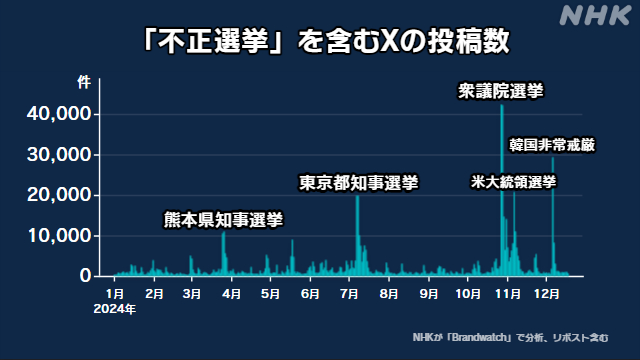 The number of X (formerly Twitter) posts related to election fraud in Japan. The figures show a sharp increase in April, when the Kumamoto Prefecture gubernatorial election was held, in July, when the Tokyo gubernatorial election took place, and in November, when the House of Representatives election occurred. NHK.
Claims that election fraud suspicions are behind the martial law declaration are also spreading in Japan. Among Japanese X users, posts stating "Martial law was declared to secure evidence of election fraud through the military" are circulating. Some related posts have recorded 19 million views.
NHK warned, "The situation of election fraud claims is not just a distant problem," urging caution as similar phenomena are appearing in Japan. In Japan, suspicions related to election fraud have emerged in the Kumamoto Prefecture gubernatorial election held in March, the Tokyo gubernatorial election in July, and the House of Representatives election in October. The content is similar to South Korea’s, including claims that early voting is manipulated and that machines used at counting centers are tampered with by external forces.
NHK emphasized, "Suspicious information of uncertain authenticity related to elections easily spreads in many countries," and stressed, "It is important to doubt whether information that aligns with one’s political stance is really true and to prevent the spread of unknown information." It added, "If even the president is influenced and may make wrong political choices, the media must take a strict stance against conspiracy theories," and noted that calls for fact-checking are growing louder.
© The Asia Business Daily(www.asiae.co.kr). All rights reserved.


















