Global Investment Banks Express Concerns Over Korean Economy
Bank of Korea Expected to Cut January Base Rate to Stimulate Economy
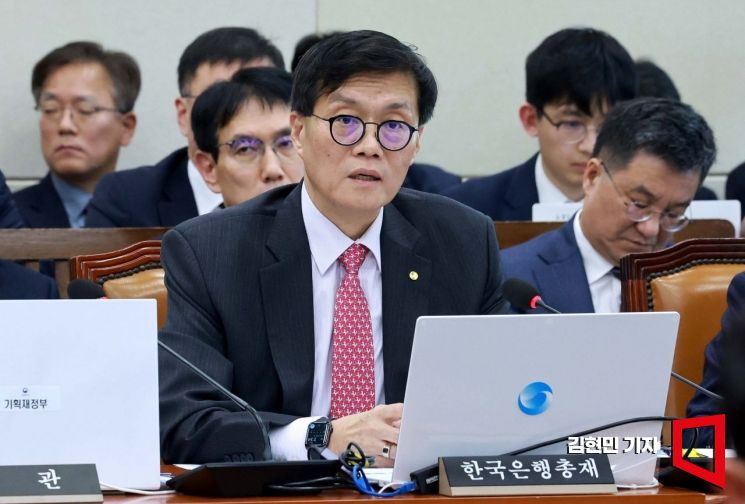 Bank of Korea Governor Lee Chang-yong is attending the plenary meeting of the Planning and Finance Committee held at the National Assembly on the 17th, responding to questions from lawmakers. Photo by Kim Hyun-min
Due to domestic political instability and concerns over economic downturn stemming from trade uncertainties under the second Trump administration, several global investment banks (IBs) have forecast that the Bank of Korea (BOK) will soon lower its benchmark interest rate.
According to the International Finance Center on the 23rd, among the five major IBs that released outlook reports on the Korean economy following the martial law situation earlier this month, four predicted that the BOK will cut the benchmark interest rate by 0.25 percentage points next month. The remaining one also expected the BOK to lower rates in February next year, indicating a dominant view that the BOK will reduce the benchmark interest rate at least once during the first quarter of next year.
Despite Exchange Rate Concerns, Rapid Rate Cuts Likely Due to Downside Economic Risks
IBs analyzed that due to the high political and economic uncertainty in Korea, the BOK will prioritize economic stimulus by lowering the benchmark interest rate faster than expected, despite concerns over the rising won-dollar exchange rate.
Citi forecasted that the BOK will prioritize stable economic growth in response to the martial law situation and implement a 0.25 percentage point rate cut in January next year. They noted that with the dovish stance of the Monetary Policy Committee, which decides the benchmark rate, the BOK is likely to weigh downside economic risks from tariffs imposed by the second Trump administration more heavily than the risks of a high exchange rate.
Barclays suggested that political instability, including the martial law situation and impeachment, has increased downside risks to Korea’s economy, making it likely that the BOK will expand monetary easing next year. They explained that the Korean economy was already facing structural domestic demand weakness before the martial law situation, and considering the added risks from the Trump administration’s trade policies, the importance of domestic demand stimulation next year is greater than ever. Accordingly, they viewed the BOK’s first rate cut, expected in February next year, could be brought forward to January.
Deutsche Bank also indicated that if external factors worsen due to trade conflicts next year, Korea’s economic growth rate, currently estimated at 1.8%, could decline further. They predicted that the BOK will support the domestic economy by cutting the benchmark interest rate in January.
Even with Rate Cuts, Downside Economic Risks Remain High
There are also forecasts that pressure for won depreciation will continue next year. Nomura Securities pointed out that with the U.S. Federal Reserve (Fed) adjusting the pace of rate cuts next year and the Trump administration’s tariff policies becoming more visible, won weakness is likely to persist. They noted that while Korea’s domestic demand may recover moderately, export shocks will inevitably slow economic growth. They projected a growth rate of 1.7%, lower than the BOK’s forecast of 1.9% for next year.
Even if the BOK cuts the benchmark interest rate, there are forecasts that downside growth risks due to political uncertainty will remain significant. HSBC expects the BOK to support the economy by cutting the benchmark interest rate by 0.25 percentage points in January, April, and July next year, but pointed out that growth prospects remain uncertain. They warned that prolonged political instability could dampen consumer and business sentiment and disrupt timely responses through fiscal policy.
If three consecutive rate cuts materialize, it would be the first time since the global financial crisis. The BOK cut rates six times consecutively from October 2008 to February 2009, lowering the rate from 5.25% to 2.00%. However, despite global IBs’ forecasts of a rate cut in January, the BOK remains cautious about its rate outlook for next year. On the 18th, BOK Governor Lee Chang-yong responded to a question about the possibility of a rate cut in January at a price explanation meeting by saying, "We will decide after reviewing various data released in January."
© The Asia Business Daily(www.asiae.co.kr). All rights reserved.
![Clutching a Stolen Dior Bag, Saying "I Hate Being Poor but Real"... The Grotesque Con of a "Human Knockoff" [Slate]](https://cwcontent.asiae.co.kr/asiaresize/183/2026021902243444107_1771435474.jpg)















