The Asahi Shimbun reported on the 22nd that the number of childless elderly men aged 65 and over in Japan is expected to more than double to 5.2 million by 2050, raising concerns about solitary deaths.
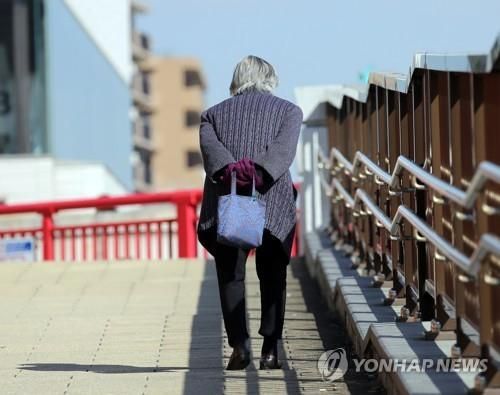
The Japan Research Institute based its projections on population estimates from the National Institute of Population and Social Security Research and national tax surveys, analyzing the presence or absence of spouses, children, and relatives within the third degree of kinship among elderly people living alone aged 65 and over.
According to the institute's estimates, the number of elderly men without children will increase to 5.2 million in 2050, 2.3 times higher than this year's 2.31 million. The number of elderly men in 2050 is projected to surpass that of women (5.13 million).
Among them, elderly men living alone without a spouse are expected to rise from 1.85 million this year to 4.16 million in 2050, and those without relatives within the third degree of kinship are projected to increase from 1.14 million to 2.02 million during the same period.
Makiko Okamoto, a researcher at the Japan Research Institute, explained, "Women naturally have longer lifespans, so the number of elderly women living alone is high, but recently, the number of elderly men without relatives has been increasing."
The reason for the increase in elderly men living alone is the rising "lifetime unmarried rate" among men aged 50. The lifetime unmarried rate for men was 5% in 1990, but showed an increasing trend to 12% in 2000, 20% in 2010, and 28% in 2020.
According to the "Solitary Death Phenomenon Report" released this month by the Japan Small Amount Short-Term Insurance Association, men accounted for 83.5% of deaths confirmed as solitary deaths.
© The Asia Business Daily(www.asiae.co.kr). All rights reserved.
![Clutching a Stolen Dior Bag, Saying "I Hate Being Poor but Real"... The Grotesque Con of a "Human Knockoff" [Slate]](https://cwcontent.asiae.co.kr/asiaresize/183/2026021902243444107_1771435474.jpg)















