765 Houses in Rural Areas
Most in Hangyeong-myeon, Hallim-eup, and Aewol-eup in Order
It has been found that the number of vacant houses in Jeju that have not been inhabited or used for over a year has increased compared to five years ago.
On the 19th, Jeju Province announced that there are a total of 1,159 vacant houses in the province this year (790 in Jeju City, 369 in Seogwipo City). This is a 34.5% (297 houses) increase from the 862 houses (548 in Jeju City, 314 in Seogwipo City) surveyed five years ago in 2019. Jeju Province commissioned the Korea Real Estate Board to identify the status of empty or dilapidated buildings based on electricity and water usage, then selected 3,500 suspected vacant houses and conducted an 11-month field survey to determine the actual vacancy status and building condition grades.
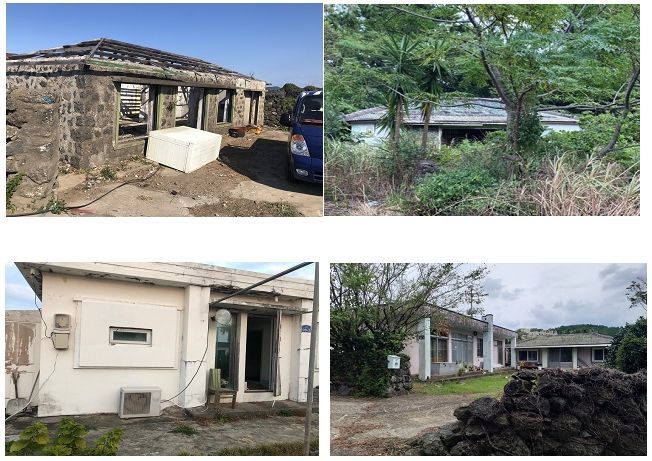
The vacancy rate was 68% in Jeju City and 32% in Seogwipo City. Additionally, rural areas had 765 houses (66%), nearly twice as many as urban areas (394 houses, 34%). By region, in Jeju City, Hangyeong-myeon had 9.5%, Hallim-eup 8.8%, and Aewol-eup 8% vacancy rates in descending order, while in Seogwipo City, Daejeong-eup had 5.2%, Seongsan-eup 4.1%, and Pyoseon-myeon 4% respectively.
Among the 1,159 vacant houses, 110 houses (9.5%), or about 1 in 10, were classified as Grade 1 vacant houses that can be used immediately. Next, Grade 2 houses, which can be inhabited or utilized after repairs, accounted for 848 houses (73.2%), and Grade 3 houses, which require demolition, numbered 201 houses (17.4%). Jeju Province prioritizes demolition support projects for high-risk Grade 3 vacant houses through annual vacant house maintenance projects. This year, about 60 vacant houses were demolished, compared to 35 last year and 33 in 2022.
Since vacant houses are private property, demolition requires the owner's consent. However, administrative authorities can forcibly demolish vacant houses only if they collapse and pose a danger to residents or if there is a risk of misuse. Jeju Province plans to offer property tax reduction benefits to owners who agree to demolish vacant houses and convert the sites into gardens or parking lots.
Based on the results of this survey, Jeju Province will commission the Jeju Research Institute to establish the "2025 Jeju-style Vacant House Maintenance Plan."
© The Asia Business Daily(www.asiae.co.kr). All rights reserved.

















